







Question: Let's suppose that you have new demand data that changes the original demand equation. Let's assume that our demand equation has the general form: D(q)=aq2+bq+c
Let's suppose that you have new demand data that changes the original demand equation.
Let's assume that our demand equation has the general form: D(q)=aq2+bq+c .
For this set of data, then, with D(q)=-0.00033q2-0.0746q+593 , we would have the following values.
- a=-0.00033
- b=-0.0746
- c=593
What if c drops by 25, and so it changes from 593 to 568, so that the new demand equation is D2(q)=-0.00033q2-0.0746q+568 ?
If we were to make this change, then for any value of q , the price per unit that you could charge when selling q items would be $25 lower for D2(q) than it would be for D(q) .
So, now take D2(q) , as shown above, to be the new demand equation and then compute the following:
A) What is the new quantity of items that will maximize profit?
Hint: You will need to start by creating a new profit function that uses this new demand function. Once you have that, then you can utilize the marginal profit function.
Answer: (Round to the nearest whole item)
B) What is the new price per item that will maximize profit? To get your answer, use the rounded quantity in part A. (Why does that make sense?)
Hint: Remember you have a new demand function.
Answer: (Round to the nearest cent/penny)
C) What is the new maximum amount of profits you can earn with this new variable cost? To get your answer, use the rounded quantity in part A.
Hint: Remember that you have a new profit function.
Answer: (Round to the nearest DOLLAR)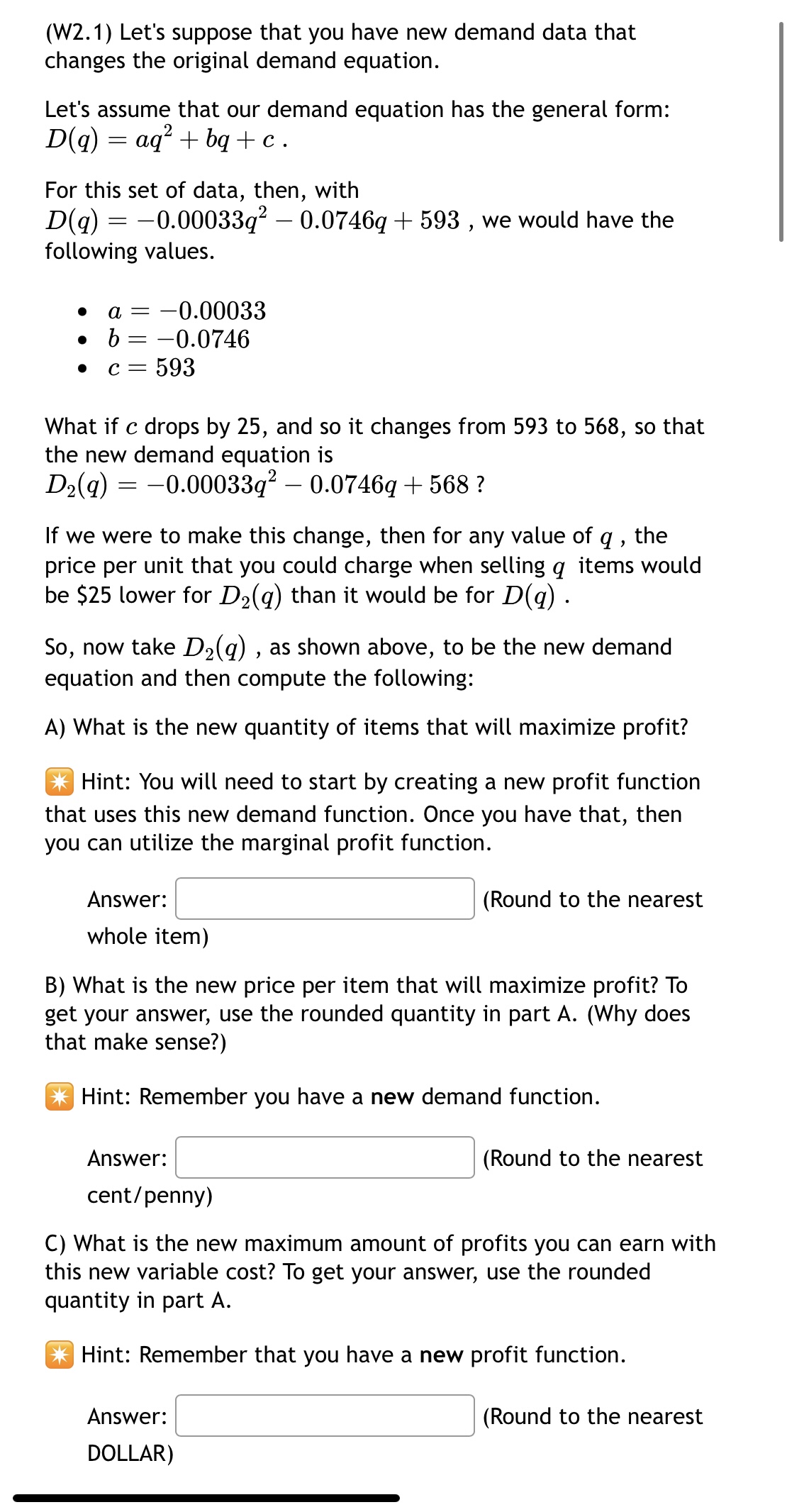
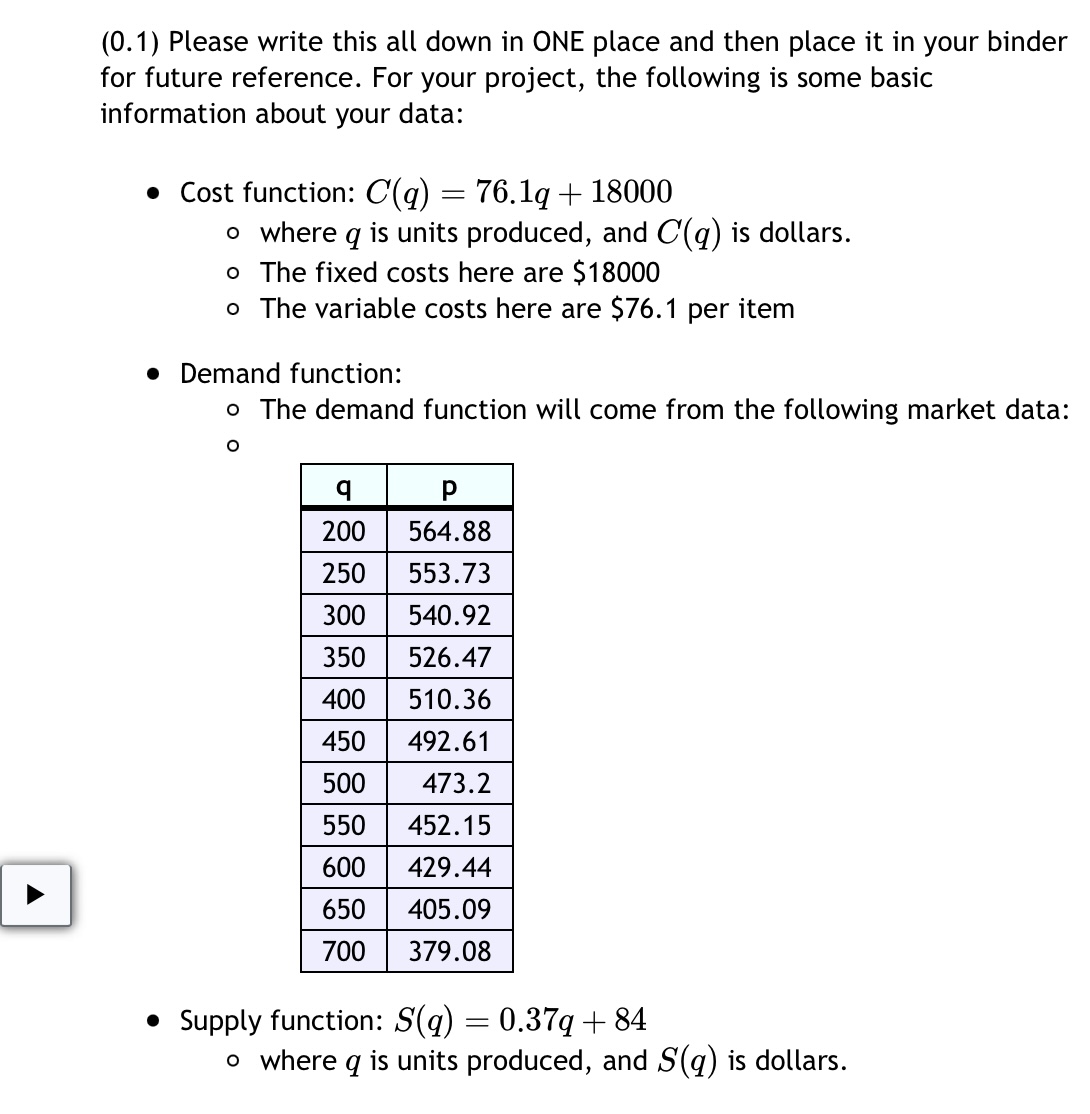
changes the original demand equation. Let's assume that our demand equation has the general form: D(q)=aq2+bq+c. For this set of data, then, with D(q)=0.00033q20.0746q+593, we would have the following values. - a=0.00033 - b=0.0746 - c=593 What if c drops by 25 , and so it changes from 593 to 568 , so that the new demand equation is D2(q)=0.00033q20.0746q+568? If we were to make this change, then for any value of q, the price per unit that you could charge when selling q items would be $25 lower for D2(q) than it would be for D(q). So, now take D2(q), as shown above, to be the new demand equation and then compute the following: A) What is the new quantity of items that will maximize profit? Hint: You will need to start by creating a new profit function that uses this new demand function. Once you have that, then you can utilize the marginal profit function. Answer: (Round to the nearest whole item) B) What is the new price per item that will maximize profit? To get your answer, use the rounded quantity in part A. (Why does that make sense?) Hint: Remember you have a new demand function. Answer: (Round to the nearest cent/penny) C) What is the new maximum amount of profits you can earn with this new variable cost? To get your answer, use the rounded quantity in part A. Hint: Remember that you have a new profit function. Answer: (Round to the nearest DOLLAR) (0.1) Please write this all down in ONE place and then place it in your binder for future reference. For your project, the following is some basic information about your data: - Cost function: C(q)=76.1q+18000 - where q is units produced, and C(q) is dollars. - The fixed costs here are $18000 - The variable costs here are $76.1 per item - Demand function: - The demand function will come from the following market data: - Supply function: S(q)=0.37q+84 - where q is units produced, and S(q) is dollars
Step by Step Solution
There are 3 Steps involved in it

Get step-by-step solutions from verified subject matter experts
 Study Help