







Question: Let's try an example that requires us to calculate pressure. Again we have a block of wood lying on a table. The block's mass is
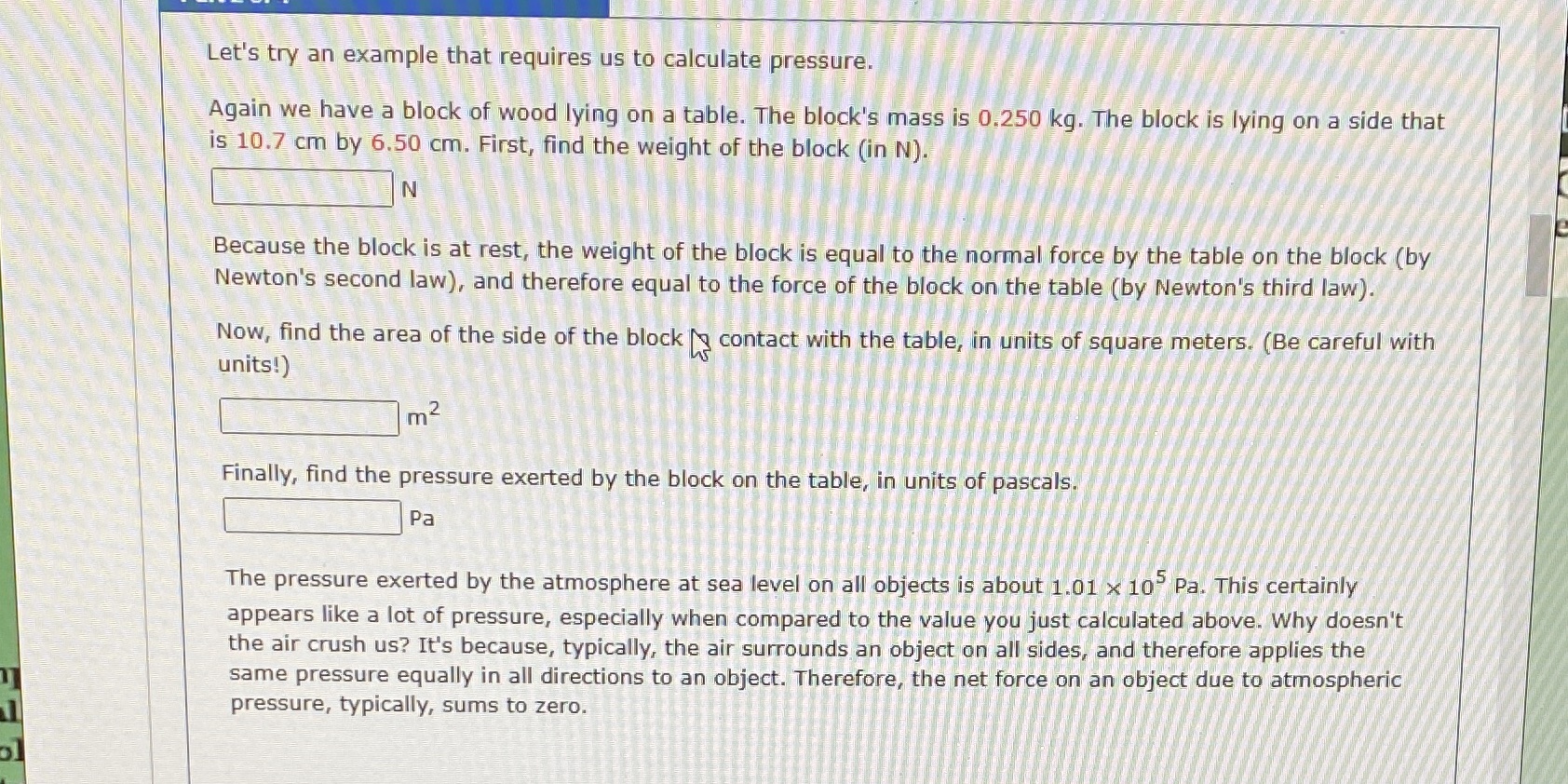
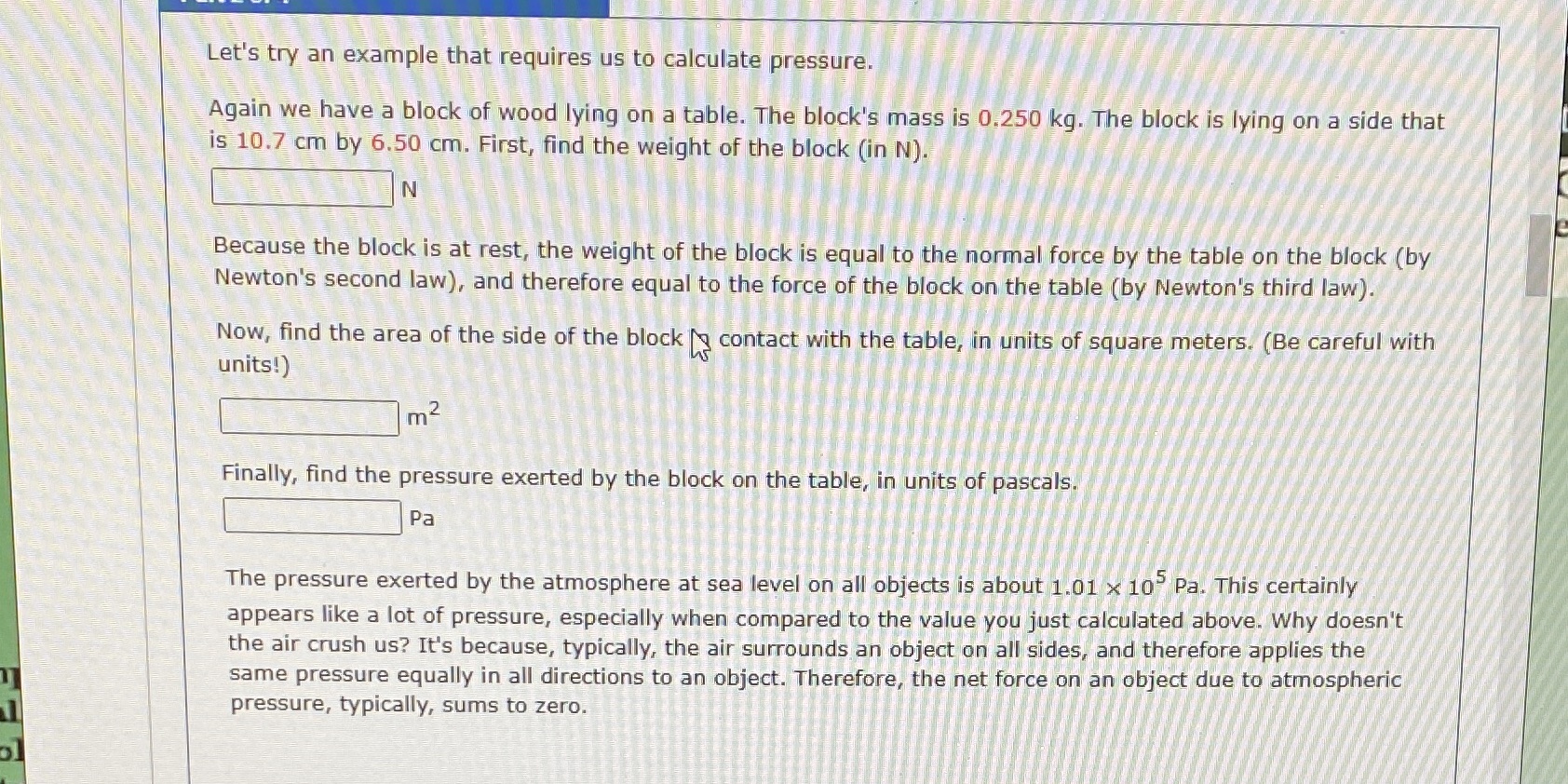
Let's try an example that requires us to calculate pressure. Again we have a block of wood lying on a table. The block's mass is 0.250 kg. The block is lying on a side that is 10.7 cm by 6.50 cm. First, find the weight of the block (in N). N Because the block is at rest, the weight of the block is equal to the normal force by the table on the block (by Newton's second law), and therefore equal to the force of the block on the table (by Newton's third law). Now, find the area of the side of the block s contact with the table, in units of square meters. (Be careful with units!) m2 Finally, find the pressure exerted by the block on the table, in units of pascals. Pa The pressure exerted by the atmosphere at sea level on all objects is about 1.01 x 10 Pa. This certainly appears like a lot of pressure, especially when compared to the value you just calculated above. Why doesn't the air crush us? It's because, typically, the air surrounds an object on all sides, and therefore applies the same pressure equally in all directions to an object. Therefore, the net force on an object due to atmospheric pressure, typically, sums to zero
Step by Step Solution
There are 3 Steps involved in it

Get step-by-step solutions from verified subject matter experts
 Study Help