







Question: Let's work through an example. Imagine that an astronomer observes a star to have an apparent magnitude of 4.2 and collects a spectrum that has
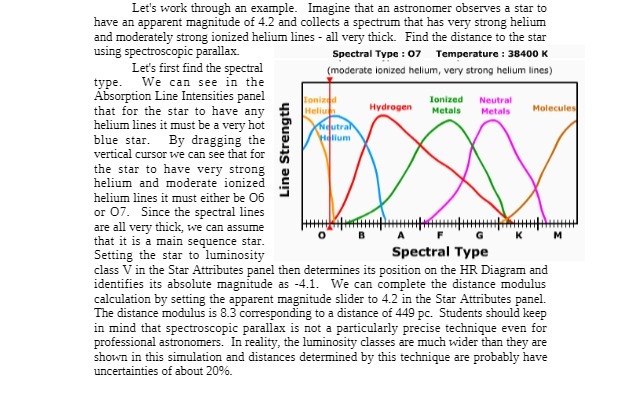
Let's work through an example. Imagine that an astronomer observes a star to have an apparent magnitude of 4.2 and collects a spectrum that has very strong helium and moderately strong ionized helium lines - all very thick. Find the distance to the star using spectroscopic parallax. Spectral Type : 07 Temperature : 38400 K Let's first find the spectral (moderate ionized helium, very strong helium lines) type. We can see in the Absorption Line Intensities panel Ionland Neutral that for the star to have any Helloin Molecules helium lines it must be a very hot blue star. By dragging the vertical cursor we can see that for Line Strength the star to have very strong helium and moderate ionized helium lines it must either be 06 or 07. Since the spectral lines are all very thick, we can assume M that it is a main sequence star. Setting the star to luminosity Spectral Type class V in the Star Attributes panel then determines its position on the HR Diagram and identifies its absolute magnitude as -4.1. We can complete the distance modulus calculation by setting the apparent magnitude slider to 4.2 in the Star Attributes panel. The distance modulus is 8.3 corresponding to a distance of 449 pc. Students should keep in mind that spectroscopic parallax is not a particularly precise technique even for professional astronomers. In reality, the luminosity classes are much wider than they are shown in this simulation and distances determined by this technique are probably have uncertainties of about 20%
Step by Step Solution
There are 3 Steps involved in it

Get step-by-step solutions from verified subject matter experts
 Study Help