







Question: Liabilities: A) Must be certain. B) Must sometimes be estimated. C) Must be for a specific amount. D) Must always have a definite date for
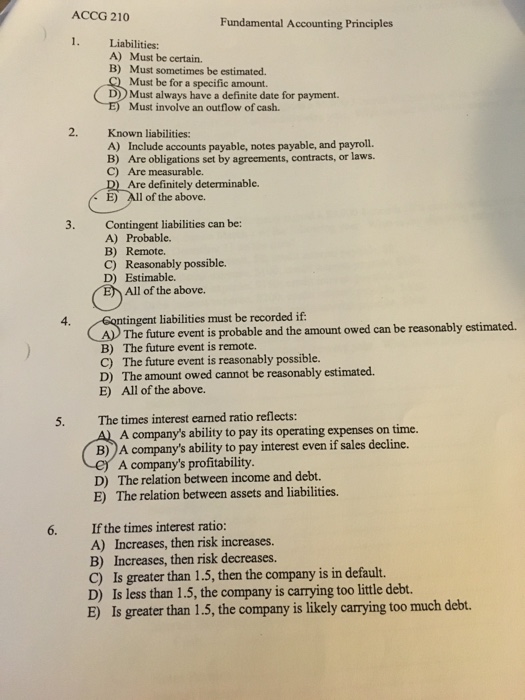
Liabilities: A) Must be certain. B) Must sometimes be estimated. C) Must be for a specific amount. D) Must always have a definite date for payment. E) Must involve an outflow of cash. 2. Known liabilities: A) Include accounts payable, notes payable, and payroll. B) Are obligations set by agreements, contracts, or laws. C) Are measurable. D) Are definitely determinable E) All of the above. 3. Contingent liablilities can be: A) Probable. B) Remote. C) Reasonably possible. D) Estimable. E) All of the above. 4. Contingent liabilities must be recorded if: A) The future event is probable and the amount owed can be reasonably estimated. B) The future event is remote. C) The future event is reasonably possible. D) The amount owed cannot be reasonably estimated. E) All of the above. The times interest earned ratio reflects: A) A company's ability to pay its operating expenses on time. B) A company's ability to pay interest even if sales decline. c) A company's profitability. D) The relation between incomc and debt. E) The relation between assets and liabilities. If the times interest ratio: A) Increases, then risk increases. B) Increases, then risk decreases. C) Is greater than 1.5, then the company is in default. D) Is less than 1.5, the company is carrying too little debt. E) Is greater than 1.5, the company is likely carrying too much debt
Step by Step Solution
There are 3 Steps involved in it

Get step-by-step solutions from verified subject matter experts
 Study Help