







Question: LincolnElectricCase Study Read through the case study and answer questions 1-5 below Question 5: discuss whether this is a management system you would consider working
LincolnElectricCase Study
Read through the case study and answer questions 1-5 below
Question 5: discuss whether this is a management system you would consider working for and why? Consider a pay-for-performance system in your 20's vs when you are in your 50's.
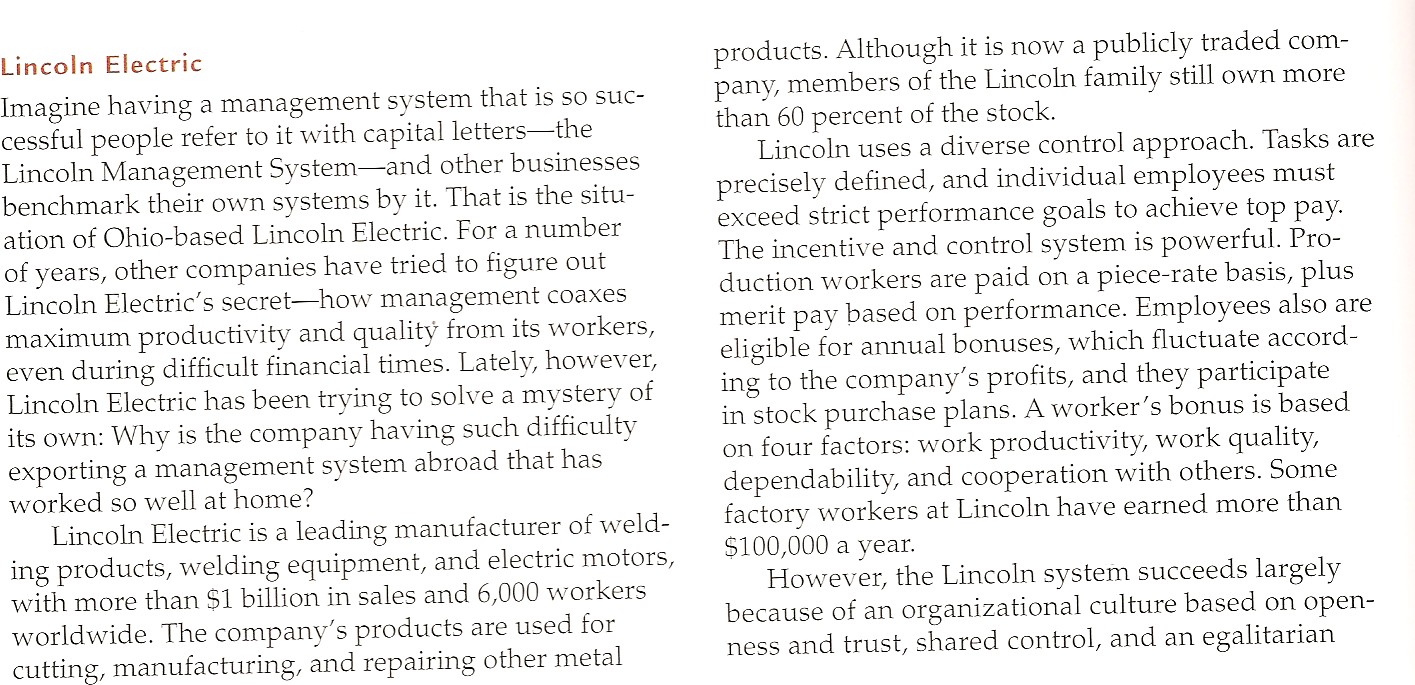 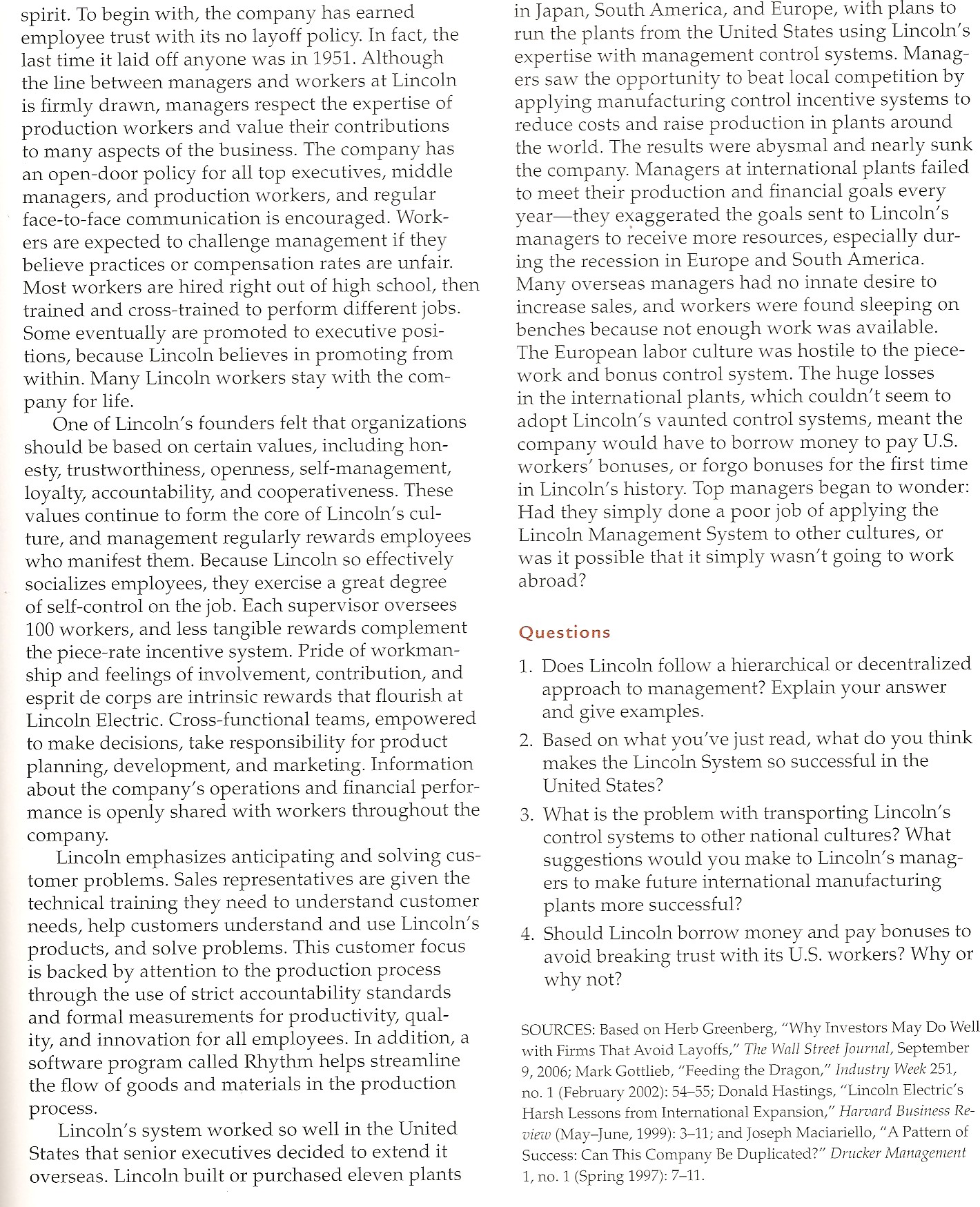 |
Lincoln Electric Imagine having a management system that is so suc- cessful people refer to it with capital lettersthe Lincoln Management Systemand other businesses benchmark their own systems by it. That is the situ4 ation of Ohiobased Lincoln Electric. For a number of years, other companies have tried to figure out Lincoln Electric's secrethow management coaxes maximum productivity and quality from its workers, even during difficult financial times. Lately, however, Lincoln Electric has been trying to solve a mystery of its own: Why is the company having such difculty exporting a management system abroad that has worked so well at home? Lincoln Electric is a leading manufacturer of weld- ing products, welding equipment, and electric motors, with more than $1 billion in sales and 6,000 workers worldwide. The company's products are used for cutting, manufacturing, and repairing other metal products. Although it is now a publicly traded com- pany, members of the Lincoln family still own more than 60 percent of the stock. Lincoln uses a diverse control approach. Tasks are precisely defined, and individual employees must exceed strict performance goals to achieve top pay. The incentive and control system is powerful. Pro- duction workers are paid on a piecearate basis, plus merit pay based on performance. Employees also are eligible for annual bonuses, which fluctuate accord ing to the company's profits, and they participate in stock purchase plans. A worker 's bonus is based on four factors: work productivity, work quality, dependability, and cooperation with others. Some factory workers at Lincoln have earned more than $100,000 a year. However, the Lincoln system succeeds largely because of an organizational culture based on open- ness and trust, shared control, and an egalitarian spirit. To begin with, the company has earned employee trust with its no layoff policy. In fact, the last time it laid off anyone was in 1951. Although the line between managers and workers at Lincoln is firmly drawn, managers respect the expertise of production workers and value their contributions to many aspects of the business. The company has an opendoor policy for all top executives, middle managers, and production workers, and regular ' facetorface communication is encouraged. Work ers are expected to challenge management if they believe practices or compensation rates are unfair. Most workers are hired right out of high school, then trained and crosstrained to perform different jobs. Some eventually are promoted to executive posi tions, because Lincoln believes in promoting from within. Many Lincoln workers stay with the comr pany for life. One of Lincoln's founders felt that organizations should be based on certain values, including hon- esty, trustworthiness, openness, self-management, loyalty, accountability, and cooperativeness. These values continue to form the core of Lincoln's cul- ture, and management regularly rewards employees who manifest them. Because Lincoln so effectively socializes employees, they exercise a great degree of selfcontrol on the job. Each supervisor oversees 100 workers, and less tangible rewards complement the piecerate incentive system. Pride of workman- ship and feelings of involvement, contribution, and esprit de corps are intrinsic rewards that ourish at Lincoln Electric. Crossfunctional teams, empowered to make decisions, take responsibility for product planning, development, and marketing. Information about the company's operations and financial perfor- mance is openly shared with workers throughout the company. Lincoln emphasizes anticipating and solving cus tomer problems. Sales representatives are given the technical training they need to understand customer needs, help customers understand and use Lincoln's products, and solve problems. This customer focus is backed by attention to the production process through the use of strict accountability standards and formal measurements for productivity, qual ity, and innovation for all employees. In addition, a software program called Rhythm helps streamline the flow of goods and materials in the production process. Lincoln's system worked so well in the United States that senior executives decided to extend it overseas. Lincoln built or purchased eleven plants in Japan, South America, and Europe, with plans to run the plants from the United States using Lincoln's expertise with management control systems. Manag ers saw the opportunity to beat local competition by applying manufacturing control incentive systems to reduce costs and raise production in plants around the world. The results were abysmal and nearly sunk the company. Managers at international plants failed to meet their production and financial goals every yearithey exaggerated the goals sent to Lincoln's managers to receive more resources, especially dur- ing the recession in Europe and South America. Many overseas managers had no innate desire to increase sales, and workers were found sleeping on benches because not enough work was available. The European labor culture was hostile to the piece work and bonus control system. The huge losses in the international plants, which couldn't seem to adopt Lincoln's vaunted control systems, meant the company would have to borrow money to pay US. workers' bonuses, or forgo bonuses for the first time in Lincoln's history. Top managers began to wonder: Had they simply done a poor job of applying the Lincoln Management System to other cultures, or was it possible that it simply wasn't going to work abroad? Questions 1. Does Lincoln follow a hierarchical or decentralized approach to management? Explain your answer and give examples. 2. Based on what you've just read, what do you think makes the Lincoln System so successful in the United States? 3. What is the problem with transporting Lincoln's control systems to other national cultures? What suggestions would you make to Lincoln's manag~ ers to make future international manufacturing plants more successful? 4. Should Lincoln borrow money and pay bonuses to avoid breaking trust with its US workers? Why or why not? SOURCES: Based on Herb Greenberg, \"Why Investors May Do Well with Firms That Avoid Layoffs,\" The Wall Street Journal, September 9, 2006; Mark Gottlieb, "Feeding the Dragon,\" Industry Week 251, no. 1 (February 2002): 5455; Donald Hastings, \"Lincoln Electric's Harsh Lessons from International Expansion,\" Hnmnrd Business Re view (MayJune, 1999): 311; and Joseph Maciariello, \"A Pattern of Success: Can This Company Be Duplicated?\" Drinker Management I, no. 1 (Spring 1997): 711
Step by Step Solution
There are 3 Steps involved in it

Get step-by-step solutions from verified subject matter experts
 Study Help