







Question: Linear Dynamical Systems A linear dynamical system consists of an n X n matrix A and an n-vector Vo: * a matrix recursion defining Vi,
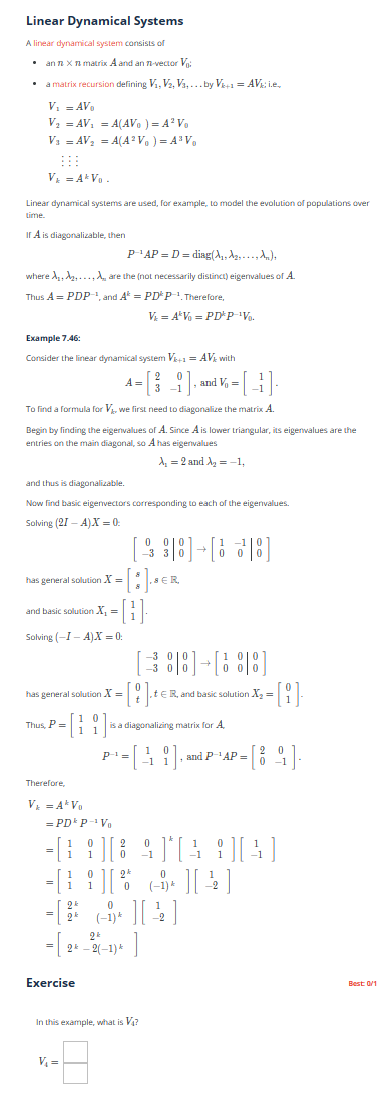
Linear Dynamical Systems A linear dynamical system consists of an n X n matrix A and an n-vector Vo: * a matrix recursion defining Vi, Ve, Va. ... by Vet = AVbi.e. V1 = AVo V2 = AV1 = A(AVo ) = A3 Vo V1 = AV, = A(A? V, ) = A3V. V* = A* Vo - Linear dynamical systems are used, for example, to model the evolution of populations over time. IF A is diagonalizable, then P-'AP = D = disg()1,Az,-. ., An): where A, An, ...; A., are the (not necessarily distinct) eigervalues of A. Thus A = PDP-1, and At = PD* P-1. Therefore, VI = Ath = PDP-'Vo. Example 7.46: Consider the linear dynamical system Vet1 = AV. with 4=[3 1], and V. = [-1] To find a formula for Vi, we first need to diagonalize the matrix A. Begin by finding the eigenvalues of A. Since A is lower triangular, its eigenvalues are the entries on the main diagonal, so A has eigenvalues A, = 2 and An = -1, and thus is diagonalizable. Now find basic eigerivectors corresponding to each of the eigerivalues. Solving (21 - A)X = 0: [ 9 918] - 18 18] [: ] ER and basic solution X, = [ ] ]. Solving (-I - A)X = 0: 818]-[8 818] has general solution X = |.fe R. and basic solution X2 - Thus, P = is a diagonalizing matrix for A P-1 = 1 1 , and PAP = [8 4 ]. Therefore, V* = A* Vo = PDP-' Vo = 2 1 = 24 -2(-1)* 2 1 Exercise Best: 0/1 In this example, what is V4? V
Step by Step Solution
There are 3 Steps involved in it

Get step-by-step solutions from verified subject matter experts
 Study Help