







Question: Linear equations Question 2. (E) The previous question helped you work out the mechanics of various Gaussian elimination variants. In this question, we see the
Linear equations
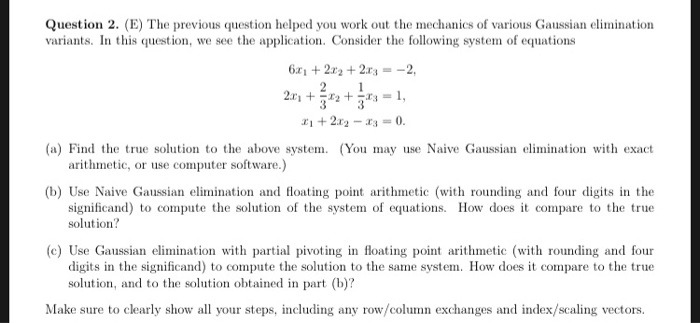
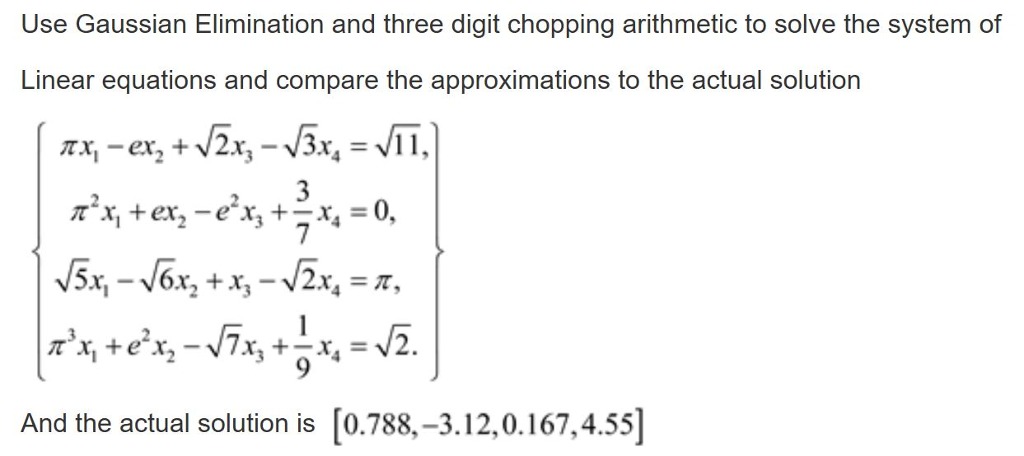
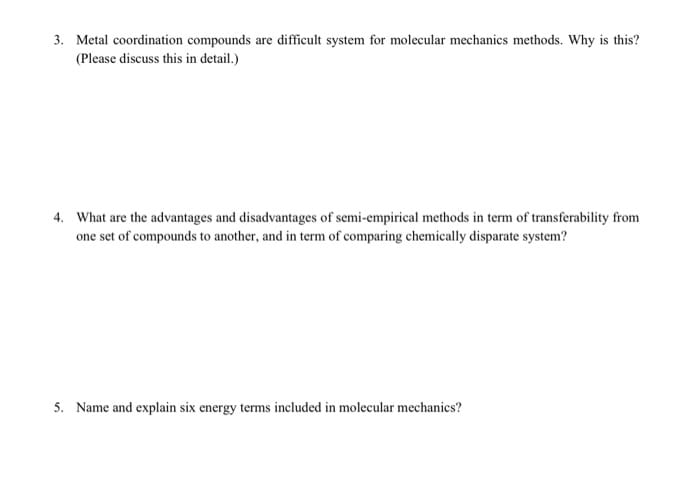
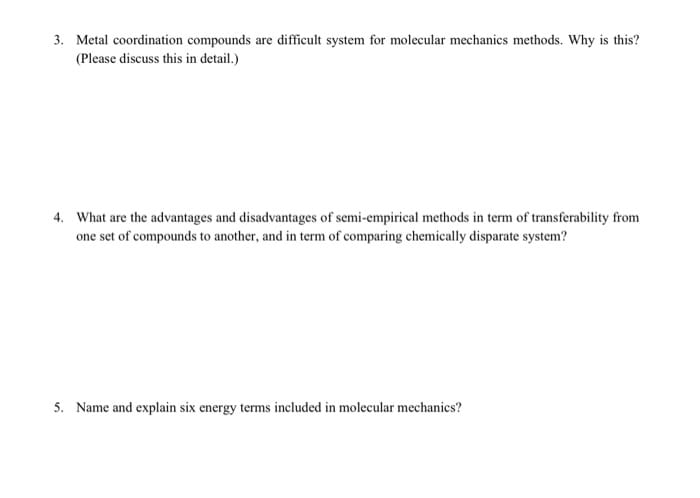
Question 2. (E) The previous question helped you work out the mechanics of various Gaussian elimination variants. In this question, we see the application. Consider the following system of equations 61 + 202 + 2.13 = -2. 2n + =1+= =1, 1 3 $1 + 212 - 13 =0. (a) Find the true solution to the above system. (You may use Naive Gaussian elimination with exact arithmetic, or use computer software.) (b) Use Naive Gaussian elimination and floating point arithmetic (with rounding and four digits in the significand) to compute the solution of the system of equations. How does it compare to the true solution? (c) Use Gaussian elimination with partial pivoting in floating point arithmetic (with rounding and four digits in the significand) to compute the solution to the same system. How does it compare to the true solution, and to the solution obtained in part (b)? Make sure to clearly show all your steps, including any row/column exchanges and index/scaling vectors.Use Gaussian Elimination and three digit chopping arithmetic to solve the system of Linear equations and compare the approximations to the actual solution 7X, - ex, + V2x, - V3x, = VII, n' x, tex, - e' x, += x, =0, (5.x, - Vox, + x, - V2x, = 1, x x, tex - VTX+- x = V2. And the actual solution is [0.788, -3.12, 0.167,4.55]3. Metal coordination compounds are difficult system for molecular mechanics methods. Why is this? (Please discuss this in detail.) 4. What are the advantages and disadvantages of semi-empirical methods in term of transferability from one set of compounds to another, and in term of comparing chemically disparate system? 5. Name and explain six energy terms included in molecular mechanics
Step by Step Solution
There are 3 Steps involved in it

Get step-by-step solutions from verified subject matter experts
 Study Help