





Question: Linear operators 1. Problem 1: Linear operators that are applied to a discrete-time signal on] can be expressed using linear algebra and matrix operations. For

Linear operators
Linear operators 1. Problem 1: Linear operators
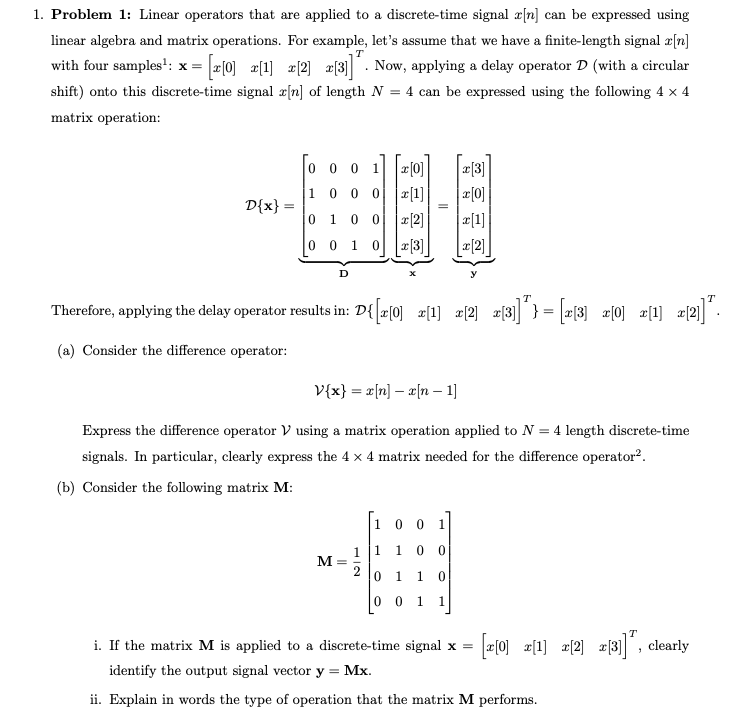
1. Problem 1: Linear operators that are applied to a discrete-time signal on] can be expressed using linear algebra and matrix operations. For example, let's assume that we have a finite-length signal r[n] with four samples!: x = x[0] x[1] x[2] x[3] . Now, applying a delay operator D (with a circular shift) onto this discrete-time signal x of length N = 4 can be expressed using the following 4 x 4 matrix operation: 0 0 0 I 3] 10 0 0 $ 1 2 0 D(x} = 01 0 0 $ 2 0 01 0 3 2 Therefore, applying the delay operator results in: D( x[0] x[1] x[2 x 3]] '}-[x13 20] x[1 x27. (a) Consider the difference operator: V(x} = x[n] - x[n - 1] Express the difference operator V using a matrix operation applied to N = 4 length discrete-time signals. In particular, clearly express the 4 x 4 matrix needed for the difference operator. (b) Consider the following matrix M: 0 0 1 10 0 M = 0 1 10 0 0 1 i. If the matrix M is applied to a discrete-time signal x = x[0] x[1] x[2] x [3] , clearly identify the output signal vector y = Mx. ii. Explain in words the type of operation that the matrix M performs

Step by Step Solution

There are 3 Steps involved in it

1 Expert Approved Answer
Step: 1 Unlock blur-text-image

Question Has Been Solved by an Expert!

Get step-by-step solutions from verified subject matter experts

Step: 2 Unlock
Step: 3 Unlock

Students Have Also Explored These Related Mathematics Questions!