





Question: Linear programming : sensitivity analysis and interpretation of solution ( please answer the question 12 a,b,c,d) draw the graph wherever it's needed. Thank u 12.
Linear programming : sensitivity analysis and interpretation of solution ( please answer the question 12 a,b,c,d) draw the graph wherever it's needed. Thank u
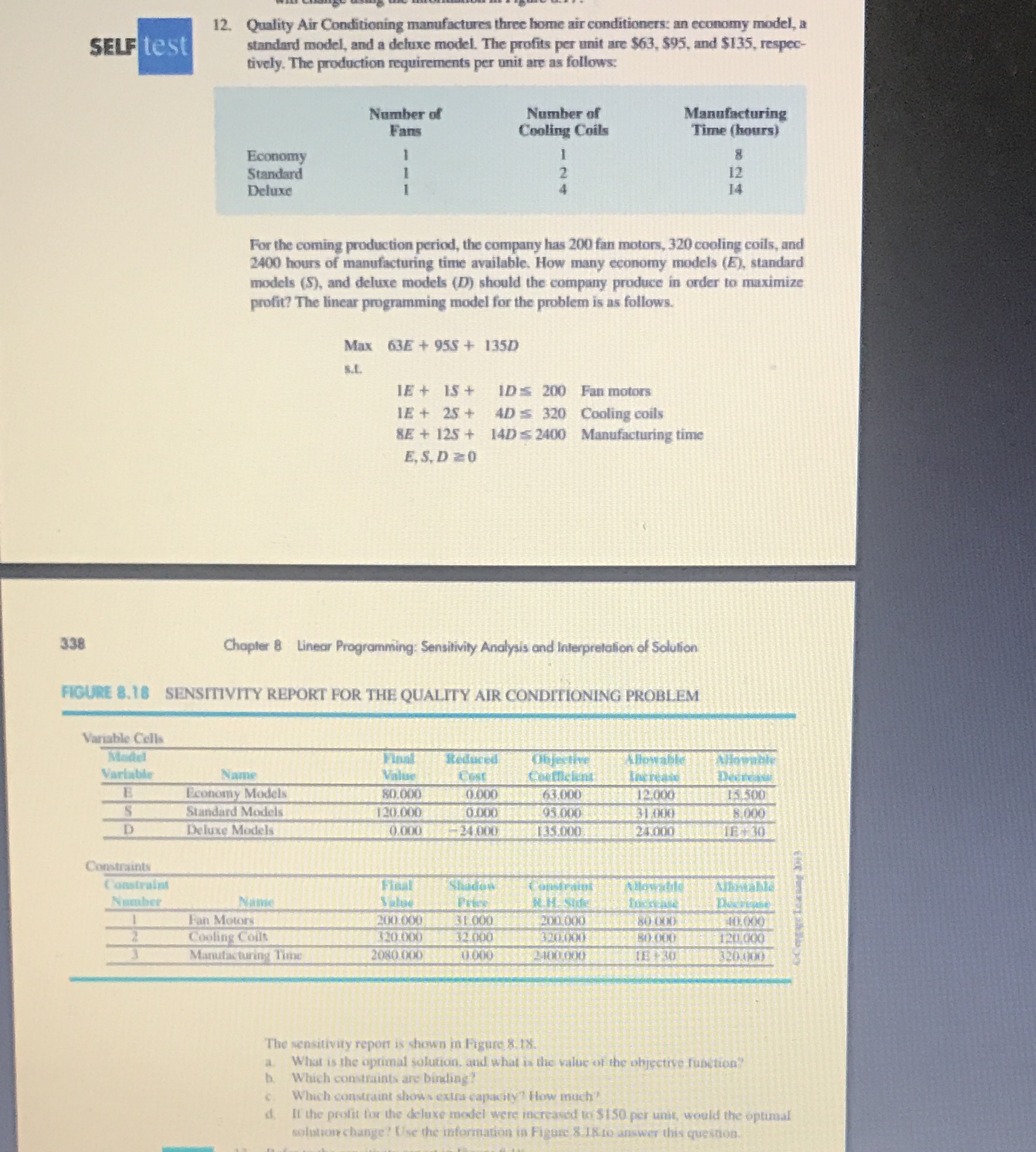
12. Quality Air Conditioning manufactures three home air conditioners: an economy model, a SELF test standard model, and a deluxe model. The profits per unit are $63, $95, and $135, respec- tively. The production requirements per unit are as follows: Number of Number of Manufacturing Fans Cooling Coils Time (hours) Economy Standard 12 Deluxe For the coming production period, the company has 200 fan motors, 320 cooling coils, and 2400 hours of manufacturing time available. How many economy models (E), standard models (S), and deluxe models (D) should the company produce in order to maximize profit? The linear programming model for the problem is as follows. Max 63E + 955 + 135D S.1. 18 + 18 + ID: 200 Fan motors IE + 25 + 4D = 320 Cooling coils 8E + 125 + 140 5 2400 Manufacturing time E, S, D 20 3.38 Chapter 8 Linear Programming: Sensitivity Analysis and Interpretation of Solution FIGURE 8.18 SENSITIVITY REPORT FOR THE QUALITY AIR CONDITIONING PROBLEM Variable Cells Madel Final Reduced Objective Allowable Variable Name Cost Economy Models 80.000 0.600 63.000 12.000 15 500 Standard Models 120.000 0.000 93.000 31 000 8.000 Deluxe Models 0.000 24.000 135.000 24.000 Constraints Constraint Final Shadow Allowable Number Name N.H. Side Fan Motors 200-060 31.060 200.000 80 060 10.000 Cooling Coils 320.000 32.000 320:000 80 000 120,090 Manufacturing Time 2080 000 9:000 2100,900 18 +30 320.0100 The sensitivity report is shown in Figure 8. 18. What is the optimal solution, and what is the value of the objective function? b. Which constraints are birding? Which condraint shows extra capacity? How much It the profit for the deluxe model were increased to $150 per unit, would the optimal solution change? Use the information in Figure 8 18 to answer this

