







Question: Linear relationship and the sample correlation coefficient Below are four bivariate data sets and the scatter plot for each. (Note that each scatter plot
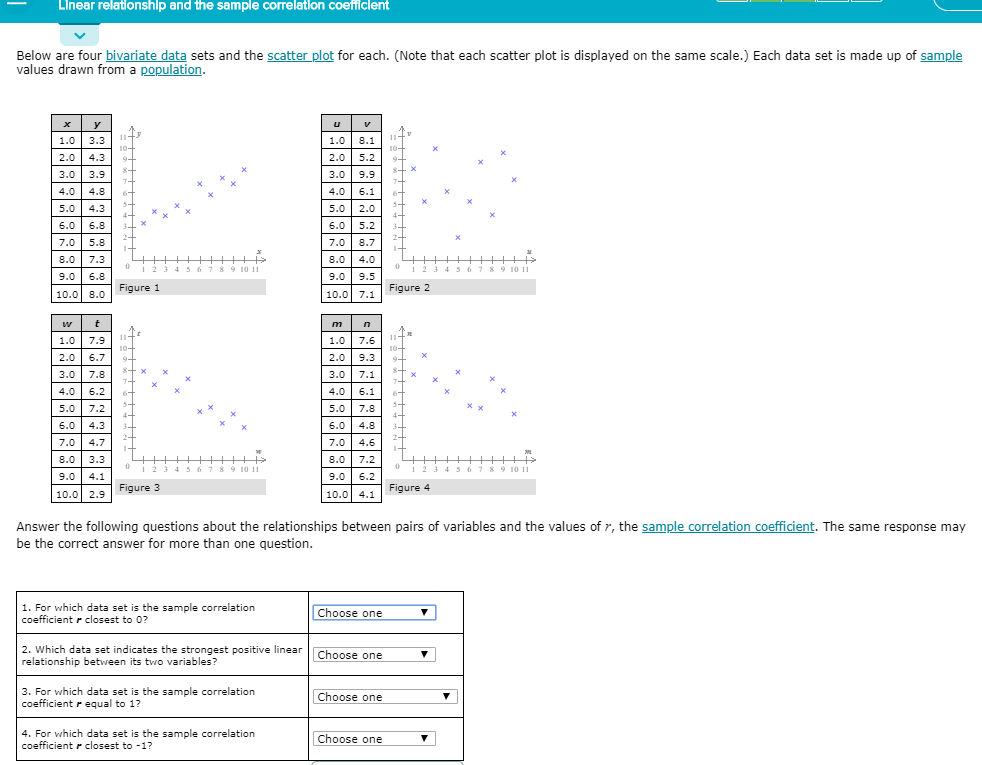
Linear relationship and the sample correlation coefficient Below are four bivariate data sets and the scatter plot for each. (Note that each scatter plot is displayed on the same scale.) Each data set is made up of sample values drawn from a population. x y 1.0 3.3 11 10- 2.0 4.3 9- 3.0 3.9 7- 4.0 4.8 5.0 4.3 6.0 6.8 7.0 5.8 8.0 7.3 9.0 6.8 10.0 8.0 v 1.0 8.1 11+ 10- 2.0 5.2 9+ 8x 3.0 9.9 4.0 6.1 5.0 2.0 6.0 5.2 x 7.0 8.7 8.0 4.0 0 6 7 8 9 10 11 0 2 4 3 6 7 8 9 10 11 9.0 9.5 Figure 1 10.0 7.1 Figure 2 W t 1.0 7.9 11- 10+ 2.0 6.7 9- 3.0 7.8 m 1.0 11+ 7.6 10- 2.0 9.3 9- 8- 3.0 7.1 x 4.0 6.2 4.0 6.1 5.0 7.2 5.0 7.8 6.0 4.3 6.0 4.8 7.0 4.7 7.0 4.6 8.0 3.3 9.0 4.1 10.0 2.9 8.0 7.2 0 0 6 7 8 9 10 11 6 7 8 9 10 11 Figure 3 9.0 6.2 10.0 4.1 Figure 4 Answer the following questions about the relationships between pairs of variables and the values of 7, the sample correlation coefficient. The same response may be the correct answer for more than one question. 1. For which data set is the sample correlation coefficient r closest to 0? Choose one 2. Which data set indicates the strongest positive linear relationship between its two variables? Choose one 3. For which data set is the sample correlation coefficient r equal to 1? Choose one 4. For which data set is the sample correlation coefficient r closest to -1? Choose one
Step by Step Solution
There are 3 Steps involved in it

Get step-by-step solutions from verified subject matter experts
 Study Help