







Question: Linear transformations with prescribed values at the elements of a basis in T (V 131 22. If S and T commute, prove that (ST) =
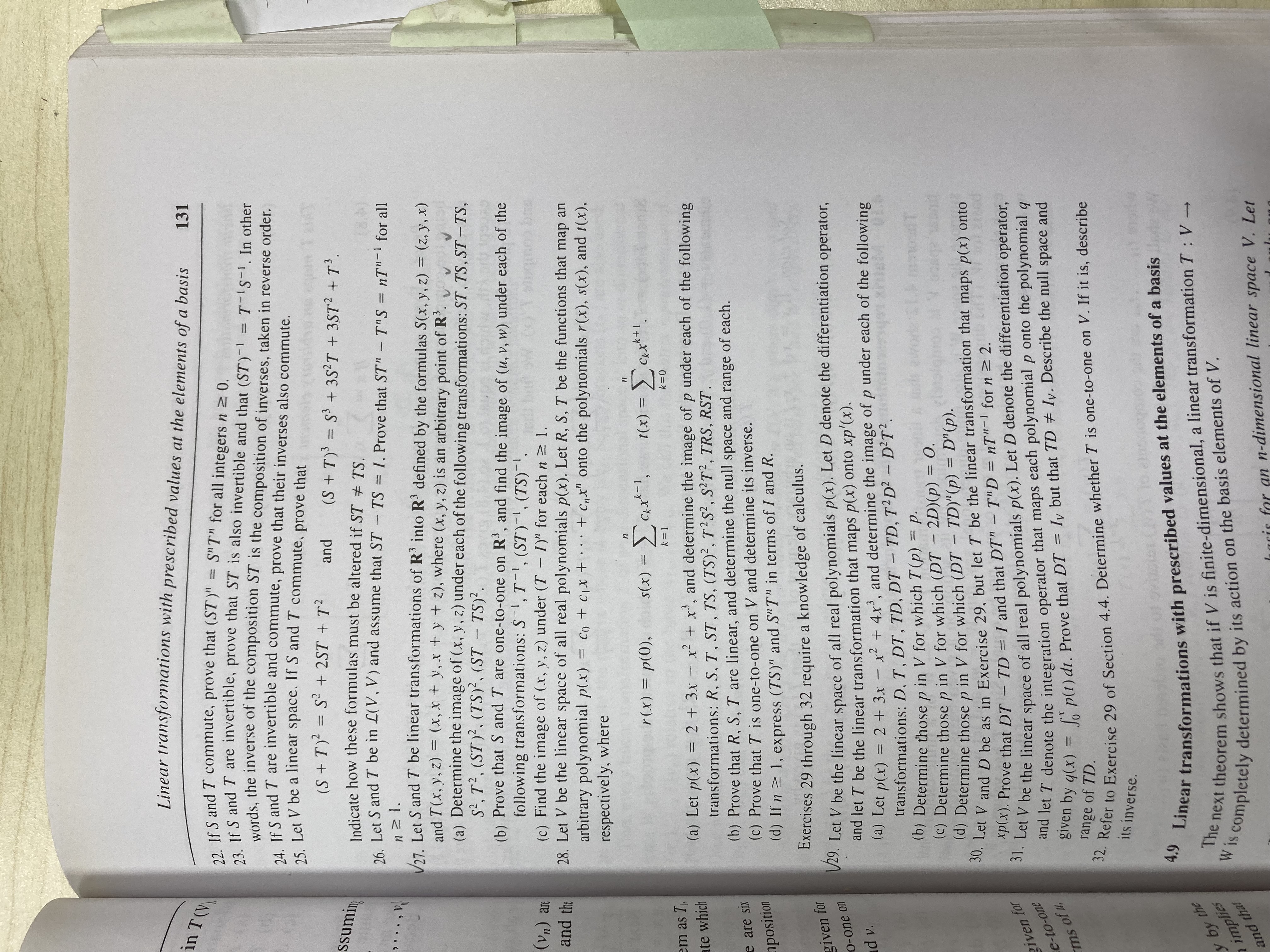
Linear transformations with prescribed values at the elements of a basis in T (V 131 22. If S and T commute, prove that (ST)" = S"T" for all integers n 2 0. 23. If S and I are invertible, prove that ST is also invertible and that (ST) -1 = -'S-1. In other words, the inverse of the composition ST is the composition of inverses, taken in reverse order. 24. If S and T are invertible and commute, prove that their inverses also commute. 25. Let V be a linear space. If S and T commute, prove that (5 + 7 ) 2 = 5 2 + 2 ST + 7 2 and ssuming ( 5 + 7 ) 3 = $ 3 + 35 2 T + 3ST 2 + 7 3. Indicate how these formulas must be altered if ST # TS. " . . . , V n2 1 . 26. Let S and T be in [(V, V) and assume that ST - TS = 1. Prove that ST" - T"S = nT"- for all 27. Let S and T be linear transformations of R' into R3 defined by the formulas S(x, y, z) = (z, y, x) and T ( x, y , z ) = ( x, x + y, x + y + z), where (x, y, z) is an arbitrary point of R'. V v (a) Determine the image of (x, y, z.) under each of the following transformations: ST , TS, ST - TS, 52, T2 , (ST ) 2, (TS ) , (ST - TS ) . (b) Prove that S and T are one-to-one on R', and find the image of (u, v, w) under each of the following transformations: S-', T-', (ST)-', (TS)-'. (Vn) are (c) Find the image of (x, y, z.) under (T - 1)" for each n 2 1. and the 28. Let V be the linear space of all real polynomials p(x). Let R, S, T be the functions that map an arbitrary polynomial p(x) = co + cix + . . . + cnx" onto the polynomials r(x), s(x), and t(x), respectively, where r (x ) = p(0 ) , s( x ) = [ ckxk - 1 , 1 ( x ) = [ ckx*ti . m as Ti K = C te which (a) Let p(x) = 2 + 3x - x2 + x', and determine the image of p under each of the following transformations: R, S, T, ST, TS, (TS), T252, ST?, TRS, RST. e are Six (b) Prove that R, S, T are linear, and determine the null space and range of each. nposition (c) Prove that T is one-to-one on V and determine its inverse. (d) If n 2 1, express (TS)" and S"T" in terms of I and R. Exercises 29 through 32 require a knowledge of calculus. given for -one on 29. Let V be the linear space of all real polynomials p(x). Let D denote the differentiation operator, d v. and let T be the linear transformation that maps p(x) onto xp'(x). (a) Let p(x) = 2 + 3x - x2 + 4x3, and determine the image of p under each of the following transformations: D. T, DT, TD, DT - TD, T2D2 - D'T2. (b) Determine those p in V for which I (p) = P. (c) Determine those p in V for which (DT - 2D)(p) = 0. (d) Determine those p in V for which (DT - TD)"(p) = D"(p). Let V and D be as in Exercise 29, but let T be the linear transformation that maps p(x) onto *p(x). Prove that DT - TD = I and that DT" - T" D = nT"- for n 2 2. given for 31 . Let V be the lin the linear space of all real polynomials p(x). Let D denote the differentiation operator, e-to-one and let T denote the integration operator that maps each polynomial p onto the polynomial q ms of l, given by q(x) = Jo' p(1) dt. Prove that DT = ly but that TD # Iv. Describe the null space and range of TD . 2. Refer to Exercise 29 of Section 4.4. Determine whether I is one-to-one on V. If it is, describe its inverse. Linear transformations with prescribed values at the elements of a basis y by the The next theorem shows that if V is finite-dimensional, a linear transformation T : V - implies and that w is completely determined by its action on the basis elements of V. n-dimensional linear space V. Let
Step by Step Solution
There are 3 Steps involved in it

Get step-by-step solutions from verified subject matter experts
 Study Help