







Question: LINGUISTICS/SYNTAX PROBLEM The following example is ambiguous: (2) Bill jumped on the table. - meaning 1: John jumped onto the table [the directional reading) (John
LINGUISTICS/SYNTAX PROBLEM
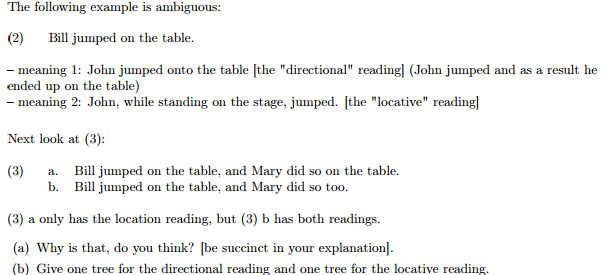
The following example is ambiguous: (2) Bill jumped on the table. - meaning 1: John jumped onto the table [the "directional" reading) (John jumped and as a result he ended up on the table) - meaning 2: John, while standing on the stage, jumped, [the "locative" reading] Next look at (3): (3) a. Bill jumped on the table, and Mary did so on the table, b. Bill jumped on the table, and Mary did so too. (3) a only has the location reading, but (3) b has both readings. (a) Why is that, do you think? [be succinct in your explanation]. (b) Give one tree for the directional reading and one tree for the locative reading. The following example is ambiguous: (2) Bill jumped on the table. - meaning 1: John jumped onto the table [the "directional" reading) (John jumped and as a result he ended up on the table) - meaning 2: John, while standing on the stage, jumped, [the "locative" reading] Next look at (3): (3) a. Bill jumped on the table, and Mary did so on the table, b. Bill jumped on the table, and Mary did so too. (3) a only has the location reading, but (3) b has both readings. (a) Why is that, do you think? [be succinct in your explanation]. (b) Give one tree for the directional reading and one tree for the locative reading
Step by Step Solution
There are 3 Steps involved in it

Get step-by-step solutions from verified subject matter experts
 Study Help