







Question: link below is for a) and b) need answer for c) and d) https://www.chegg.com/homework-help/questions-and-answers/consider-firm-production-function-q-sqrt-z-using-one-input-eg-labor-produce-units-output-q-q104462507 Consider a firm with production function q=z, using one input (e.g.,

link below is for a) and b) need answer for c) and d)
https://www.chegg.com/homework-help/questions-and-answers/consider-firm-production-function-q-sqrt-z-using-one-input-eg-labor-produce-units-output-q-q104462507
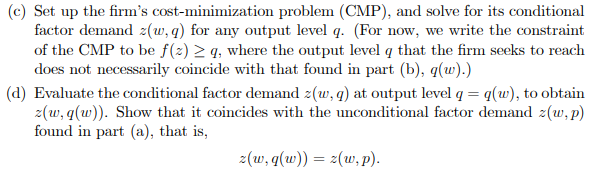
Consider a firm with production function q=z, using one input (e.g., labor) to produce units of output q. The price of every unit of input is w>0, and the price of every unit of output is p>0. (c) Set up the firm's cost-minimization problem (CMP), and solve for its conditional factor demand z(w,q) for any output level q. (For now, we write the constraint of the CMP to be f(z)q, where the output level q that the firm seeks to reach does not necessarily coincide with that found in part (b), q(w).) (d) Evaluate the conditional factor demand z(w,q) at output level q=q(w), to obtain z(w,q(w)). Show that it coincides with the unconditional factor demand z(w,p) found in part (a), that is, z(w,q(w))=z(w,p) Consider a firm with production function q=z, using one input (e.g., labor) to produce units of output q. The price of every unit of input is w>0, and the price of every unit of output is p>0. (c) Set up the firm's cost-minimization problem (CMP), and solve for its conditional factor demand z(w,q) for any output level q. (For now, we write the constraint of the CMP to be f(z)q, where the output level q that the firm seeks to reach does not necessarily coincide with that found in part (b), q(w).) (d) Evaluate the conditional factor demand z(w,q) at output level q=q(w), to obtain z(w,q(w)). Show that it coincides with the unconditional factor demand z(w,p) found in part (a), that is, z(w,q(w))=z(w,p)
Step by Step Solution
There are 3 Steps involved in it

Get step-by-step solutions from verified subject matter experts
 Study Help