







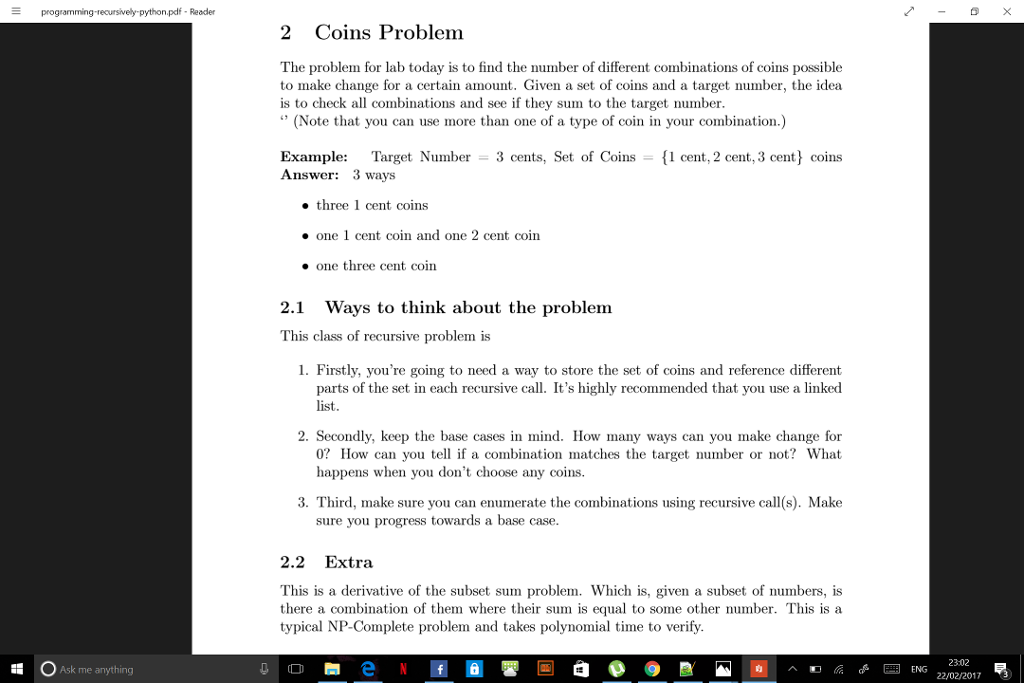
Question: Linked List Implementation class ListNode: def __init__(self, data, link=None): self.data = data self.link = link class LinkedList: def __init__(self, L=None): self.head=None if L:
""" Linked List Implementation """ class ListNode: def __init__(self, data, link=None): self.data = data self.link = link class LinkedList: def __init__(self, L=None): self.head=None if L: for i in L: self.add(i)
def isEmpty(self): if self.head == None: return True else: return False
def add(self, value): self.head=ListNode(value,self.head)
def remove_head(self): item = None if not self.isEmpty(): self.head= self.head.link item = self.head.data return item
""" Coins stuff """ class CoinSet: def __init__(self, coins): self.cList = LinkedList(coins)
def waysToMakeChange(self,amount): pass
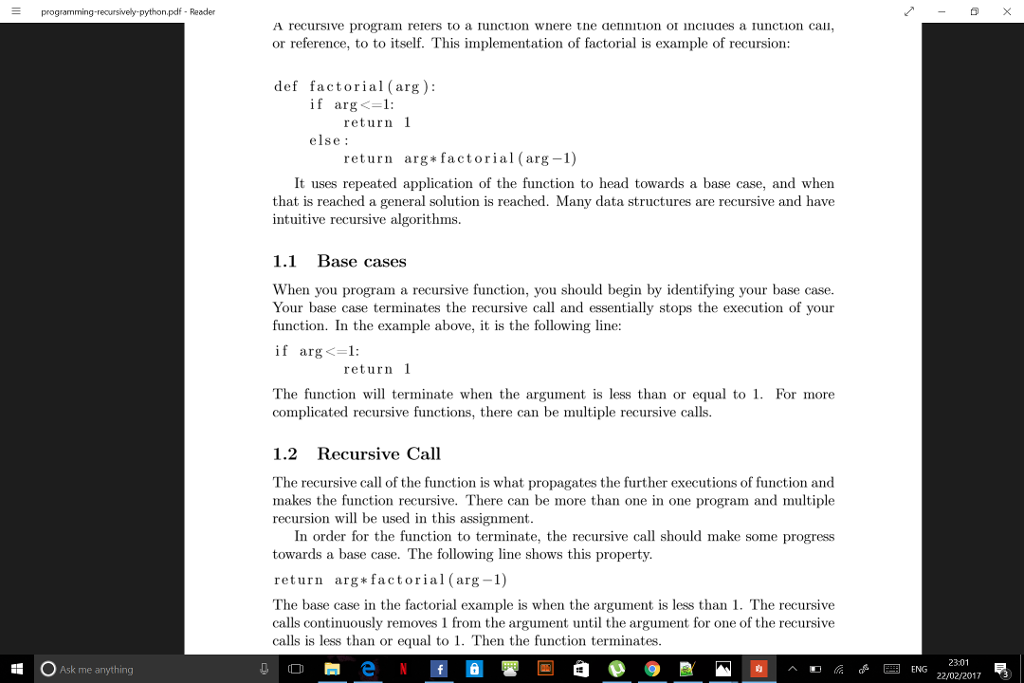
programming recursively python pdf-Reader Ask me an A recursive program remers to a nunction Wnere tne aennition or includes a Iunction call, reference, to to itself. This implementation of factorial is example of recursion: or def factorial (arg): l f arg return 1 else return arg k factorial (arg -1) It uses repeated application of the function to head towards a base case, and when that is reached a general solution is reached. Many data structures are recursive and have intuitive recursive algorithms. 1.1 Base cases When you program a recursive function, you should begin by identifying your base case. Your base case terminates the recursive call and essentially stops the execution of your function. In the example above, it is the following line: if arg 1: return 1 The function will terminate when the argument is less than or equal to 1. For more complicated recursive functions, there can be multiple recursive calls. 1.2 Recursive Call The recursive call of the function is what propagates the further executions of function and makes the function recursive. There can be more than one in one program and multiple recursion will be used in this assignment. In order for the function to terminate, the recursive call should make some progress towards a base case. The following line shows this property. return arg factorial (arg -1) The base case in the factorial example is when the argument is less than 1. The recursive calls continuously removes 1 from the argument until the argument for one of the recursive calls is less than or equal to 1. Then the function terminates 2301 22/02/2017 programming recursively python pdf-Reader Ask me an A recursive program remers to a nunction Wnere tne aennition or includes a Iunction call, reference, to to itself. This implementation of factorial is example of recursion: or def factorial (arg): l f arg return 1 else return arg k factorial (arg -1) It uses repeated application of the function to head towards a base case, and when that is reached a general solution is reached. Many data structures are recursive and have intuitive recursive algorithms. 1.1 Base cases When you program a recursive function, you should begin by identifying your base case. Your base case terminates the recursive call and essentially stops the execution of your function. In the example above, it is the following line: if arg 1: return 1 The function will terminate when the argument is less than or equal to 1. For more complicated recursive functions, there can be multiple recursive calls. 1.2 Recursive Call The recursive call of the function is what propagates the further executions of function and makes the function recursive. There can be more than one in one program and multiple recursion will be used in this assignment. In order for the function to terminate, the recursive call should make some progress towards a base case. The following line shows this property. return arg factorial (arg -1) The base case in the factorial example is when the argument is less than 1. The recursive calls continuously removes 1 from the argument until the argument for one of the recursive calls is less than or equal to 1. Then the function terminates 2301 22/02/2017
Step by Step Solution
There are 3 Steps involved in it

Get step-by-step solutions from verified subject matter experts
 Study Help