



Question: ln(k) = -delta H / (R * T)? 26-28. Consider the reaction described by CO2(g)+H2(g)CO(g)+H2O(g) The molar heat capacitites of CO2(g),H2(g),CO(g), and H2O(g) can be
ln(k) = -delta H / (R * T)? 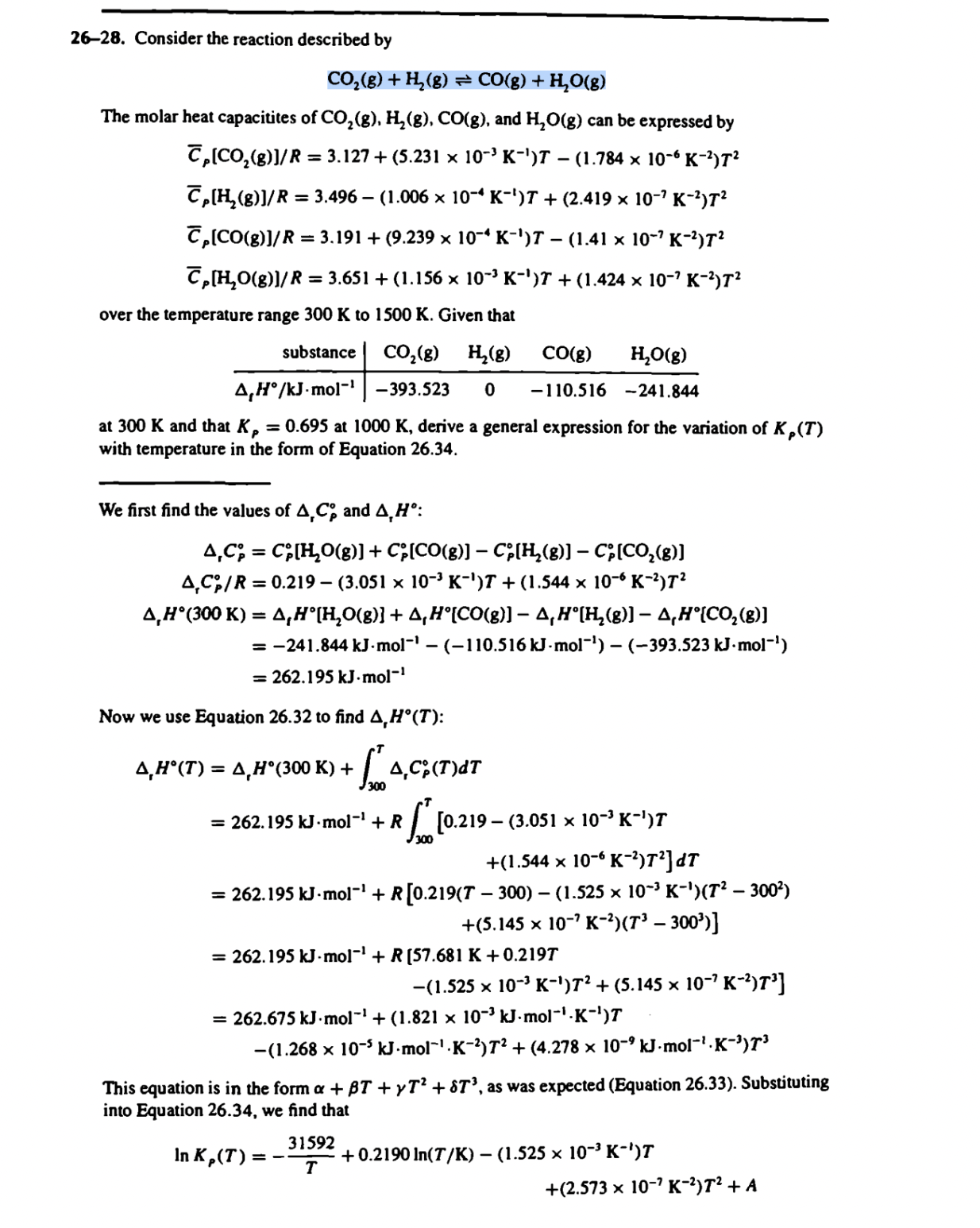
26-28. Consider the reaction described by CO2(g)+H2(g)CO(g)+H2O(g) The molar heat capacitites of CO2(g),H2(g),CO(g), and H2O(g) can be expressed by Cp[CO2(g)]/R=3.127+(5.231103K1)T(1.784106K2)T2Cp[H2(g)]/R=3.496(1.006104K1)T+(2.419107K2)T2Cp[CO(g)]/R=3.191+(9.239104K1)T(1.41107K2)T2Cp[H2O(g)]/R=3.651+(1.156103K1)T+(1.424107K2)T2 over the temperature range 300K to 1500K. Given that at 300K and that Kp=0.695 at 1000K, derive a general expression for the variation of Kp(T) with temperature in the form of Equation 26.34. We first find the values of rCp and rH : rCPrCP/RrH(300K)=CP[H2O(g)]+CP0[CO(g)]CP[H2(g)]CP[CO2(g)]=0.219(3.051103K1)T+(1.544106K2)T2=fH[H2O(g)]+rH[CO(g)]rH[H2(g)]rH[CO2(g)]=241.844kJmol1(110.516kJmol1)(393.523kJmol1)=262.195kJmol1 Now we use Equation 26.32 to find rH(T) : rH(T)=rH(300K)+300TrCp(T)dT=262.195kJmol1+R300[0.219(3.051103K1)T+(1.544106K2)T2]dT=262.195kJmol1+R[0.219(T300)(1.525103K1)(T23002)+(5.145107K2)(T33003)]=262.195kJmol1+R[57.681K+0.219T(1.525103K1)T2+(5.145107K2)T3]=262.675kJmol1+(1.821103kJmol1K1)T(1.268105kJmol1K2)T2+(4.278109kJmol1K3)T3 This equation is in the form +T+T2+T3, as was expected (Equation 26.33). Substituting into Equation 26.34, we find that lnKp(T)=T31592+0.2190ln(T/K)(1.525103K1)T+(2.573107K2)T2+A 26-28. Consider the reaction described by CO2(g)+H2(g)CO(g)+H2O(g) The molar heat capacitites of CO2(g),H2(g),CO(g), and H2O(g) can be expressed by Cp[CO2(g)]/R=3.127+(5.231103K1)T(1.784106K2)T2Cp[H2(g)]/R=3.496(1.006104K1)T+(2.419107K2)T2Cp[CO(g)]/R=3.191+(9.239104K1)T(1.41107K2)T2Cp[H2O(g)]/R=3.651+(1.156103K1)T+(1.424107K2)T2 over the temperature range 300K to 1500K. Given that at 300K and that Kp=0.695 at 1000K, derive a general expression for the variation of Kp(T) with temperature in the form of Equation 26.34. We first find the values of rCp and rH : rCPrCP/RrH(300K)=CP[H2O(g)]+CP0[CO(g)]CP[H2(g)]CP[CO2(g)]=0.219(3.051103K1)T+(1.544106K2)T2=fH[H2O(g)]+rH[CO(g)]rH[H2(g)]rH[CO2(g)]=241.844kJmol1(110.516kJmol1)(393.523kJmol1)=262.195kJmol1 Now we use Equation 26.32 to find rH(T) : rH(T)=rH(300K)+300TrCp(T)dT=262.195kJmol1+R300[0.219(3.051103K1)T+(1.544106K2)T2]dT=262.195kJmol1+R[0.219(T300)(1.525103K1)(T23002)+(5.145107K2)(T33003)]=262.195kJmol1+R[57.681K+0.219T(1.525103K1)T2+(5.145107K2)T3]=262.675kJmol1+(1.821103kJmol1K1)T(1.268105kJmol1K2)T2+(4.278109kJmol1K3)T3 This equation is in the form +T+T2+T3, as was expected (Equation 26.33). Substituting into Equation 26.34, we find that lnKp(T)=T31592+0.2190ln(T/K)(1.525103K1)T+(2.573107K2)T2+A
Step by Step Solution
There are 3 Steps involved in it

Get step-by-step solutions from verified subject matter experts