







Question: LO 3 a. E3.16 Identifying and Analyzing Variable Interest Entities Corporations A and B are formed to pur- chase property and lease it to end
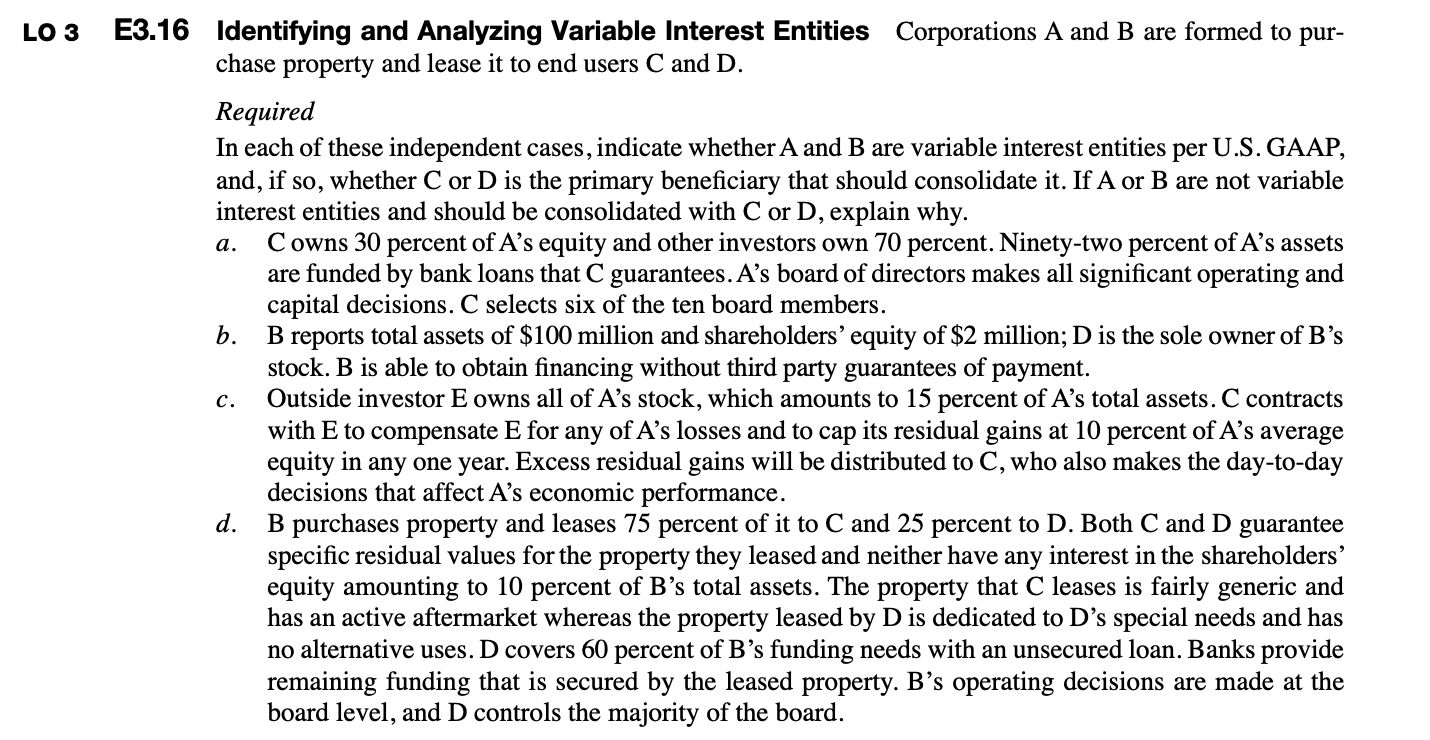
LO 3 a. E3.16 Identifying and Analyzing Variable Interest Entities Corporations A and B are formed to pur- chase property and lease it to end users C and D. Required In each of these independent cases, indicate whether A and B are variable interest entities per U.S. GAAP, and, if so, whether C or D is the primary beneficiary that should consolidate it. If A or B are not variable interest entities and should be consolidated with C or D, explain why. Cowns 30 percent of A's equity and other investors own 70 percent. Ninety-two percent of A's assets are funded by bank loans that C guarantees. A's board of directors makes all significant operating and capital decisions. C selects six of the ten board members. b. B reports total assets of $100 million and shareholders' equity of $2 million; D is the sole owner of B's stock. B is able to obtain financing without third party guarantees of payment. c. Outside investor E owns all of A's stock, which amounts to 15 percent of A's total assets. C contracts with E to compensate E for any of As losses and to cap its residual gains at 10 percent of A's average equity in any one year. Excess residual gains will be distributed to C, who also makes the day-to-day decisions that affect A's economic performance. d. B purchases property and leases 75 percent of it to C and 25 percent to D. Both C and D guarantee specific residual values for the property they leased and neither have any interest in the shareholders' equity amounting to 10 percent of Bs total assets. The property that C leases is fairly generic and has an active aftermarket whereas the property leased by D is dedicated to D's special needs and has no alternative uses. D covers 60 percent of B's funding needs with an unsecured loan. Banks provide remaining funding that is secured by the leased property. B's operating decisions are made at the board level, and D controls the majority of the board
Step by Step Solution
There are 3 Steps involved in it

Get step-by-step solutions from verified subject matter experts
 Study Help