Question: Locate a peer-reviewed research article that describes/defines Analysis of Student Learning . Then, create an article review in which you respond to each of the
Locate a peer-reviewed research article that describes/defines Analysis of Student Learning. Then, create an article review in which you respond to each of the following:
1. Summarize the information (one paragraph)
2. Give your opinion of the information (one paragraph)
3. Describe how you will use the information to inform the development and implementation of your Impact on Student Learning (one paragraph).
4. Include a bibliographic entry for the article (reference for the article)
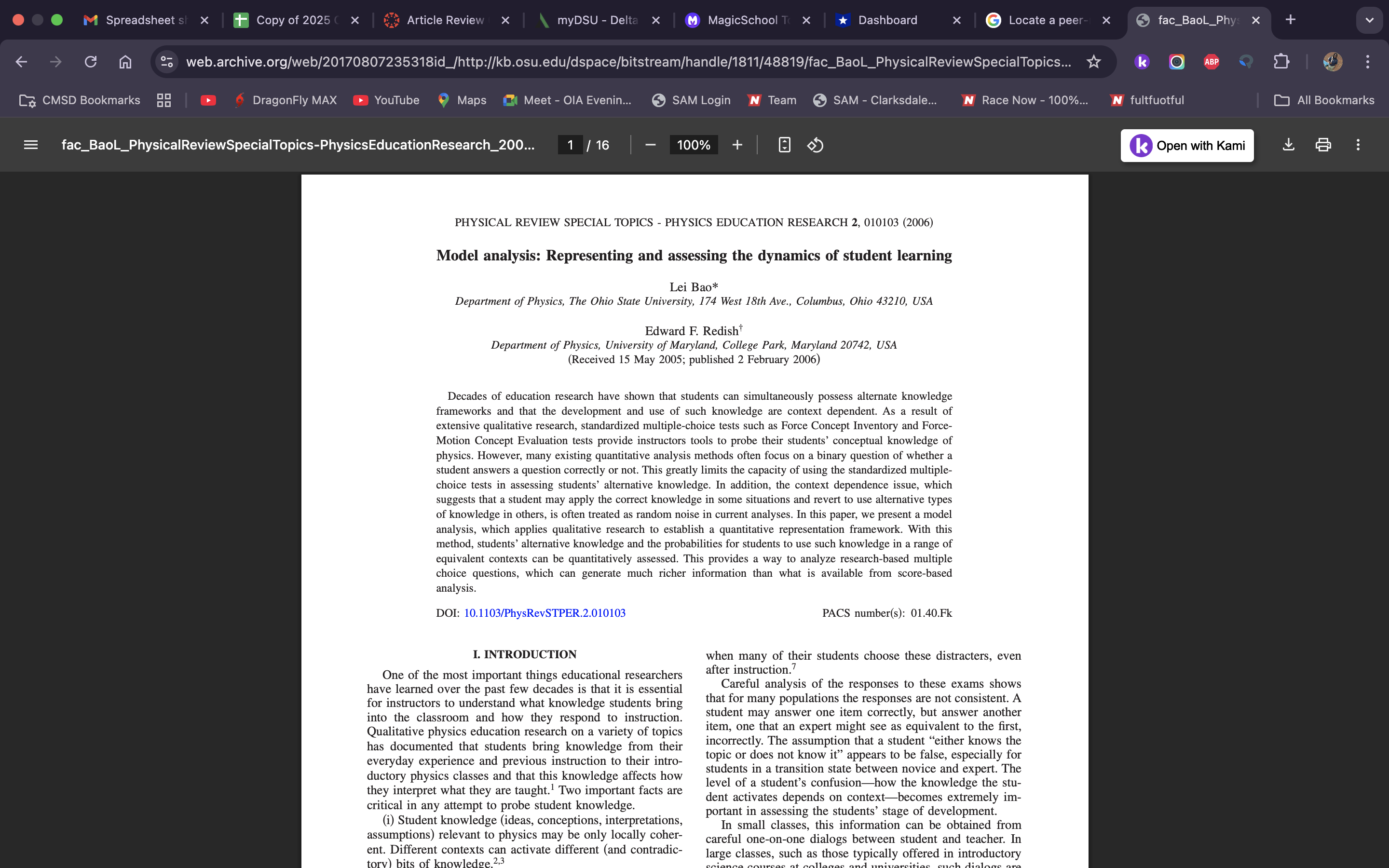
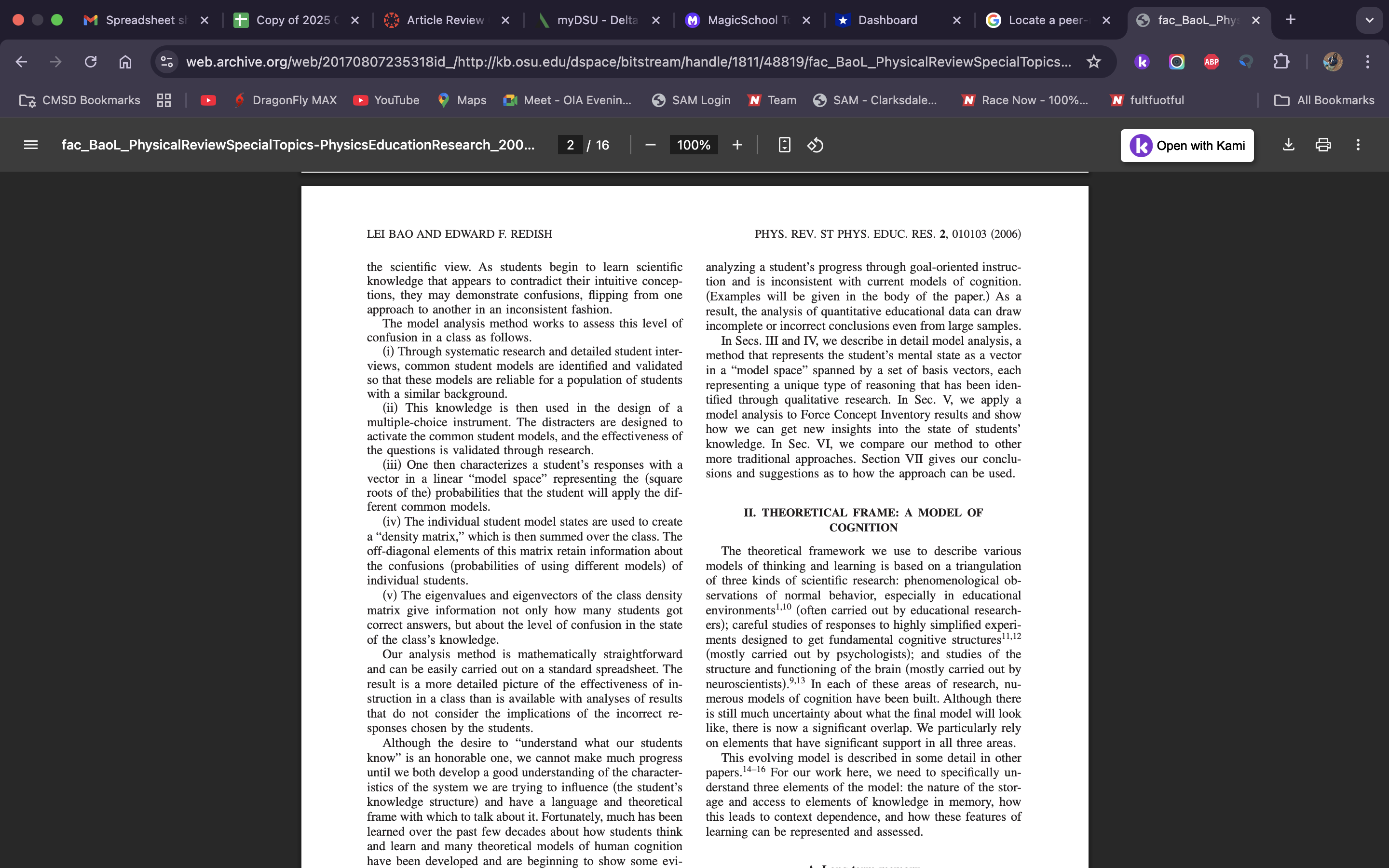
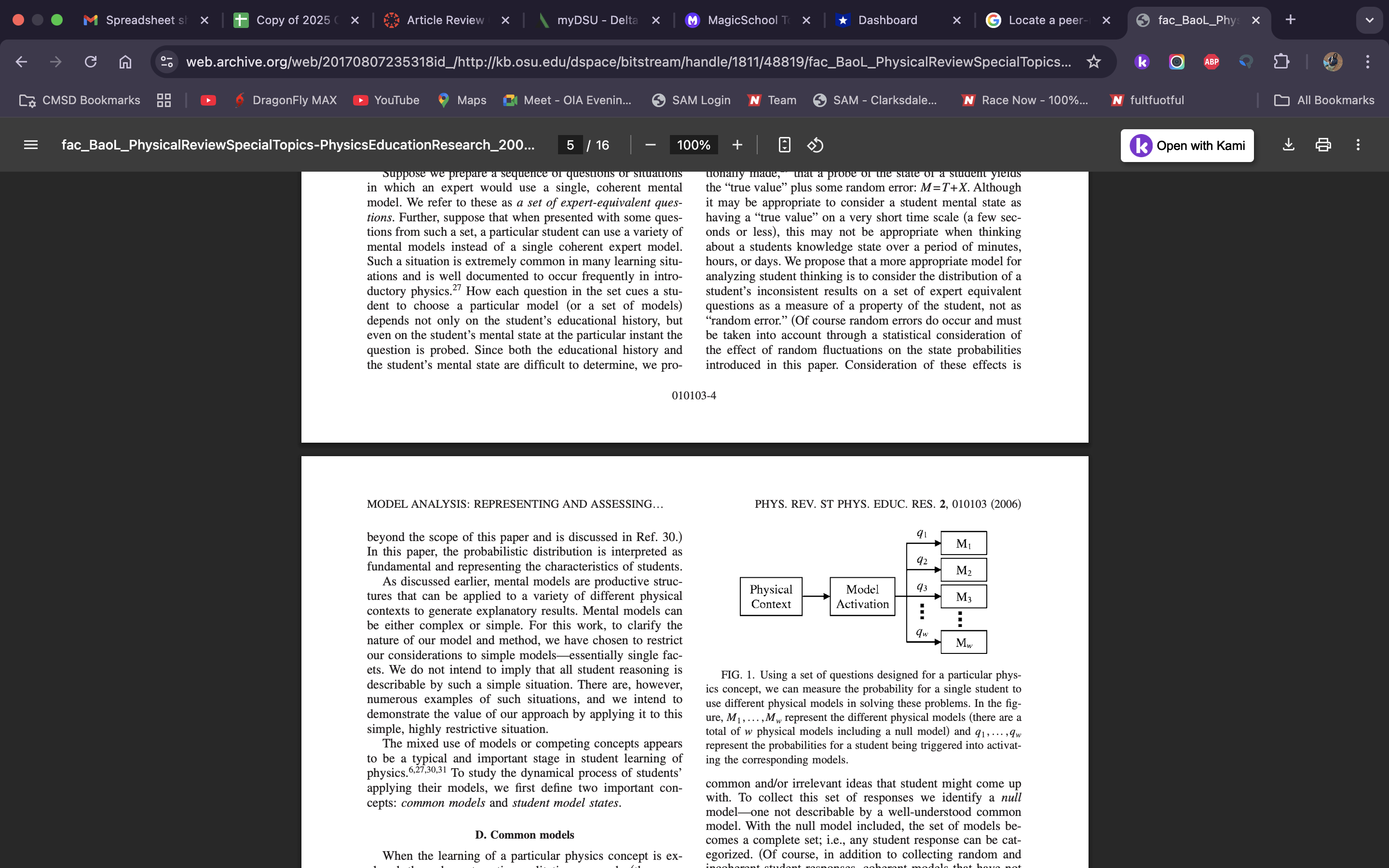
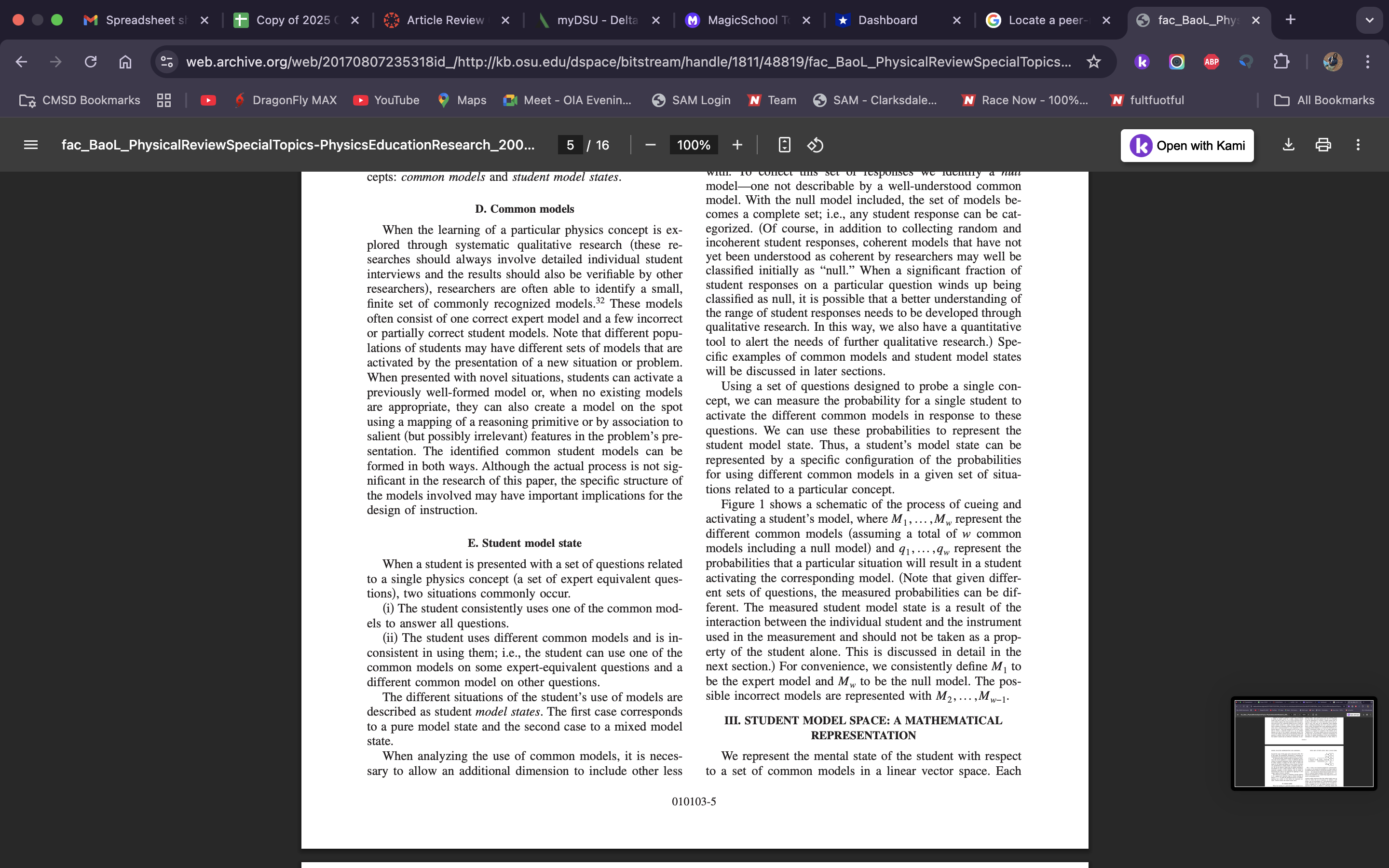
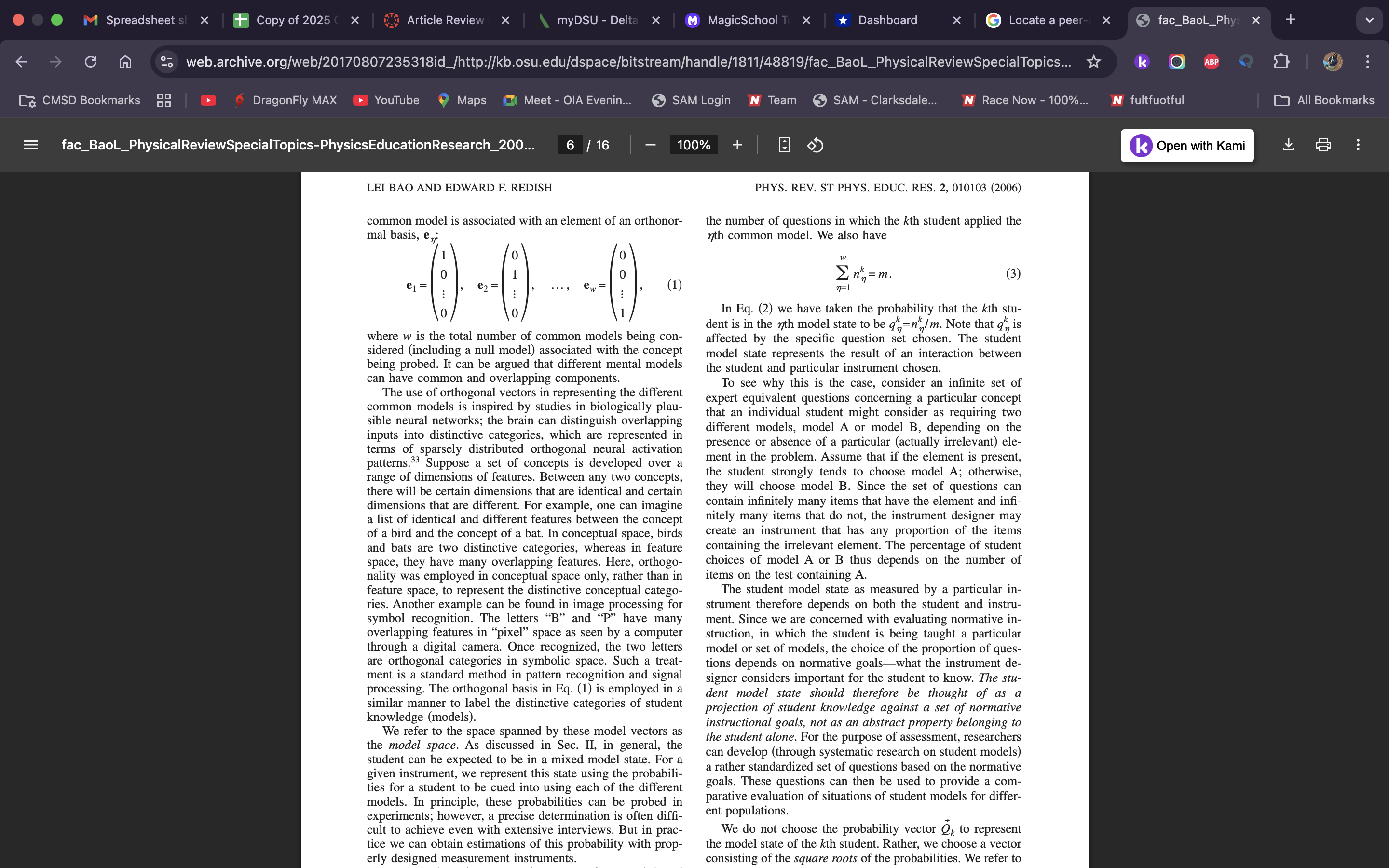
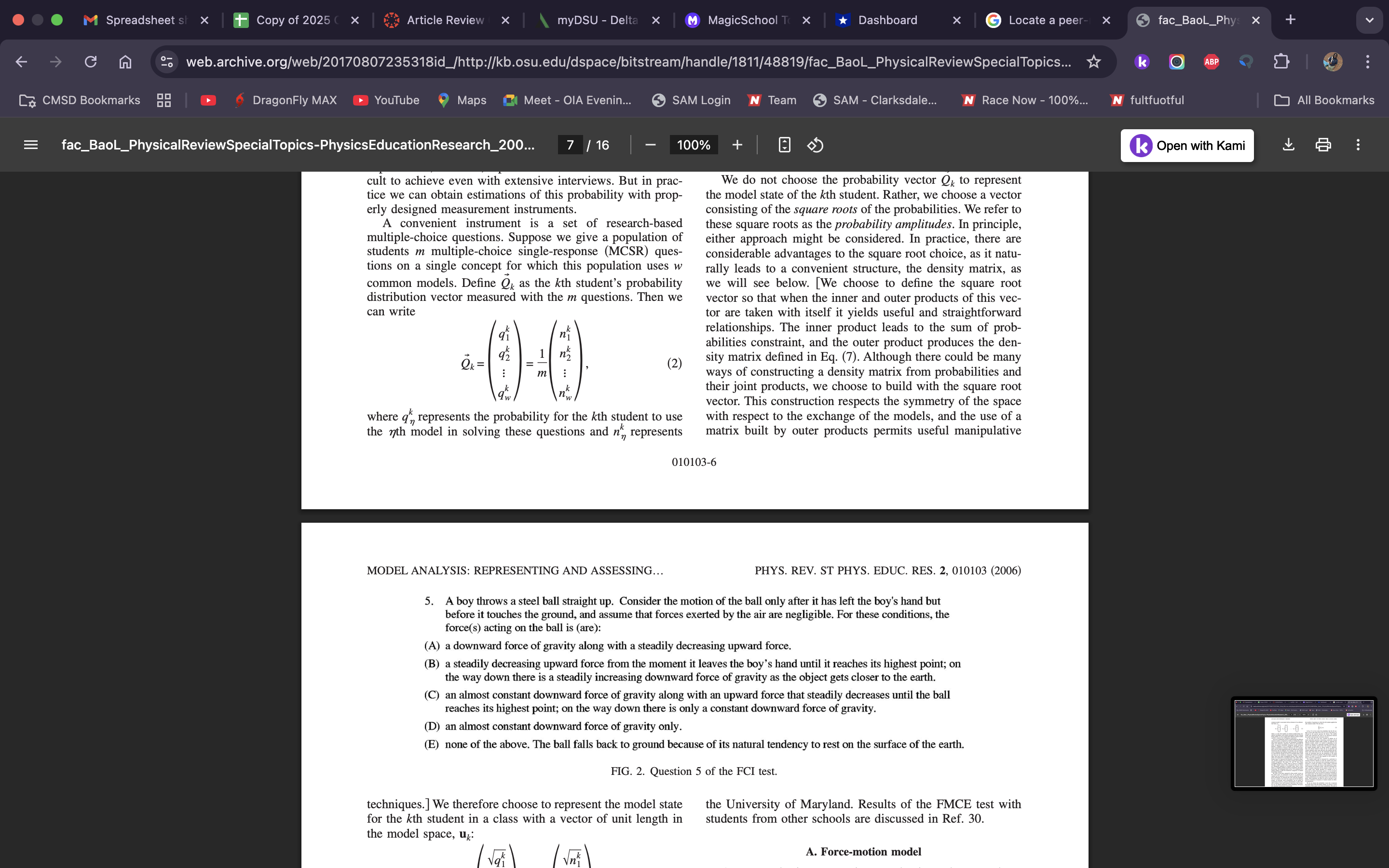
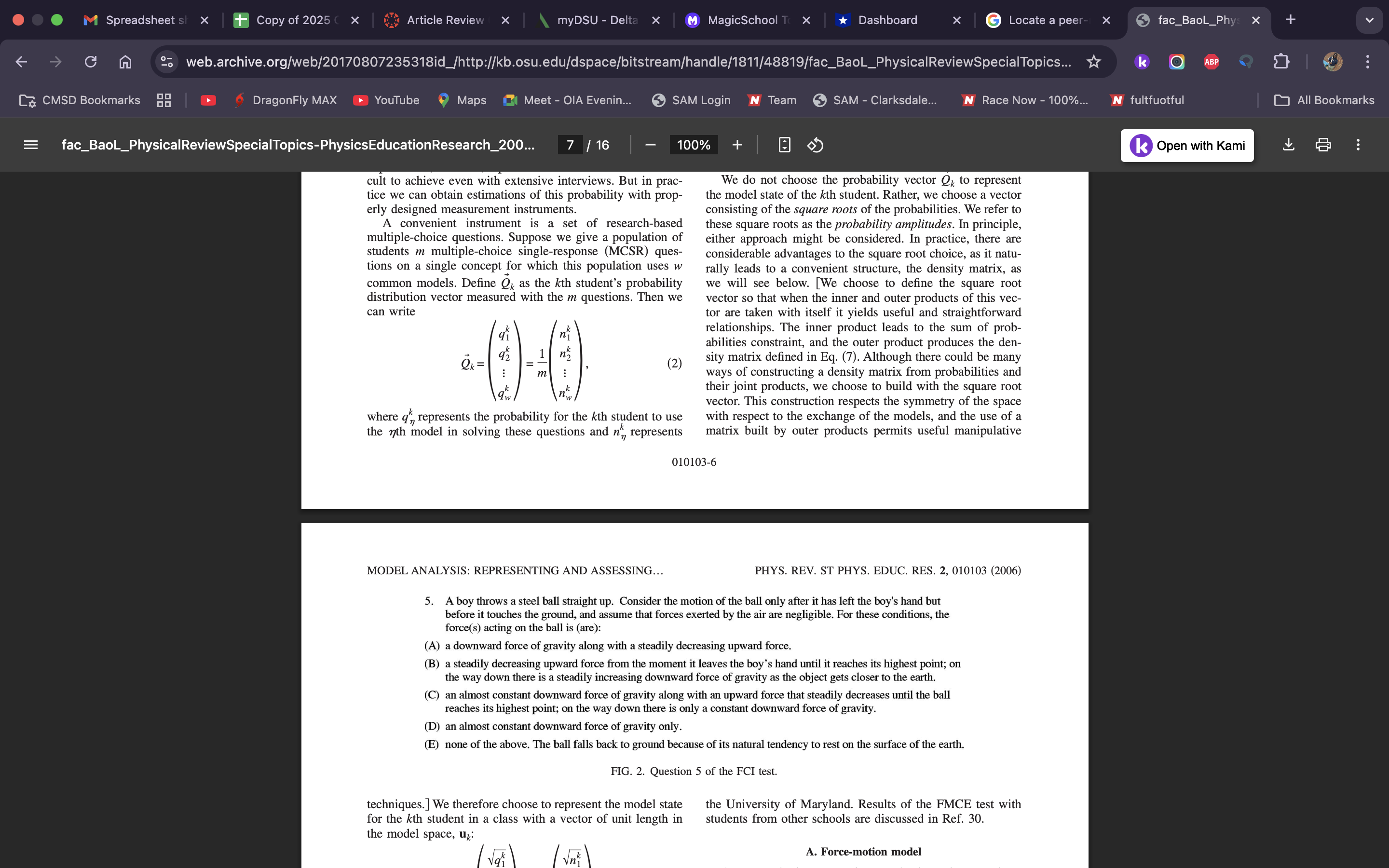
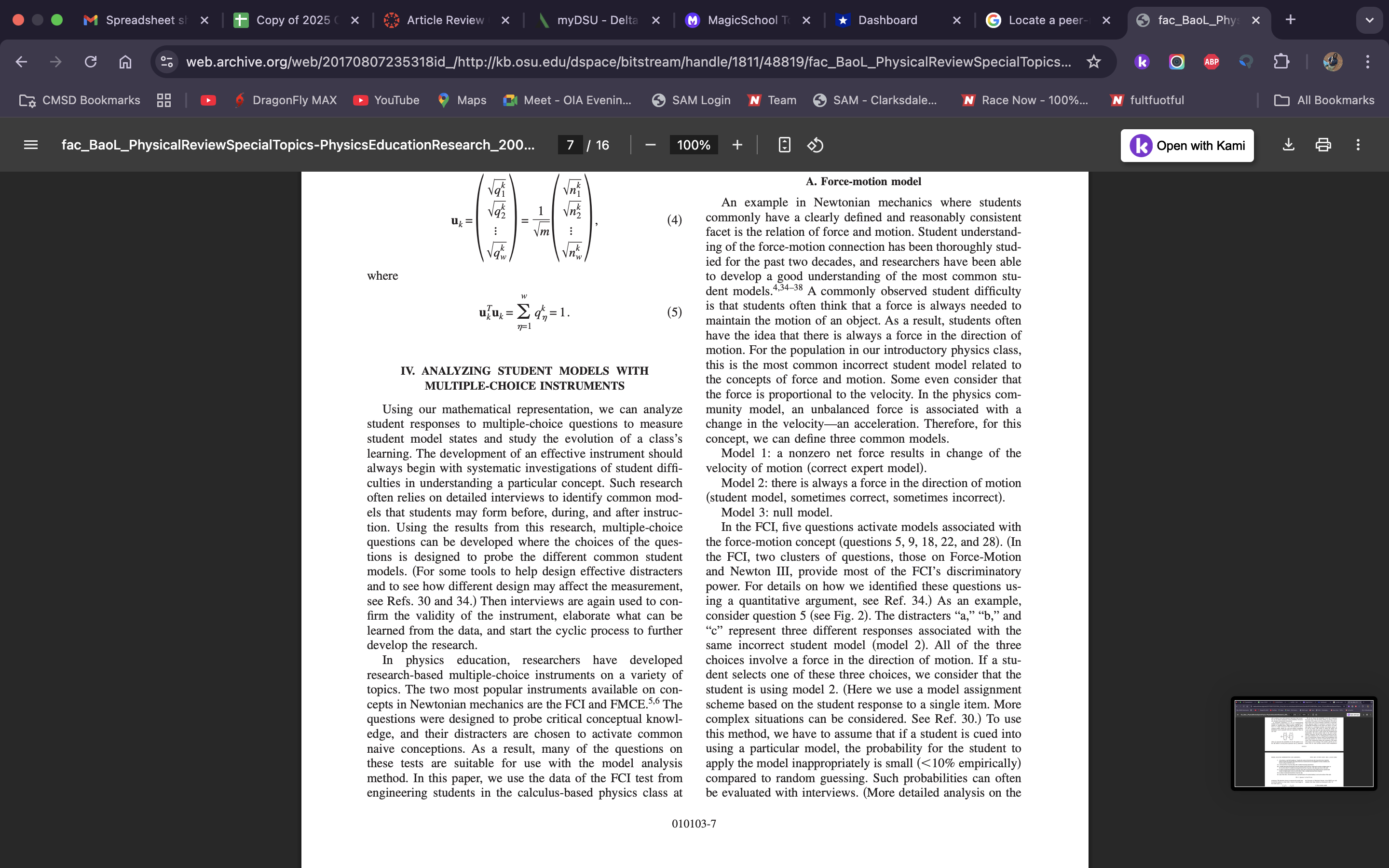
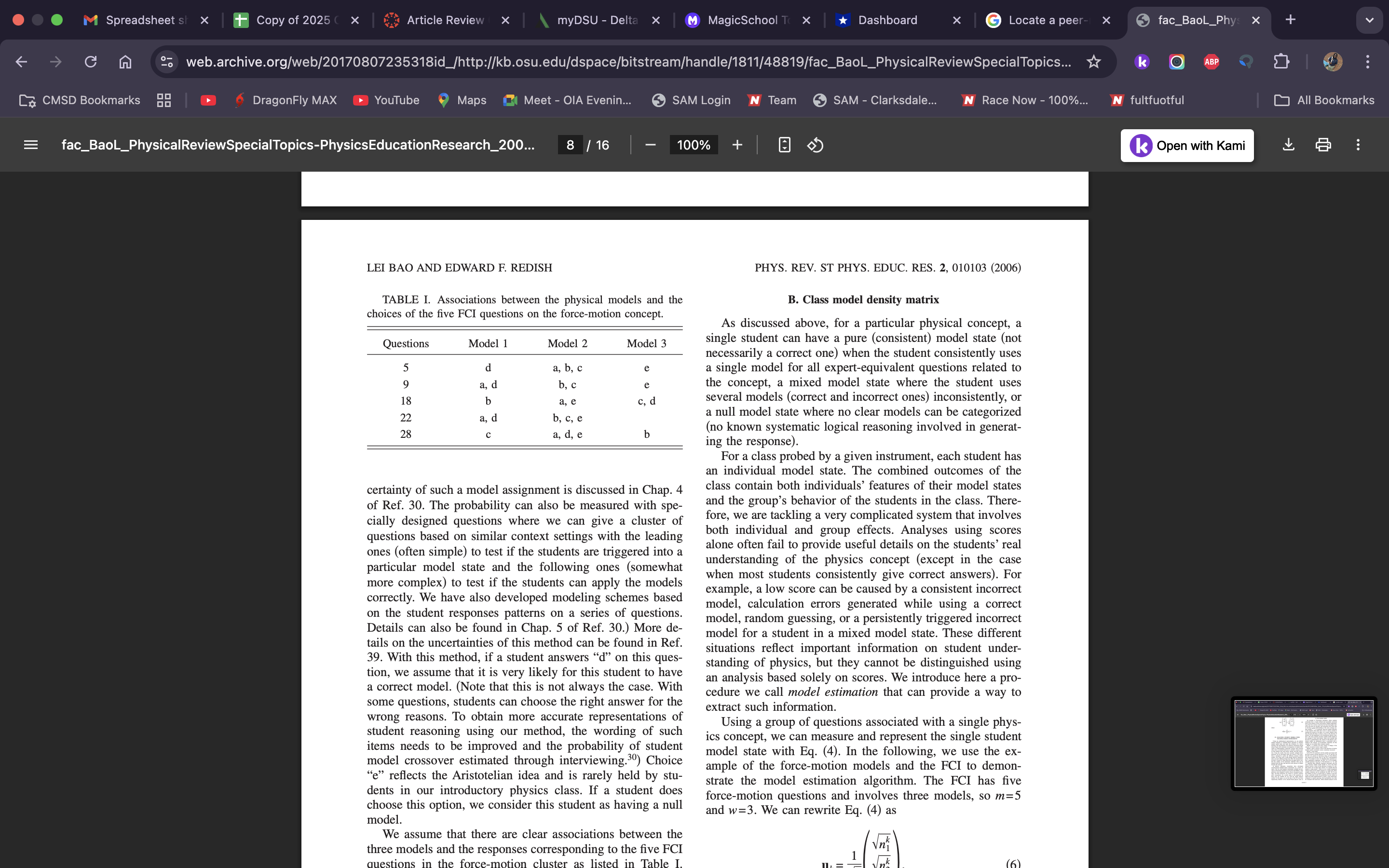
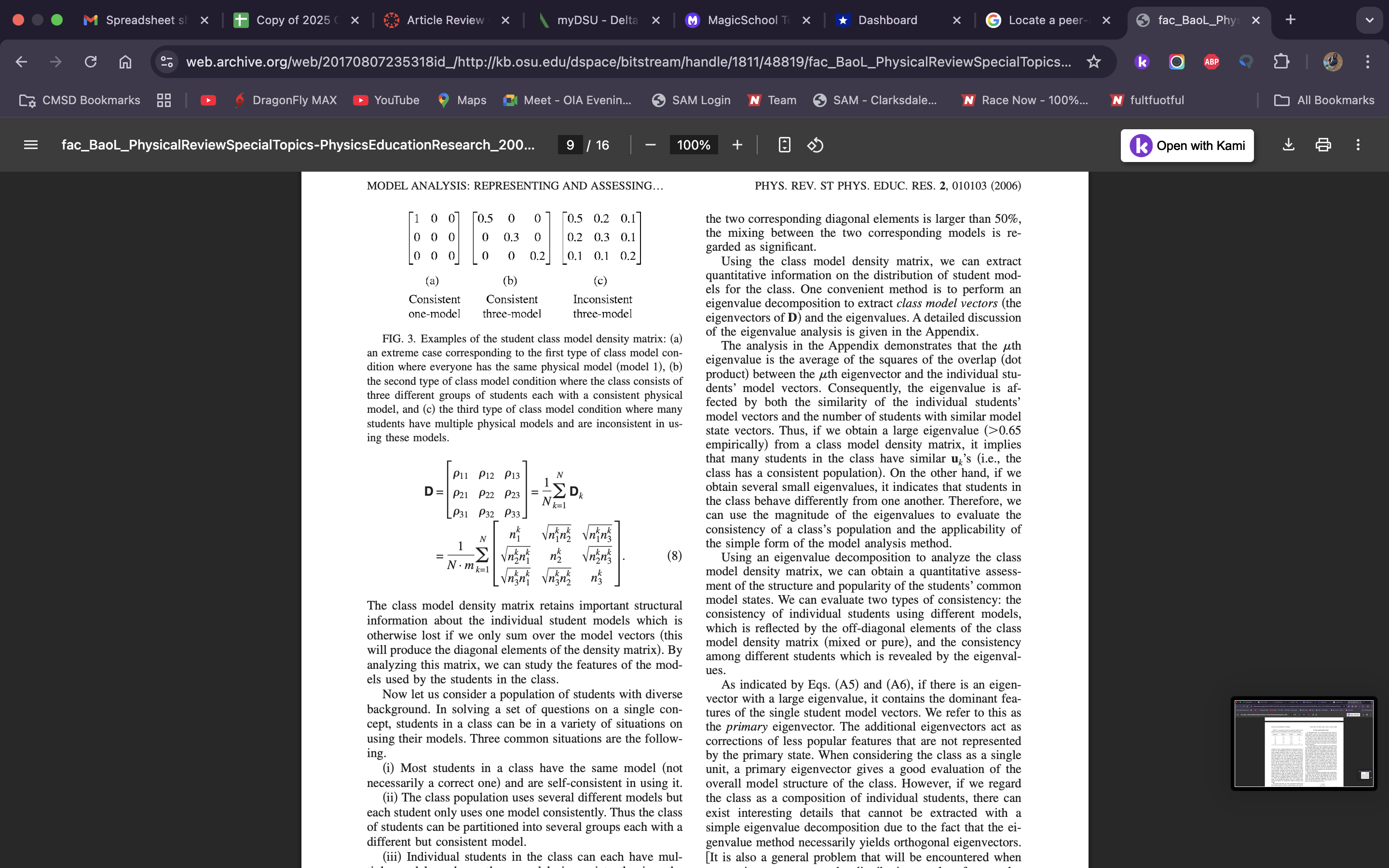
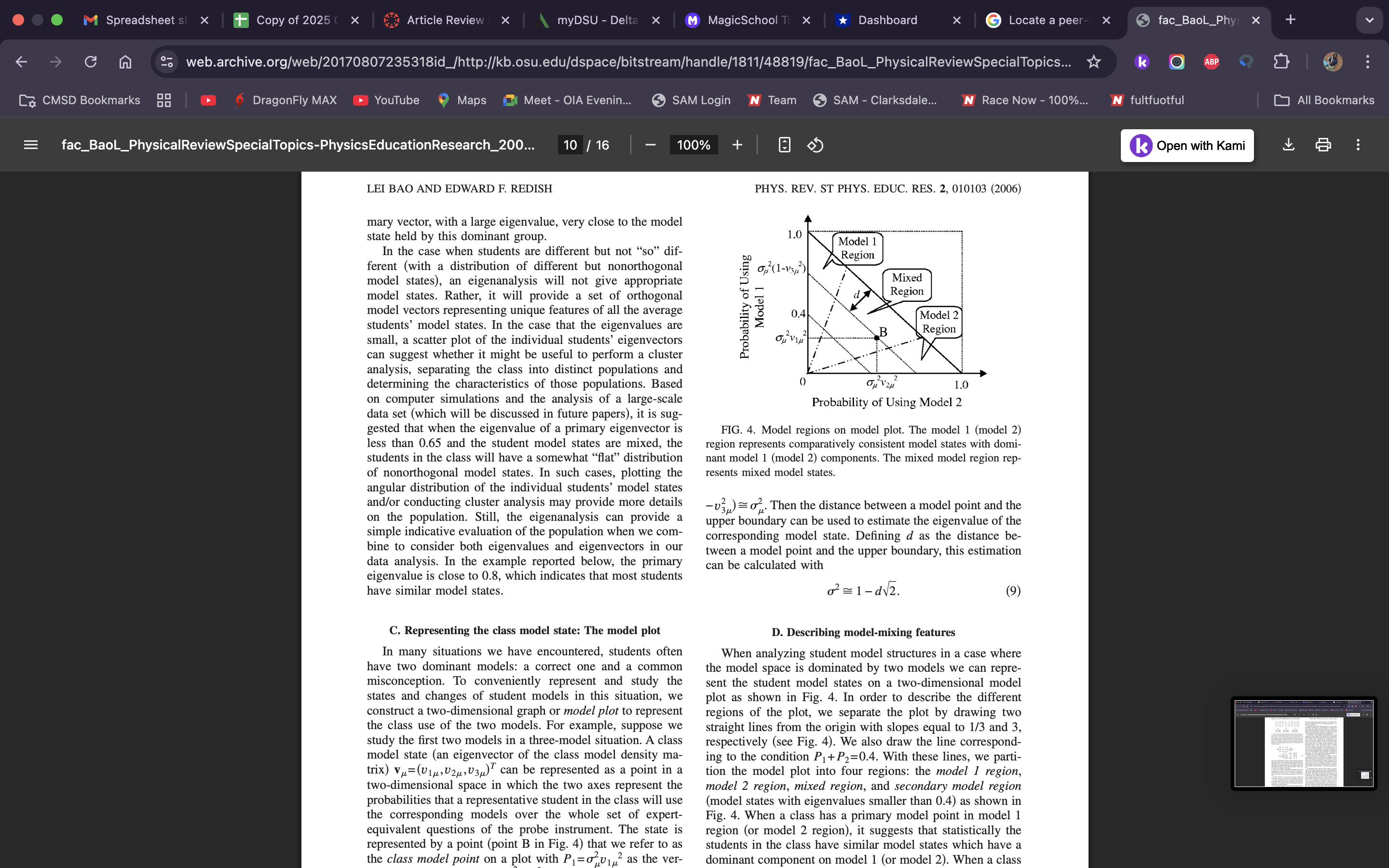
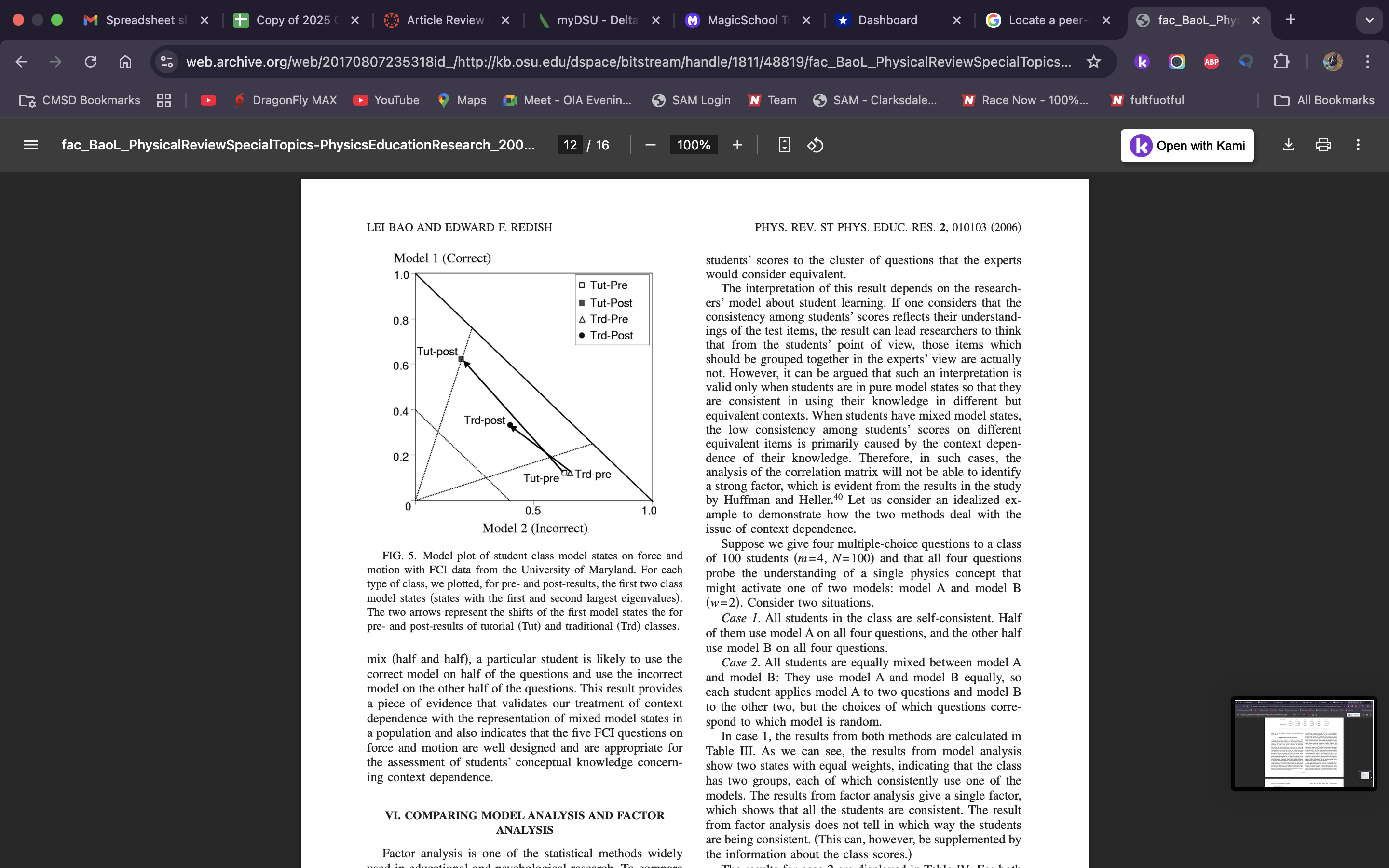
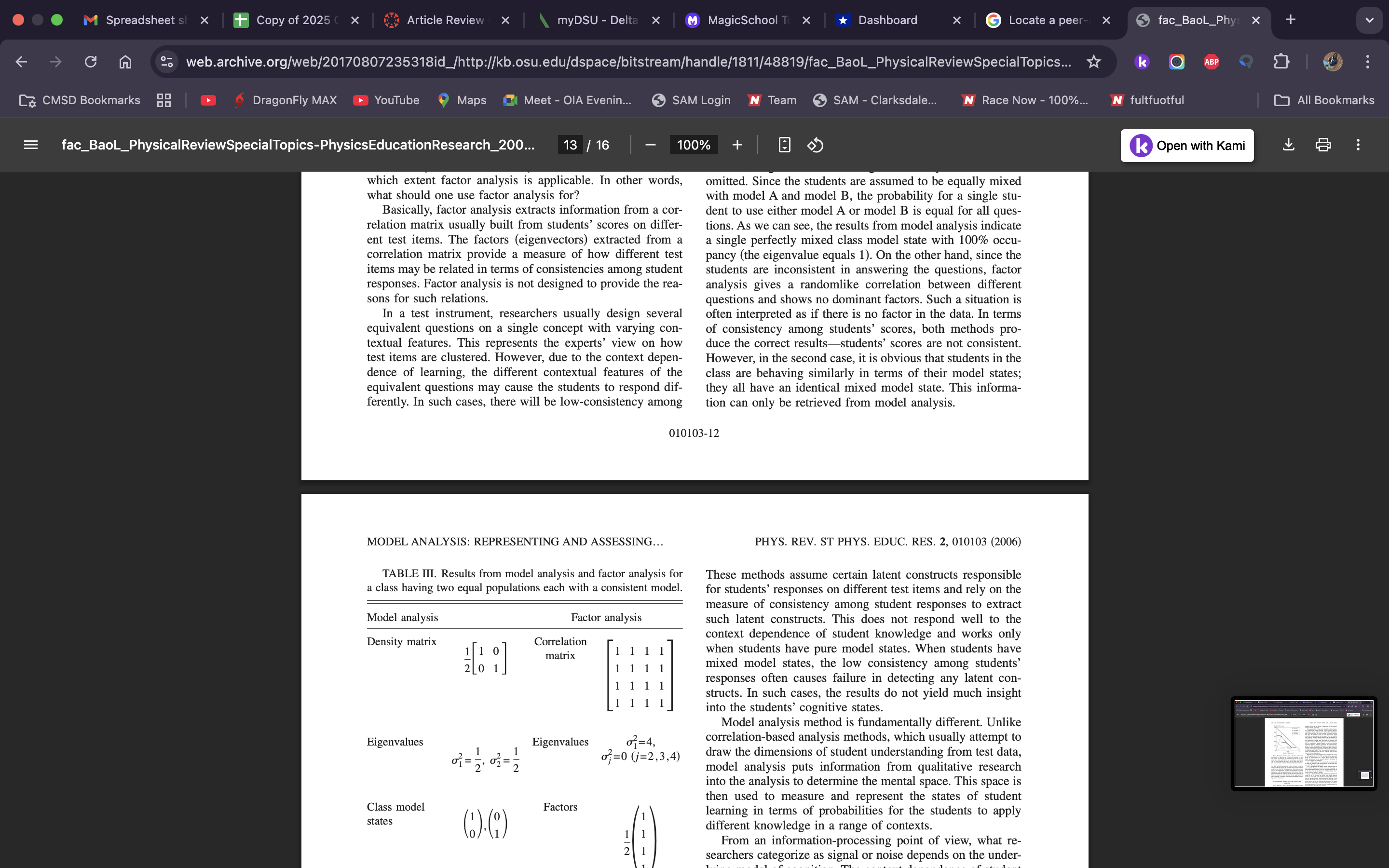
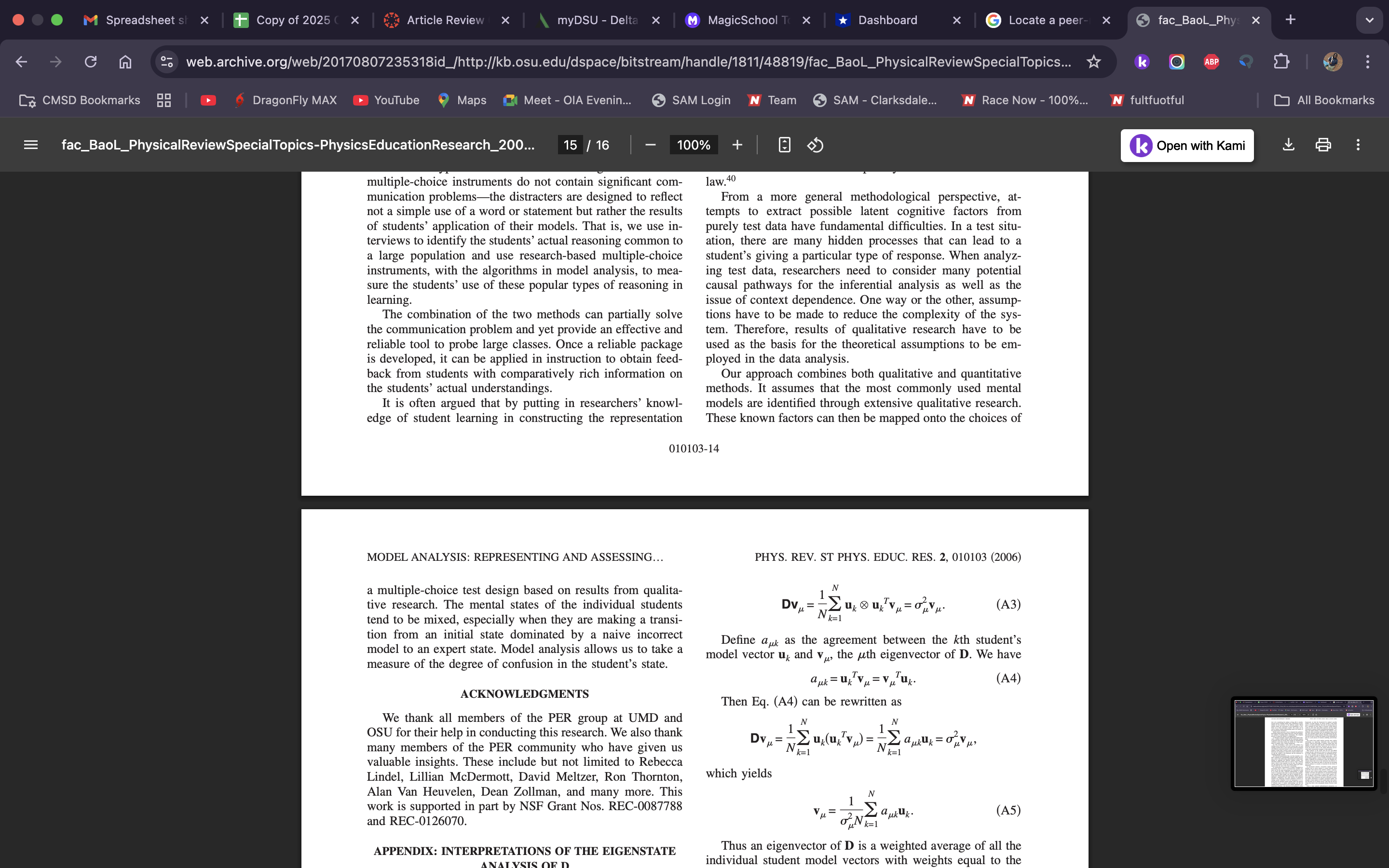
O MSpreadsheet sl x + Copy of 2025 ( X Article Review X myDSU - Delta x M MagicSchool T X *Dashboard G Locate a peer- X fac_BaoL_Phys X -> G 2 web.archive.org/web/20170807235318id_/http://kb.osu.edu/dspace/bitstream/handle/1811/48819/fac_BaoL_PhysicalReviewSpecialTopics... K O ABP Ca CMSD Bookmarks 88 DragonFly MAX YouTube . Maps Meet - OIA Evenin... SAM Login N Team SAM - Clarksdale. N Race Now - 100%... N fultfuotful All Bookmarks fac_BaoL_PhysicalReviewSpecialTopics-PhysicsEducationResearch_200... 1 / 16 100% + k Open with Kami PHYSICAL REVIEW SPECIAL TOPICS - PHYSICS EDUCATION RESEARCH 2, 010103 (2006) Model analysis: Representing and assessing the dynamics of student learning Lei Bao* Department of Physics, The Ohio State University, 174 West 18th Ave., Columbus, Ohio 43210, USA Edward F. Redish Department of Physics, University of Maryland, College Park, Maryland 20742, USA (Received 15 May 2005; published 2 February 2006) Decades of education research have shown that students can simultaneously possess alternate knowledge frameworks and that the development and use of such knowledge are context dependent. As a result of extensive qualitative research, standardized multiple-choice tests such as Force Concept Inventory and Force- Motion Concept Evaluation tests provide instructors tools to probe their students' conceptual knowledge of physics. However, many existing quantitative analysis methods often focus on a binary question of whether a student answers a question correctly or not. This greatly limits the capacity of using the standardized multiple- choice tests in assessing students' alternative knowledge. In addition, the context dependence issue, which suggests that a student may apply the correct knowledge in some situations and revert to use alternative types of knowledge in others, is often treated as random noise in current analyses. In this paper, we present a model analysis, which applies qualitative research to establish a quantitative representation framework. With this method, students' alternative knowledge and the probabilities for students to use such knowledge in a range of equivalent contexts can be quantitatively assessed. This provides a way to analyze research-based multiple choice questions, which can generate much richer information than what is available from score-based analysis. DOI: 10.1103/PhysRevSTPER.2.010103 PACS number(s): 01.40.FK I. INTRODUCTION when many of their students choose these distracters, even One of the most important things educational researchers after instruction.' have learned over the past few decades is that it is essential Careful analysis of the responses to these exams shows for instructors to understand what knowledge students bring that for many populations the responses are not consistent. A into the classroom and how they respond to instruction. student may answer one item correctly, but answer another Qualitative physics education research on a variety of topics item, one that an expert might see as equivalent to the first, has documented that students bring knowledge from their incorrectly. The assumption that a student "either knows the everyday experience and previous instruction to their intro- topic or does not know it" appears to be false, especially for ductory physics classes and that this knowledge affects how students in a transition state between novice and expert. The they interpret what they are taught. Two important facts are level of a student's confusion-how the knowledge the stu- critical in any attempt to probe student knowledge. dent activates depends on context-becomes extremely im- (i) Student knowledge (ideas, conceptions, interpretations, portant in assessing the students' stage of development. In small classes, this information can be obtained from assumptions) relevant to physics may be only locally coher- careful one-on-one dialogs between student and teacher. In ent. Different contexts can activate different (and contradict ledge 2,3 large classes, such as those typically offered in introductory@ Soe sa-iig 4 MA Copy of 2025. x Article Revie! x myDSU - Del Be @ MagicSchool be * Dashboard x () [Melero of-1-) x @ fac_BaoL_Phy x a S Cc fn web.archive.org/web/20170807235318id_/http://kb.osu.edu/dspace/bitstream/handle/1811/48819/fac_BaoL_PhysicalReviewSpecialTopics... 77 [es WON IS) =fole) Cu R= DragonFly MAX (*) YouTube Maps (% Meet-OlAEvenin.. @ SAMLogin \\N Team @ SAM- Clarksdale... 1 Clee Ct, MU eit CoLaiT|| cle o The impact of these exams can be both revealing and powerful. Faculty who are not aware of the prevalence and strength of student alternative concep- tions fail to see the distracters as reasonable alternatives and may consider the exam as trivial. They can then be surprised 1554-9178/2006/2(1)/010103(16) 010103-1 PACS number(s): 01.40.Fk when many of their students choose these distracters, even after instruction.' Careful analysis of the responses to these exams shows that for many populations the responses are not consistent. A student may answer one item correctly, but answer another item, one that an expert might see as equivalent to the first, incorrectly. The assumption that a student \"either knows the topic or does not know it\" appears to be false, especially for students in a transition state between novice and expert. The level of a student's confusionhow the knowledge the stu- dent activates depends on contextbecomes extremely im- portant in assessing the students' stage of development. In small classes, this information can be obtained from careful one-on-one dialogs between student and teacher. In large classes, such as those typically offered in introductory science courses at colleges and universities, such dialogs are all but impossible. Instructors in these venues often resort to pre-post testing using research-based closed-ended diagnos- tic instruments. But the results from these instruments tend to be used in a very limited waythrough overall scores and average pre- post gains. This approach may miss much valuable informa- tion, especially if the instrument has been designed on the basis of strong qualitative research, contains subclusters of questions probing similar issues, and has distracters that rep- resent alternative modes of student reasoning. In this paper, we present a method of model analysis that allows an instructor to extract specific information from a well-designed assessment instrument (test) on the state of a class's knowledge. The method is especially valuable in cases where qualitative research has documented that stu- dents enter a class with a small number of strong naive con- ceptions that conflict with or encourage misinterpretations of 2006 The American Physical Society USK aid FA Copy of 2025 {OVID Lol) C1 DragonFly MAX fac_BaoL_PhysicalReviewSpecialTopics-PhysicsEducationResearch_: Article Revie) x myDSU - Del bd web.archive.org/web/20170807235318id_/http://kb.osu.edu/dspace/bitstream/ YouTube Maps % Meet - OIA Evenin... LEI BAO AND EDWARD F. REDISH the scientific view. As students begin to learn scientific knowledge that appears to contradict their intuitive concep- tions, they may demonstrate confusions, flipping from one approach to another in an inconsistent fashion. The model analysis method works to assess this level of confusion in a class as follows. (i) Through systematic research and detailed student inter- views, common student models are identified and validated so that these models are reliable for a population of students with a similar background. (ii) This knowledge is then used in the design of a multiple-choice instrument. The distracters are designed to activate the common student models, and the effectiveness of the questions is validated through research. (iii) One then characterizes a student's responses with a vector in a linear \"model space\" representing the (square roots of the) probabilities that the student will apply the dif- ferent common models. (iv) The individual student model states are used to create a \"density matrix,\" which is then summed over the class. The off-diagonal elements of this matrix retain information about the confusions (probabilities of using different models) of individual students. (v) The eigenvalues and eigenvectors of the class density matrix give information not only how many students got correct answers, but about the level of confusion in the state of the class's knowledge. Our analysis method is mathematically straightforward and can be easily carried out on a standard spreadsheet. The result is a more detailed picture of the effectiveness of in- struction in a class than is available with analyses of results that do not consider the implications of the incorrect re- sponses chosen by the students. Although the desire to \"understand what our students know\" is an honorable one, we cannot make much progress until we both develop a good understanding of the character- istics of the system we are trying to influence (the student's knowledge structure) and have a language and theoretical frame with which to talk about it. Fortunately, much has been learned over the past few decades about how students think and learn and many theoretical models of human cognition have been developed and are beginning to show some evi- @ MagicSchool 4 @ SAM Login %* Dashboard bd ndle/1811/48819/fac_BaoL_PhysicalReviewSpecialTopics... N Team @ SAM- Clarksdale... cle o In the modular model of diSessa and Minstrell, students are assumed to have their knowledge \"in pieces.\" Different bits of knowledge tend to be weakly connected. As a result, different contexts can easily cue different responses, al- though in this model it is possible that a particular \"piece\" can be robust and activated with a high probability in a va- riety of situations. An alternative view of student thinking in physics is the one espoused explicitly by Caramazza et al. and Vosniadou.\"2?3 In this view, students possess a coherent and () Locate a pee: e@ fac_BaoL_Ph IN Race Now - 100%... @ Soe sa-iig 4 MA Copy of 2025. x Article Revie! x myDSU - Del Be @ MagicSchool be * Dashboard x () Locate a pee x @ fac_BaoL_Phy x a S Cc fn web.archive.org/web/20170807235318id_/http://kb.osu.edu/dspace/bitstream/handle/1811/48819/fac_BaoL_PhysicalReviewSpecialTopics... 77 [es WON IS) =fole) Cu R= DragonFly MAX (*) YouTube Maps (% Meet-OlAEvenin.. @ SAMLogin \\N Team @ SAM- Clarksdale... I Clean Slee. nicely] cle o and their collaborators. DiSessa investigated people's sense of physical mechanismthat is, their understanding of why things work the way they do.?! What he found was that many students, even after instruction in physics, often come up with simple statements that describe the way they think things function in the real world. They often consider these statements to be \"frreducible\"as the obvious or ultimate answer; that is, one espoused explicitly by Caramazza et al. and Vosniadou.\"3 In this view, students possess a coherent and organized \"alternative\" or \"naive\" theory of a particular physical topic or situation. Despite describing student re- sponses as theory like, Vosniadou cites cases in which stu- dents appear to be mixing elements of contradictory models. In the theory described in Redish'* and Hammer et al.,'> these two theories can be seen as extreme assumptions about the nature of knowledge structures most likely to be found among naive students. The difference between the two theo- retical models is largely in the expectation of whether one will observe responses that can be interpreted as consistent across many contexts or depending more sensitively on con- text. The question as to which model is correct becomes an empirical one. The answer as to which model should be pre- ferred could depend on both the populations involved and the circumstances that one wants to consider as an appropriate range of contexts. In one study, a careful multifaceted obser- vation of the behavior of preservice teachers learning topics in physics over long periods (many weeks) revealed shifts in student choices of reasoning from consistent (and wrong), through mixed, and back to consistent (this time, agreeing with the more scientific conceptions).\"* If this turns out to be general, assessing the state of the students' choice of reason- ing patterns could have important instructional implications. To be able to discuss the cognitive issues clearly and without prejudice towards one model or another, we use the general term mental model: a robust and coherent knowledge element or strongly associated set of knowledge elements. For example, in the contexts involving motion, students of- ten believe that there is always a force in the direction of motion. This represents a robustly established association be- tween motion and force and thus is characterized as a mental model. We use this term in a broad and inclusive sense. A mental model may be simple or complex, correct or incor- rect, activated as a whole or generated spontaneously in re- sponse to a situation. Note that this term appears frequently in the cognitive and educational literature, often in undefined and inconsistent ways. Our use of the term is probably clos- est to that used by Norman.?> The popular (and sometimes debated) term misconception can be viewed as reasoning involving mental models that have problematic elements for the student's creation of an expert view and that appear in a given population with sig- 010103-3 USK aid FA Copy of 2025 {OVID Lol) C1 DragonFly MAX fac_BaoL_PhysicalReviewSpecialTopics-PhysicsEducationResearch_: Article Revie) x myDSU - Del bd web.archive.org/web/20170807235318id_/http://kb.osu.edu/dspace/bitstream/ YouTube Maps % Meet - OIA Evenin... nificant probabilities (though not necessarily consistently in a given student). We stress that our use of this term implies no assumption about the structure or cognitive mental creation of this response. In particular, we do not need to assume either that it is irreducible (has no component parts) or that it is stored and recalled rather than generated on the spot. In assessing the state of students' knowledge, what one needs to determine is both the models the students possess and can use and the context dependence of their use of these models. C. Context dependence and the state of the student from the point of view of an expert The context dependence of the cognitive response may be considered in a variety of ways. From the point of view of the student, his or her mental system may feel perfectly con- sistent, despite appearing inconsistent to an expert. The stu- dent might use a mental model inappropriately because he or she has failed to attach appropriate conditions to its application,\" the student might fail to associate a mental model with a circumstance in which it is appropriate, or the student may associate with different mental models in equivalent circumstances, cueing on irrelevant elements of the situation and not noticing that the circumstances are equivalent. From the point of view of the cognitive researcher, it may be of great interest to consider the student as always being in a consistent mental state or as flipping from one mental state to another in response to a variety of cues. However, from the point of view of the educational researcher or of the instructor interested in goal-oriented instructionthat is, in acculturating students to understand particular community- developed viewpointswe suggest that there is considerable value in analyzing the student thinking as projected against an expert view. The \"expert\" here needs to be both a subject expert and an expert in education research so as not to un- dervalue or misunderstand the view of the student. For ex- ample, in considering the motion of compact objects, a naive physics student might view objects in terms of a generic concept of \"motion\" with inappropriately entangled ideas of position, velocity, acceleration, and force. The mental mod- els used by the student must be understood in terms of their own internal consistencies, not as \"errors\" when projected against the expert view. @ MagicSchool 4 @ SAM Login %* Dashboard bd ndle/1811/48819/fac_BaoL_PhysicalReviewSpecialTopics... N Team @ SAM- Clarksdale... cle o? These models often consist of one correct expert model and a few incorrect or partially correct student models. Note that different popu- lations of students may have different sets of models that are activated by the presentation of a new situation or problem. When presented with novel situations, students can activate a previously well-formed model or, when no existing models are appropriate, they can also create a model on the spot using a mapping of a reasoning primitive or by association to salient (but possibly irrelevant) features in the problem's pre- sentation. The identified common student models can be formed in both ways. Although the actual process is not sig- nificant in the research of this paper, the specific structure of the models involved may have important implications for the design of instruction. E. Student model state When a student is presented with a set of questions related to a single physics concept (a set of expert equivalent ques- tions), two situations commonly occur. (i) The student consistently uses one of the common mod- els to answer all questions. (ii) The student uses different common models and is in- consistent in using them; i.e., the student can use one of the common models on some expert-equivalent questions and a different common model on other questions. The different situations of the student's use of models are described as student model states. The first case corresponds to a pure model state and the second case to a mixed model state. When analyzing the use of common models, it is neces- sary to allow an additional dimension to include other less @ SAM Login @ MagicSchool x * Dashboard oa ndle/1811/48819/fac_BaoL_PhysicalReviewSpecialTopics... N Team @ SAM- Clarksdale... 100% + (A) modelone not describable by a well-understood common model. With the null model included, the set of models be- comes a complete set; i.e., any student response can be cat- egorized. (Of course, in addition to collecting random and incoherent student responses, coherent models that have not yet been understood as coherent by researchers may well be classified initially as \"null.\" When a significant fraction of student responses on a particular question winds up being classified as null, it is possible that a better understanding of the range of student responses needs to be developed through qualitative research. In this way, we also have a quantitative tool to alert the needs of further qualitative research.) Spe- cific examples of common models and student model states will be discussed in later sections. Using a set of questions designed to probe a single con- cept, we can measure the probability for a single student to activate the different common models in response to these questions. We can use these probabilities to represent the student model state. Thus, a student's model state can be represented by a specific configuration of the probabilities for using different common models in a given set of situa- tions related to a particular concept. Figure 1 shows a schematic of the process of cueing and activating a student's model, where M,,...,M,, represent the different common models (assuming a total of w common models including a null model) and qj, ...,q, represent the probabilities that a particular situation will result in a student activating the corresponding model. (Note that given differ- ent sets of questions, the measured probabilities can be dif- ferent. The measured student model state is a result of the interaction between the individual student and the instrument used in the measurement and should not be taken as a prop- erty of the student alone. This is discussed in detail in the next section.) For convenience, we consistently define M, to be the expert model and M,, to be the null model. The pos- sible incorrect models are represented with M),...,M,,_1- M,,_- II. STUDENT MODEL SPACE: A MATHEMATICAL REPRESENTATION We represent the mental state of the student with respect to a set of common models in a linear vector space. Each 010103-5 () Locate a pee wr IN Race Now - 100%... od @ fac_Baol_Ph 9 IN fultfuotful Pa th @ Soe sa-iig 4 MA Copy of 2025. x Article Revie! x myDSU - Del Be @ MagicSchool be * Dashboard x () [Melero of-1-) x @ fac_BaoL_Phy x a S Cc fn web.archive.org/web/20170807235318id_/http://kb.osu.edu/dspace/bitstream/handle/1811/48819/fac_BaoL_PhysicalReviewSpecialTopics... 77 [es WON IS) =fole) Cu R= DragonFly MAX fac_BaoL_PhysicalReviewSpecialTopics-PhysicsEducationResearch_: *) YouTube Maps (2% Meet - OIA Evenin... LEI BAO AND EDWARD F. REDISH common model is associated with an element of an orthonor- mal basis, e,: 1 0 0 0 1 0 ez]. |. e=|. fe ws eel. @ 0 0 1 where w is the total number of common models being con- sidered (including a null model) associated with the concept being probed. It can be argued that different mental models can have common and overlapping components. The use of orthogonal vectors in representing the different common models is inspired by studies in biologically plau- sible neural networks; the brain can distinguish overlapping inputs into distinctive categories, which are represented in terms of sparsely distributed orthogonal neural activation patterns.? Suppose a set of concepts is developed over a range of dimensions of features. Between any two concepts, there will be certain dimensions that are identical and certain dimensions that are different. For example, one can imagine a list of identical and different features between the concept of a bird and the concept of a bat. In conceptual space, birds and bats are two distinctive categories, whereas in feature space, they have many overlapping features. Here, orthogo- nality was employed in conceptual space only, rather than in feature space, to represent the distinctive conceptual catego- ries. Another example can be found in image processing for symbol recognition. The letters \"B\" and \"P\" have many overlapping features in \"pixel\" space as seen by a computer through a digital camera. Once recognized, the two letters are orthogonal categories in symbolic space. Such a treat- ment is a standard method in pattern recognition and signal processing. The orthogonal basis in Eq. (1) is employed in a similar manner to label the distinctive categories of student knowledge (models). We refer to the space spanned by these model vectors as the model space. As discussed in Sec. II, in general, the student can be expected to be in a mixed model state. For a given instrument, we represent this state using the probabili- ties for a student to be cued into using each of the different models. In principle, these probabilities can be probed in experiments; however, a precise determination is often diffi- cult to achieve even with extensive interviews. But in prac- tice we can obtain estimations of this probability with prop- erly designed measurement instruments. @ SAM Login N Team @ SAM- Clarksdale... cle o n=m. (3) I In Eq. (2) we have taken the probability that the kth stu- dent is in the 7th model state to be giani/m. Note that %, is affected by the specific question set chosen. The student model state represents the result of an interaction between the student and particular instrument chosen. To see why this is the case, consider an infinite set of expert equivalent questions concerning a particular concept that an individual student might consider as requiring two different models, model A or model B, depending on the presence or absence of a particular (actually irrelevant) ele- ment in the problem. Assume that if the element is present, the student strongly tends to choose model A; otherwise, they will choose model B. Since the set of questions can contain infinitely many items that have the element and infi- nitely many items that do not, the instrument designer may create an instrument that has any proportion of the items containing the irrelevant element. The percentage of student choices of model A or B thus depends on the number of items on the test containing A. The student model state as measured by a particular in- strument therefore depends on both the student and instru- ment. Since we are concerned with evaluating normative in- struction, in which the student is being taught a particular model or set of models, the choice of the proportion of ques- tions depends on normative goalswhat the instrument de- signer considers important for the student to know. The stu- dent model state should therefore be thought of as a projection of student knowledge against a set of normative instructional goals, not as an abstract property belonging to the student alone. For the purpose of assessment, researchers can develop (through systematic research on student models) arather standardized set of questions based on the normative goals. These questions can then be used to provide a com- parative evaluation of situations of student models for differ- ent populations. 'We do not choose the probability vector Oo, to represent the model state of the kth student. Rather, we choose a vector consisting of the square roots of the probabilities. We refer to IN Race Now - 100%... IN fultfuotful O MSpreadsheet sl x + Copy of 2025 ( X Article Review X myDSU - Delta x M MagicSchool T X *Dashboard G Locate a peer- X S fac_BaoL_Phys X -> G 2 web.archive.org/web/20170807235318id_/http://kb.osu.edu/dspace/bitstream/handle/1811/48819/fac_BaoL_PhysicalReviewSpecialTopics... K O ABP Ca CMSD Bookmarks 88 DragonFly MAX YouTube Maps Meet - OIA Evenin... SAM Login N Team SAM - Clarksdale... N Race Now - 100%... N fultfuotful All Bookmarks fac_BaoL_PhysicalReviewSpecialTopics-PhysicsEducationResearch_200... 7 / 16 100% k Open with Kami cult to achieve even with extensive interviews. But in prac- We do not choose the probability vector 2k to represent tice we can obtain estimations of this probability with prop- the model state of the kth student. Rather, we choose a vector erly designed measurement instruments. consisting of the square roots of the probabilities. We refer to A convenient instrument is a set of research-based these square roots as the probability amplitudes. In principle, multiple-choice questions. Suppose we give a population of either approach might be considered. In practice, there are students m multiple-choice single-response (MCSR) ques- considerable advantages to the square root choice, as it natu- tions on a single concept for which this population uses w rally leads to a convenient structure, the density matrix, as common models. Define Ox as the kth student's probability we will see below. [We choose to define the square root distribution vector measured with the m questions. Then we vector so that when the inner and outer products of this vec- can write tor are taken with itself it yields useful and straightforward ni relationships. The inner product leads to the sum of prob- abilities constraint, and the outer product produces the den- OK= (2) sity matrix defined in Eq. (7). Although there could be many m ways of constructing a density matrix from probabilities and their joint products, we choose to build with the square root vector. This construction respects the symmetry of the space where q, represents the probability for the kth student to use with respect to the exchange of the models, and the use of a the nth model in solving these questions and n, represents matrix built by outer products permits useful manipulative 010103-6 MODEL ANALYSIS: REPRESENTING AND ASSESSING... PHYS. REV. ST PHYS. EDUC. RES. 2, 010103 (2006) 5. A boy throws a steel ball straight up. Consider the motion of the ball only after it has left the boy's hand but before it touches the ground, and assume that forces exerted by the air are negligible. For these conditions, the force(s) acting on the ball is (are): (A) a downward force of gravity along with a steadily decreasing upward force. (B) a steadily decreasing upward force from the moment it leaves the boy's hand until it reaches its highest point; on the way down there is a steadily increasing downward force of gravity as the object gets closer to the earth. (C) an almost constant downward force of gravity along with an upward force that steadily decreases until the ball reaches its highest point; on the way down there is only a constant downward force of gravity. (D) an almost constant downward force of gravity only. (E) none of the above. The ball falls back to ground because of its natural tendency to rest on the surface of the earth. FIG. 2. Question 5 of the FCI test. techniques.] We therefore choose to represent the model state the University of Maryland. Results of the FMCE test with for the kth student in a class with a vector of unit length in students from other schools are discussed in Ref. 30. the model space, uk: A. Force-motion modelO MSpreadsheet sl x + Copy of 2025 ( X Article Review X myDSU - Delta x M MagicSchool T X *Dashboard G Locate a peer- X S fac_BaoL_Phys X -> G 2 web.archive.org/web/20170807235318id_/http://kb.osu.edu/dspace/bitstream/handle/1811/48819/fac_BaoL_PhysicalReviewSpecialTopics... K O ABP Ca CMSD Bookmarks 88 DragonFly MAX YouTube Maps Meet - OIA Evenin... SAM Login N Team SAM - Clarksdale... N Race Now - 100%... N fultfuotful All Bookmarks fac_BaoL_PhysicalReviewSpecialTopics-PhysicsEducationResearch_200... 7 / 16 100% k Open with Kami cult to achieve even with extensive interviews. But in prac- We do not choose the probability vector 2k to represent tice we can obtain estimations of this probability with prop- the model state of the kth student. Rather, we choose a vector erly designed measurement instruments. consisting of the square roots of the probabilities. We refer to A convenient instrument is a set of research-based these square roots as the probability amplitudes. In principle, multiple-choice questions. Suppose we give a population of either approach might be considered. In practice, there are students m multiple-choice single-response (MCSR) ques- considerable advantages to the square root choice, as it natu- tions on a single concept for which this population uses w rally leads to a convenient structure, the density matrix, as common models. Define Ox as the kth student's probability we will see below. [We choose to define the square root distribution vector measured with the m questions. Then we vector so that when the inner and outer products of this vec- can write tor are taken with itself it yields useful and straightforward ni relationships. The inner product leads to the sum of prob- abilities constraint, and the outer product produces the den- OK= (2) sity matrix defined in Eq. (7). Although there could be many m ways of constructing a density matrix from probabilities and their joint products, we choose to build with the square root vector. This construction respects the symmetry of the space where q, represents the probability for the kth student to use with respect to the exchange of the models, and the use of a the nth model in solving these questions and n, represents matrix built by outer products permits useful manipulative 010103-6 MODEL ANALYSIS: REPRESENTING AND ASSESSING... PHYS. REV. ST PHYS. EDUC. RES. 2, 010103 (2006) 5. A boy throws a steel ball straight up. Consider the motion of the ball only after it has left the boy's hand but before it touches the ground, and assume that forces exerted by the air are negligible. For these conditions, the force(s) acting on the ball is (are): (A) a downward force of gravity along with a steadily decreasing upward force. (B) a steadily decreasing upward force from the moment it leaves the boy's hand until it reaches its highest point; on the way down there is a steadily increasing downward force of gravity as the object gets closer to the earth. (C) an almost constant downward force of gravity along with an upward force that steadily decreases until the ball reaches its highest point; on the way down there is only a constant downward force of gravity. (D) an almost constant downward force of gravity only. (E) none of the above. The ball falls back to ground because of its natural tendency to rest on the surface of the earth. FIG. 2. Question 5 of the FCI test. techniques.] We therefore choose to represent the model state the University of Maryland. Results of the FMCE test with for the kth student in a class with a vector of unit length in students from other schools are discussed in Ref. 30. the model space, uk: A. Force-motion model@ Soe sa-iig 4 MA Copy of 2025. x Article Revie! x myDSU - Del Be @ MagicSchool be * Dashboard x () [Melero of-1-) x @ fac_BaoL_Phy x a S Cc fn web.archive.org/web/20170807235318id_/http://kb.osu.edu/dspace/bitstream/handle/1811/48819/fac_BaoL_PhysicalReviewSpecialTopics... 77 [es WON IS) =fole) Cu R= DragonFly MAX (*) YouTube Maps (% Meet-OlAEvenin.. @ SAMLogin \\N Team @ SAM- Clarksdale... 1 Clee Ct, MU eit CoLaiT|| cle o D, Nia P31 P32 P33 ni ning Vain Vnknk on Vnknk |. (8) vnink Vnknk nk The class model density matrix retains important structural information about the individual student models which is otherwise lost if we only sum over the model vectors (this will produce the diagonal elements of the density matrix). By analyzing this matrix, we can study the features of the mod- els used by the students in the class. Now let us consider a population of students with diverse background. In solving a set of questions on a single con- cept, students in a class can be in a variety of situations on using their models. Three common situations are the follow- ing. (i) Most students in a class have the same model (not necessarily a correct one) and are self-consistent in using it. (ii) The class population uses several different models but each student only uses one model consistently. Thus the class of students can be partitioned into several groups each with a different but consistent model. (iii) Individual students in the class can each have mul- N 1 = k=l "Nem @ MagicSchool 4 @ SAM Login %* Dashboard bd ndle/1811/48819/fac_BaoL_PhysicalReviewSpecialTopics... N Team @ SAM- Clarksdale... cle o
Step by Step Solution
There are 3 Steps involved in it
1 Expert Approved Answer
Step: 1 Unlock
Question Has Been Solved by an Expert!
Get step-by-step solutions from verified subject matter experts
Step: 2 Unlock
Step: 3 Unlock
Students Have Also Explored These Related Accounting Questions!














 Study Help