







Question: Look at the program below. Which of the three functions above (runtime_increment, runtime_print and runtime_pow) has the time complexity 'closer' (or more similar) to that
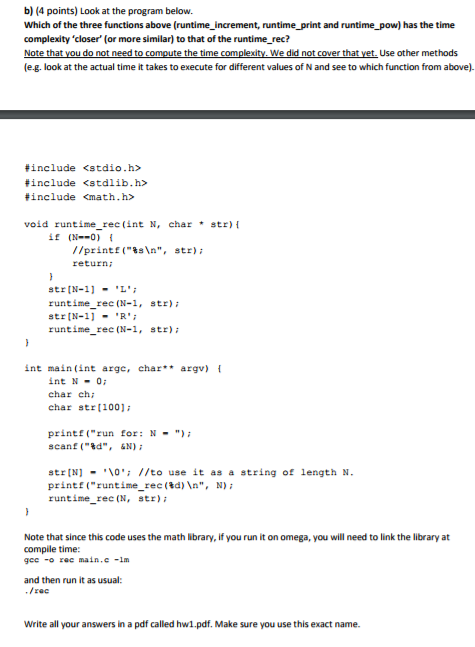
Look at the program below. Which of the three functions above (runtime_increment, runtime_print and runtime_pow) has the time complexity 'closer' (or more similar) to that of the runtime_rec? Use other methods e.g. look at the actual time it takes to execute for different values of N and see to which function from above). #include #include #include void runtime_rec(int N, char * str){ if (N == 0){ //printf("#s ", str): return: } str[N = 1] = 'L': runtime_rec(N-1, str): str[N-1] = 'R': runtime_rec(N=l, str): } int main(int argc, char** argv) { int N = 0: char ch: char str[100]: printf("run for: N = "): scanf("%d*, &N): str[N] = '\0': //to use it as a string of length N. printf("runtime_rec(%d) ", N): runtime_rec (N, str): } Note that since this code uses the math library, if you run it on omega, you will need to link the library at compile time: gcc -o rec train.c -lm and then run it as usual: ./rec Write all your answers in a pdf called hw1.pdf. Make sure you use this exact name
Step by Step Solution
There are 3 Steps involved in it

Get step-by-step solutions from verified subject matter experts
 Study Help