Question: Looking back at Chapter 5, what secondary data would be useful to identify who the target audience should be for this business? Based on what
- Looking back at Chapter 5, what secondary data would be useful to identify who the target audience should be for this business?
- Based on what you learned in Chapter 5, identify a packaged services firm that would be helpful in locating a successful coffee shop in different locales. Assume that since the coffee shop owner has several successful coffee shops, the owner has a database of current customer information.
- In considering either the prescription service or the coffee shop venture, what qualitative research techniques would you recommend that the prospective business owners use? Why would you recommend these qualitative techniques?
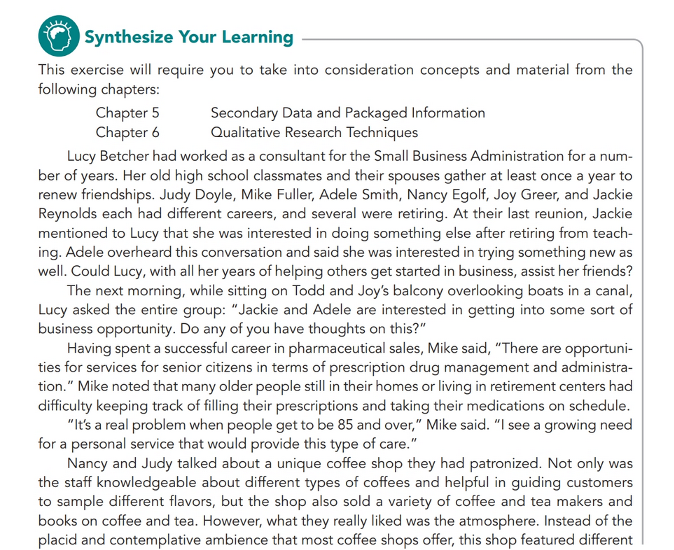
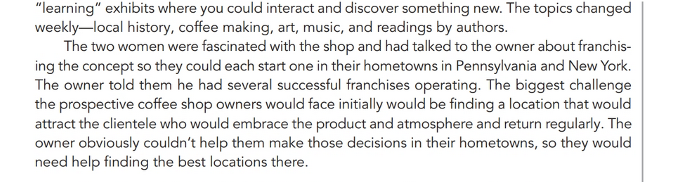
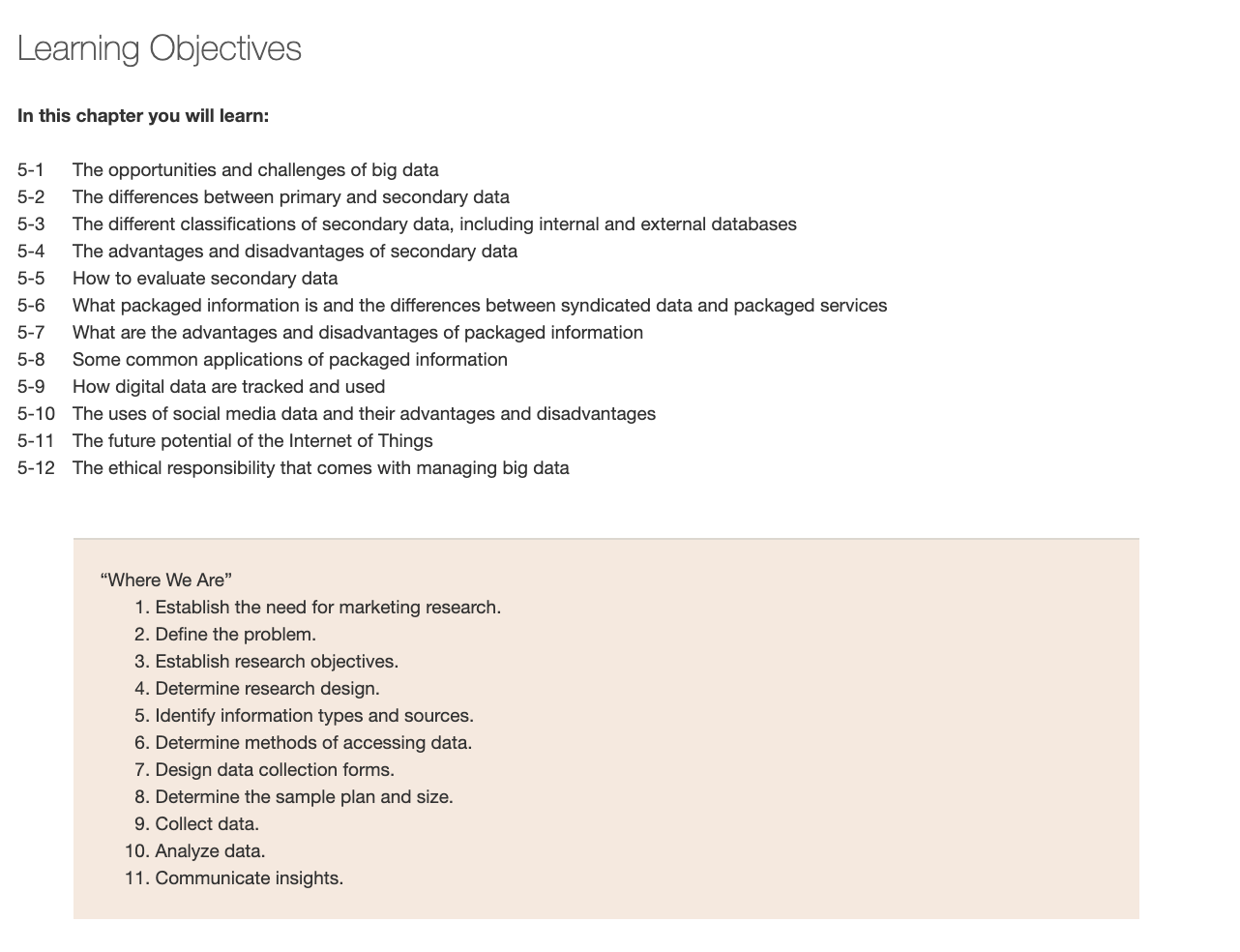
Synthesize Your Learning This exercise will require you to take into consideration concepts and material from the following chapters: Chapter 5 Secondary Data and Packaged Information Chapter 6 Qualitative Research Techniques Lucy Betcher had worked as a consultant for the Small Business Administration for a num- ber of years. Her old high school classmates and their spouses gather at least once a year to renew friendships. Judy Doyle, Mike Fuller, Adele Smith, Nancy Egolf, Joy Greer, and Jackie Reynolds each had different careers, and several were retiring. At their last reunion, Jackie mentioned to Lucy that she was interested in doing something else after retiring from teach- ing. Adele overheard this conversation and said she was interested in trying something new as well. Could Lucy, with all her years of helping others get started in business, assist her friends? The next morning, while sitting on Todd and Joy's balcony overlooking boats in a canal, Lucy asked the entire group: "Jackie and Adele are interested in getting into some sort of business opportunity. Do any of you have thoughts on this?" Having spent a successful career in pharmaceutical sales, Mike said, "There are opportuni- ties for services for senior citizens in terms of prescription drug management and administra- tion." Mike noted that many older people still in their homes or living in retirement centers had difficulty keeping track of filling their prescriptions and taking their medications on schedule. "It's a real problem when people get to be 85 and over," Mike said. "I see a growing need for a personal service that would provide this type of care." Nancy and Judy talked about a unique coffee shop they had patronized. Not only was the staff knowledgeable about different types of coffees and helpful in guiding customers to sample different flavors, but the shop also sold a variety of coffee and tea makers and books on coffee and tea. However, what they really liked was the atmosphere. Instead of the placid and contemplative ambience that most coffee shops offer, this shop featured different "learning" exhibits where you could interact and discover something new. The topics changed weeklylocal history, coffee making, art, music, and readings by authors. The two women were fascinated with the shop and had talked to the owner about franchis- ing the concept so they could each start one in their hometowns in Pennsylvania and New York. The owner told them he had several successful franchises operating. The biggest challenge the prospective coffee shop owners would face initially would be finding a location that would attract the clientele who would embrace the product and atmosphere and return regularly. The owner obviously couldn't help them make those decisions in their hometowns, so they would need help finding the best locations there. Learning Objectives In this chapter you will learn: 5-1 The opportunities and challenges of big data 5-2 The differences between primary and secondary data 5-3 The different classifications of secondary data, including internal and external databases 5-4 The advantages and disadvantages of secondary data 5-5 How to evaluate secondary data 5-6 What packaged information is and the differences between syndicated data and packaged services 5-7 What are the advantages and disadvantages of packaged information 5-8 Some common applications of packaged information 5-9 How digital data are tracked and used 5-10 The uses of social media data and their advantages and disadvantages 5-11 The future potential of the Internet of Things 5-12 The ethical responsibility that comes with managing big data "Where We Are" 1. Establish the need for marketing research. 2. Define the problem. 3. Establish research objectives. 4. Determine research design. 5. Identify information types and sources. 6. Determine methods of accessing data. 7. Design data collection forms. 8. Determine the sample plan and size. 9. Collect data. 10. Analyze data. 11. Communicate insights









 Study Help