







Question: LOOKING FOR HELP WITH QUESTION #2 1. Consider an economy with the following functions: Yt = (t + 1+ + G+ + NXt Ct =
LOOKING FOR HELP WITH QUESTION #2
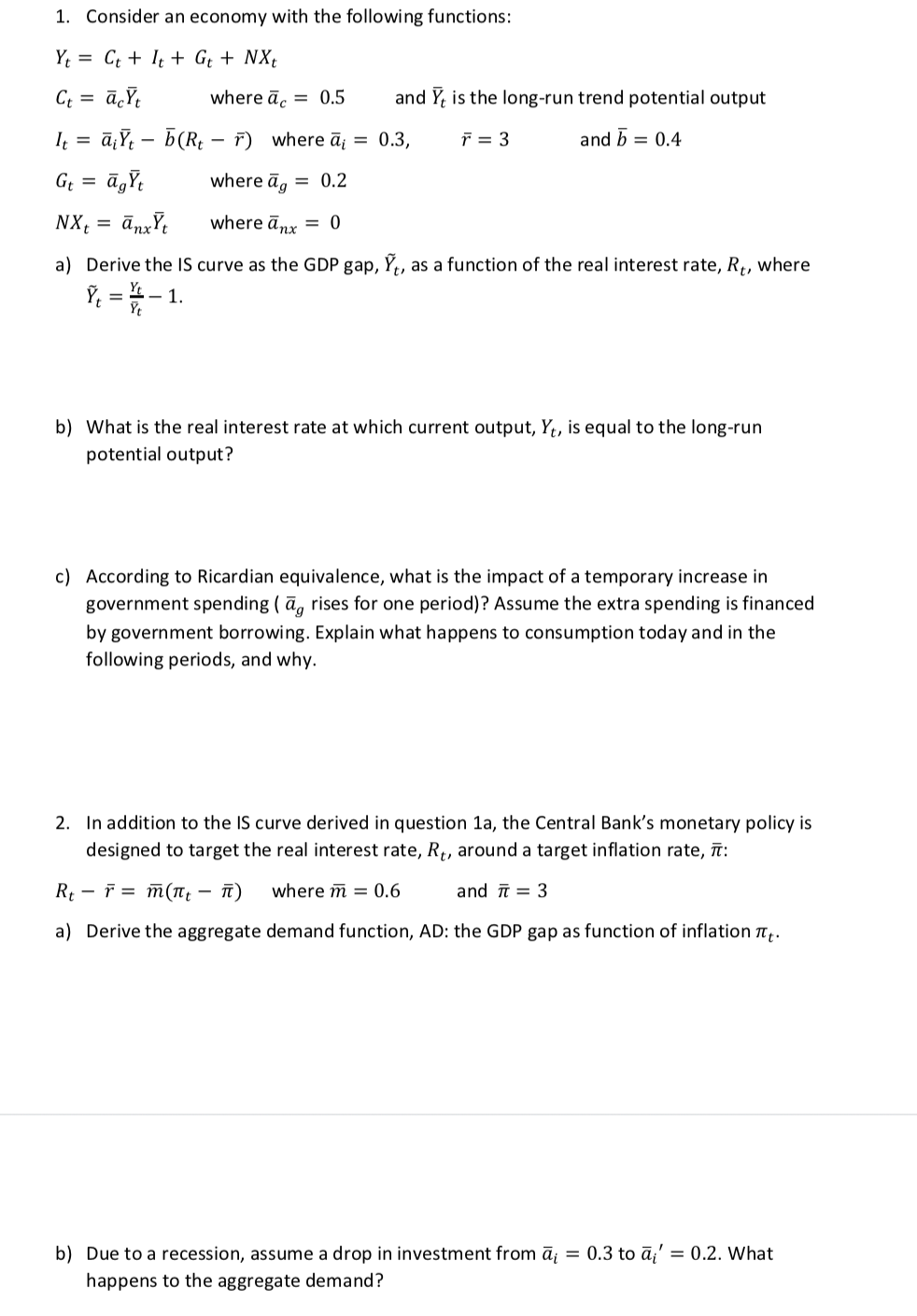
1. Consider an economy with the following functions: Yt = (t + 1+ + G+ + NXt Ct = ct where c = 0.5 and 7, is the long-run trend potential output It ;y - (Rt ) where 0.3, r = 3 and b = 0.4 G+ = ,7 where g NX anxit where nx = 0 a) Derive the IS curve as the GDP gap, Tz, as a function of the real interest rate, Rt, where , =-1. = 0.2 b) What is the real interest rate at which current output, Yt, is equal to the long-run potential output? c) According to Ricardian equivalence, what is the impact of a temporary increase in government spending ( , rises for one period)? Assume the extra spending is financed by government borrowing. Explain what happens to consumption today and in the following periods, and why. 2. In addition to the IS curve derived in question 1a, the Central Bank's monetary policy is designed to target the real interest rate, Rt, around a target inflation rate, T: Rt - r = m(Itt TT) where m = 0.6 and = 3 a) Derive the aggregate demand function, AD: the GDP gap as function of inflation it. b) Due to a recession, assume a drop in investment from ; = 0.3 to ;' = 0.2. What happens to the aggregate demand? 1. Consider an economy with the following functions: Yt = (t + 1+ + G+ + NXt Ct = ct where c = 0.5 and 7, is the long-run trend potential output It ;y - (Rt ) where 0.3, r = 3 and b = 0.4 G+ = ,7 where g NX anxit where nx = 0 a) Derive the IS curve as the GDP gap, Tz, as a function of the real interest rate, Rt, where , =-1. = 0.2 b) What is the real interest rate at which current output, Yt, is equal to the long-run potential output? c) According to Ricardian equivalence, what is the impact of a temporary increase in government spending ( , rises for one period)? Assume the extra spending is financed by government borrowing. Explain what happens to consumption today and in the following periods, and why. 2. In addition to the IS curve derived in question 1a, the Central Bank's monetary policy is designed to target the real interest rate, Rt, around a target inflation rate, T: Rt - r = m(Itt TT) where m = 0.6 and = 3 a) Derive the aggregate demand function, AD: the GDP gap as function of inflation it. b) Due to a recession, assume a drop in investment from ; = 0.3 to ;' = 0.2. What happens to the aggregate demand
Step by Step Solution
There are 3 Steps involved in it

Get step-by-step solutions from verified subject matter experts
 Study Help