







Question: Looking for solutions, thanks a lot. Problem #1 Consider an economy where the LM curve can be represented with M A+1500 50000(i-0.03) where A is
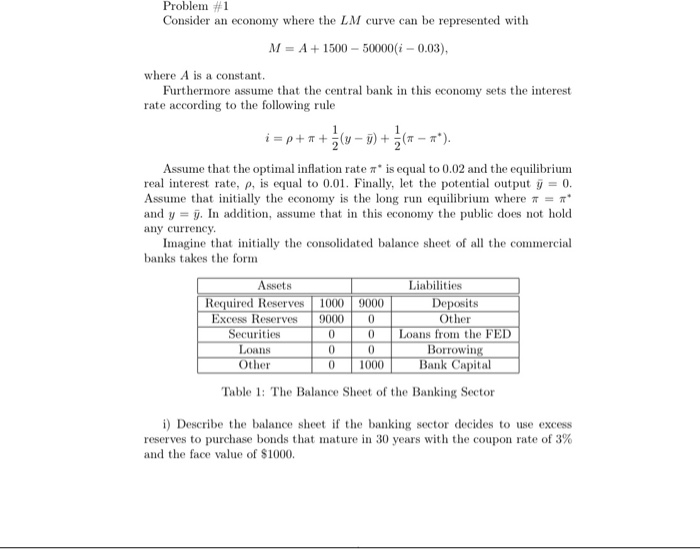
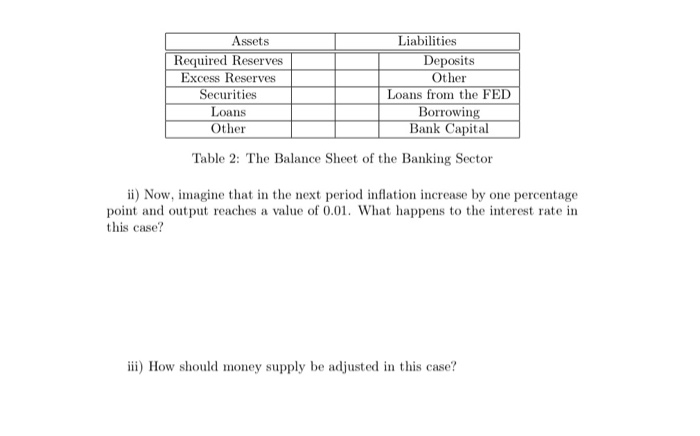
Problem #1 Consider an economy where the LM curve can be represented with M A+1500 50000(i-0.03) where A is a constant. Furthermore rate according to the following rule assume that the central bank in this economy sets the interest - n*) -) + Assume that the optimal inflation rate is equal to 0.02 and the equilibrium real interest rate, p, is equal to 0.01. Finally, let the potential output 0 Assume that initially the economy is the long run equilibrium where and y . In addition, assume that in this economy the public does not hold any currency Imagine that initially the consolidated balance sheet of all the commercial banks takes the form Liabilities Assets Deposits Required Reserves 1000 9000 Excess Reserves Other 9000 0 Securities Loans from the FED Borrowing Bank Capital 0 Loans Other 1000 Table 1: The Balance Sheet of the Banking Sector i) Describe the balance sheet if the banking sector decides to use excess reserves to purchase bonds that mature in 30 years with the coupon rate of 3 % and the face value of $1000. Assets Liabilities Required Reserves Excess Reserves Securities Loans Deposits Other Loans from the FED Borrowing Bank Capital Other Table 2: The Balance Sheet of the Banking Sector ii) Now, imagine that in the next period inflation increase by one percentage point and output reaches a value of 0.01. What happens to the interest rate in this case? ii How should money supply be adjusted in this case
Step by Step Solution
There are 3 Steps involved in it

Get step-by-step solutions from verified subject matter experts
 Study Help