







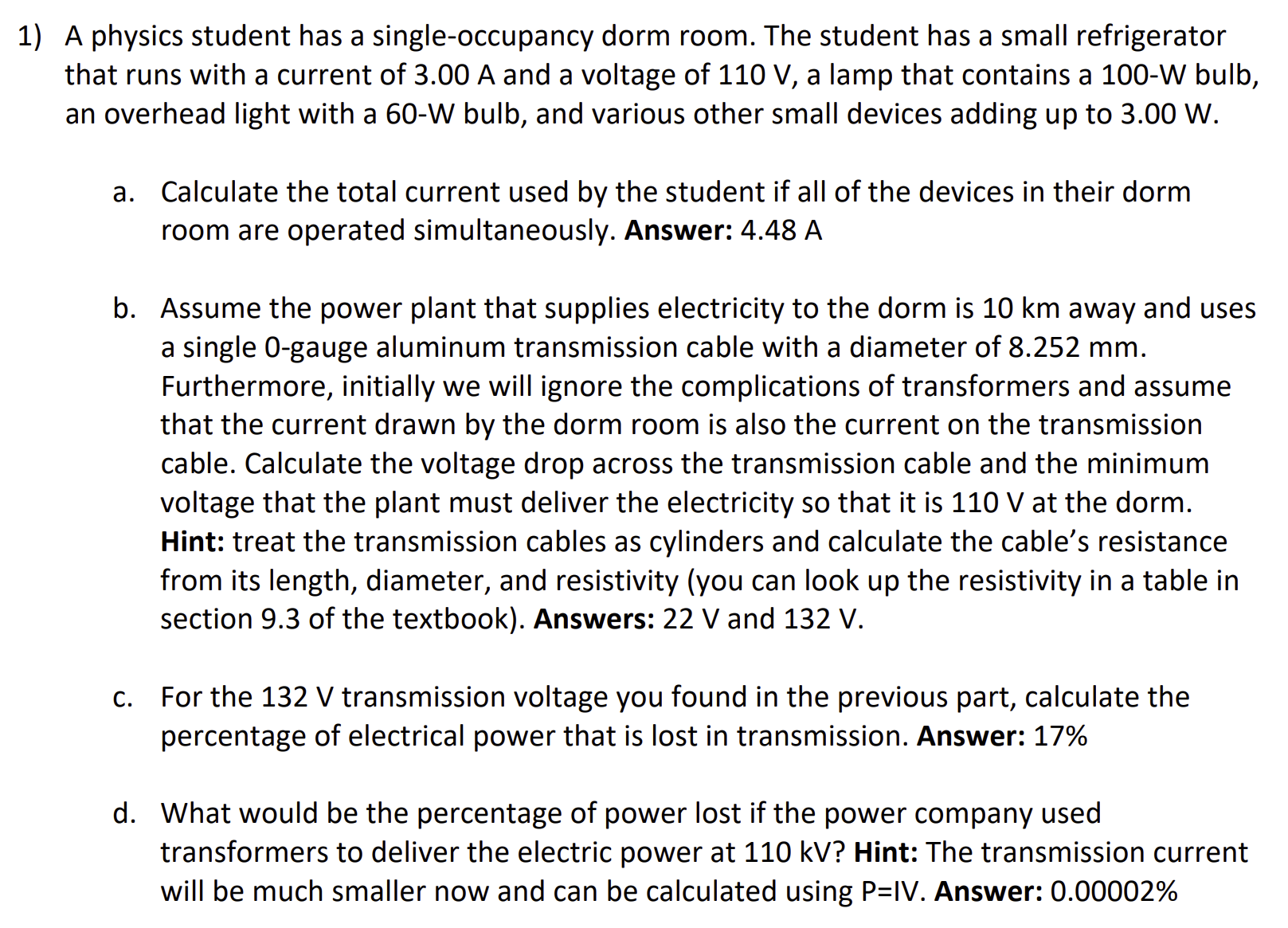
Question: ( Looking for the step by step problem solving to get these answers ) A physics student has a single - occupancy dorm room. The
Looking for the step by step problem solving to get these answersA physics student has a singleoccupancy dorm room. The student has a small refrigerator
that runs with a current of A and a voltage of a lamp that contains a bulb,
an overhead light with a W bulb, and various other small devices adding up to
a Calculate the total current used by the student if all of the devices in their dorm
room are operated simultaneously. Answer:
b Assume the power plant that supplies electricity to the dorm is away and uses
a single gauge aluminum transmission cable with a diameter of
Furthermore, initially we will ignore the complications of transformers and assume
that the current drawn by the dorm room is also the current on the transmission
cable. Calculate the voltage drop across the transmission cable and the minimum
voltage that the plant must deliver the electricity so that it is at the dorm.
Hint: treat the transmission cables as cylinders and calculate the cable's resistance
from its length, diameter, and resistivity you can look up the resistivity in a table in
section of the textbook Answers: and
c For the transmission voltage you found in the previous part, calculate the
percentage of electrical power that is lost in transmission. Answer:
d What would be the percentage of power lost if the power company used
transformers to deliver the electric power at Hint: The transmission current
will be much smaller now and can be calculated using PIV Answer:
Step by Step Solution
There are 3 Steps involved in it
1 Expert Approved Answer
Step: 1 Unlock

Question Has Been Solved by an Expert!
Get step-by-step solutions from verified subject matter experts
Step: 2 Unlock
Step: 3 Unlock
 Study Help