







Question: Looking for tutor who are knowledgeable explained very well every slide of my report. (your own opinion) Must be brief explanation but concise. No google
Looking for tutor who are knowledgeable explained very well every slide of my report. (your own opinion) Must be brief explanation but concise. No google translateo google or paraphrase must be knowledgeable on this topic please. (TAGALOG AND ENGLISH TAGLISH EXPLANATION)
This is 11 slides.
Please serious on this. ?
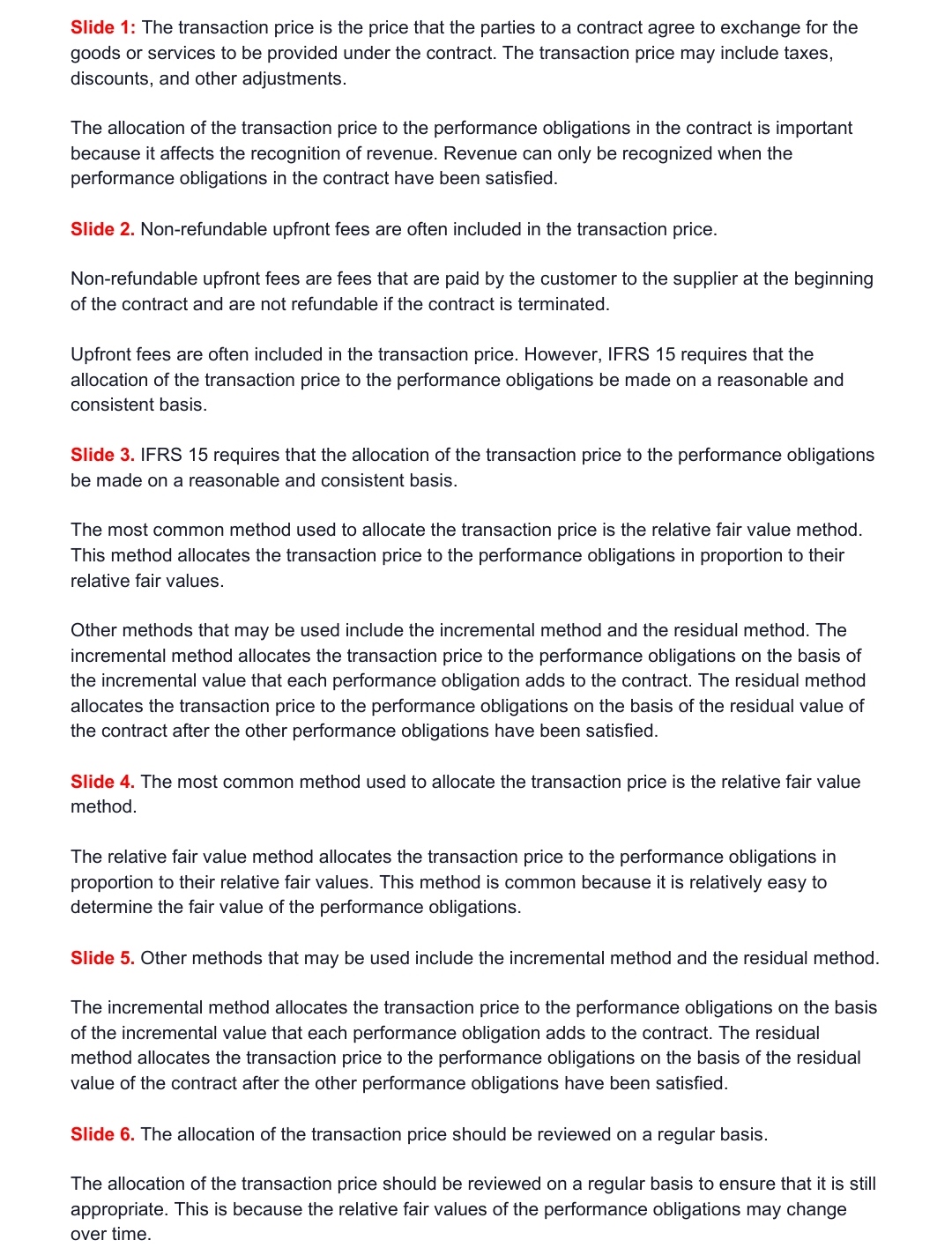
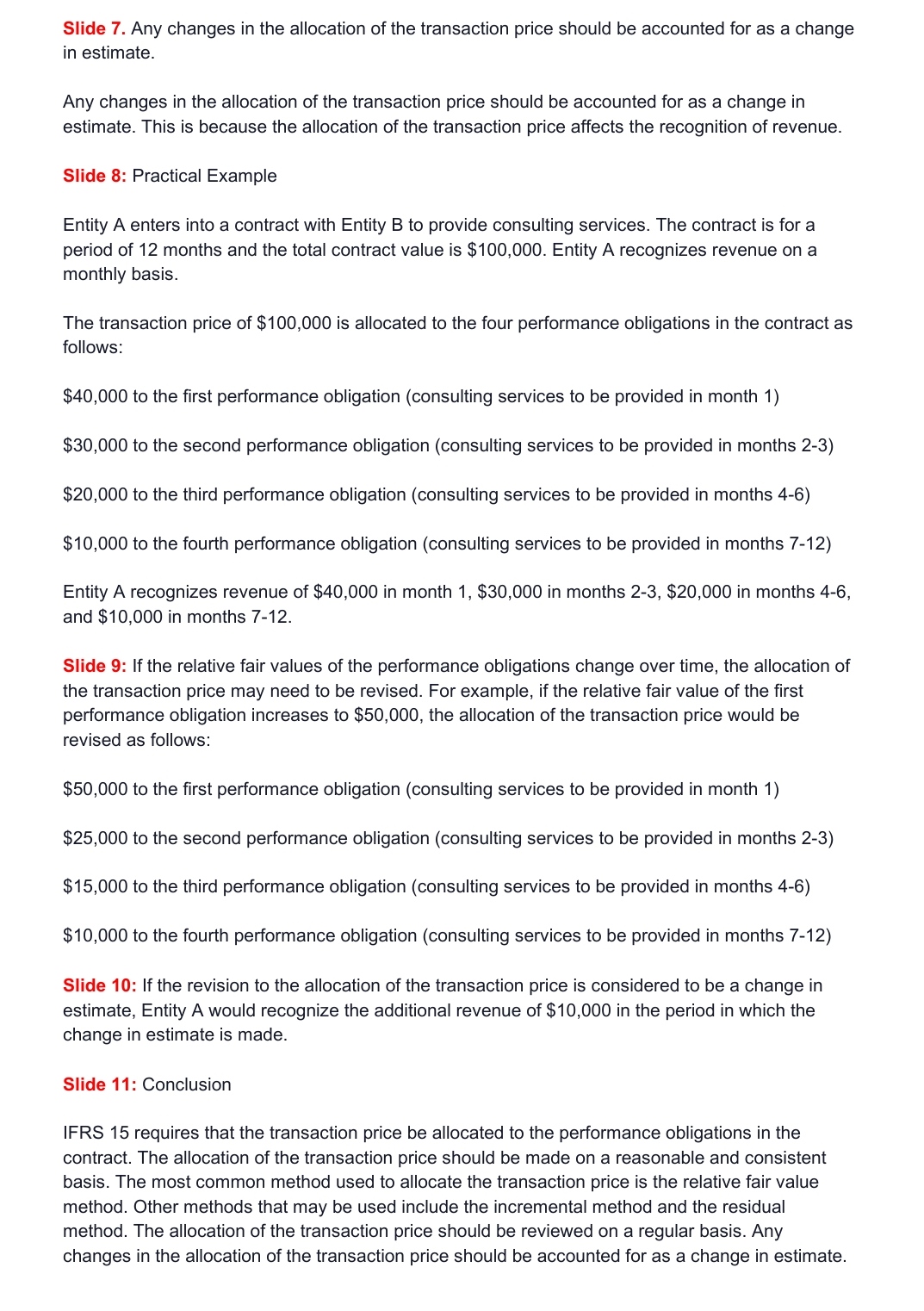
Slide 1: The transaction price is the price that the parties to a contract agree to exchange for the goods or services to be provided under the contract. The transaction price may include taxes, discounts, and other adjustments. The allocation of the transaction price to the performance obligations in the contract is important because it affects the recognition of revenue. Revenue can only be recognized when the performance obligations in the contract have been satised. Slide 2. Non-refundable upfront fees are often included in the transaction price. Non-refundable upfront fees are fees that are paid by the customer to the supplier at the beginning of the contract and are not refundable if the contract is terminated. Upfront fees are often included in the transaction price. However, IFRS 15 requires that the allocation of the transaction price to the performance obligations be made on a reasonable and consistent basis. Slide 3. IFRS 15 requires that the allocation of the transaction price to the performance obligations be made on a reasonable and consistent basis. The most common method used to allocate the transaction price is the relative fair value method. This method allocates the transaction price to the performance obligations in proportion to their relative fair values. Other methods that may be used include the incremental method and the residual method. The incremental method allocates the transaction price to the performance obligations on the basis of the incremental value that each performance obligation adds to the contract. The residual method allocates the transaction price to the performance obligations on the basis of the residual value of the contract after the other performance obligations have been satised. Slide 4. The most common method used to allocate the transaction price is the relative fair value method. The relative fair value method allocates the transaction price to the performance obligations in proportion to their relative fair values. This method is common because it is relatively easy to determine the fair value of the performance obligations. Slide 5. Other methods that may be used include the incremental method and the residual method. The incremental method allocates the transaction price to the performance obligations on the basis of the incremental value that each performance obligation adds to the contract. The residual method allocates the transaction price to the performance obligations on the basis of the residual value of the contract after the other performance obligations have been satised. Slide 6. The allocation of the transaction price should be reviewed on a regular basis. The allocation of the transaction price should be reviewed on a regular basis to ensure that it is still appropriate. This is because the relative fair values of the performance obligations may change over time. Slide 7. Any changes in the allocation of the transaction price should be accounted for as a change in estimate. Any changes in the allocation of the transaction price should be accounted for as a change in estimate. This is because the allocation of the transaction price affects the recognition of revenue. Slide 8: Practical Example Entity A enters into a contract with Entity B to provide consulting services. The contract is for a period of 12 months and the total contract value is $100,000. Entity A recognizes revenue on a monthly basis. The transaction price of $100,000 is allocated to the four performance obligations in the contract as follows: $40,000 to the rst performance obligation (consulting services to be provided in month 1) $30,000 to the second performance obligation (consulting services to be provided in months 2-3) $20,000 to the third performance obligation (consulting services to be provided in months 4-6) $10,000 to the fourth performance obligation (consulting services to be provided in months 7-12) Entity A recognizes revenue of $40,000 in month 1, $30,000 in months 2-3, $20,000 in months 4-6, and $10,000 in months 7-12. Slide 9: If the relative fair values of the performance obligations change over time, the allocation of the transaction price may need to be revised. For example, if the relative fair value of the rst performance obligation increases to $50,000, the allocation of the transaction price would be revised as follows: $50,000 to the rst performance obligation (consulting services to be provided in month 1) $25,000 to the second performance obligation (consulting services to be provided in months 2-3) $15,000 to the third performance obligation (consulting services to be provided in months 4-6) $10,000 to the fourth performance obligation (consulting services to be provided in months 7-12) Slide 10: If the revision to the allocation of the transaction price is considered to be a change in estimate, Entity A would recognize the additional revenue of $10,000 in the period in which the change in estimate is made. Slide 11: Conclusion IFRS 15 requires that the transaction price be allocated to the performance obligations in the contract. The allocation of the transaction price should be made on a reasonable and consistent basis. The most common method used to allocate the transaction price is the relative fair value method. Other methods that may be used include the incremental method and the residual method. The allocation of the transaction price should be reviewed on a regular basis. Any changes in the allocation of the transaction price should be accounted for as a change in estimate
Step by Step Solution
There are 3 Steps involved in it

Get step-by-step solutions from verified subject matter experts
 Study Help