







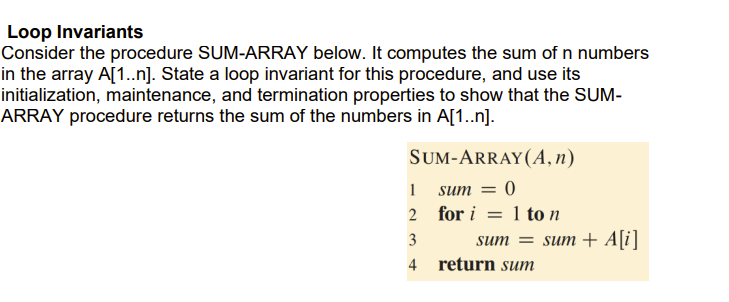
Question: Loop Invariants Consider the procedure SUM-ARRAY below. It computes the sum of n numbers n the array A[1..n]. State a loop invariant for this procedure,
![of n numbers n the array A[1..n]. State a loop invariant for](https://dsd5zvtm8ll6.cloudfront.net/si.experts.images/questions/2024/09/66e3c82b91ebc_94766e3c82b16a28.jpg)
Loop Invariants Consider the procedure SUM-ARRAY below. It computes the sum of n numbers n the array A[1..n]. State a loop invariant for this procedure, and use its nitialization, maintenance, and termination properties to show that the SUMARRAY procedure returns the sum of the numbers in A[1..n]. SUM-ARRAY(A,n)1sum=0fori=1tonsum=sum+A[i]returnsum Inversions and Insertion-Sort Consider the insertion-sort algorithm given below (from CLRS): INSERTION-SORT (A,n) 12345678fori=2tonkey=A[i]//InsertA[i]intothesortedsubarrayA[1:i1].j=i1whilej>0andA[j]>keyA[j+1]=A[j]j=j1A[j+1]=key Let A[1..n] be an array of n distinct numbers. If I
Step by Step Solution
There are 3 Steps involved in it

Get step-by-step solutions from verified subject matter experts
 Study Help