







Question: lord - Hom... 2 3 80% Problem 1.6 Consider a thermodynamic process performed on one mole of an ideal gas that consists of two steps:
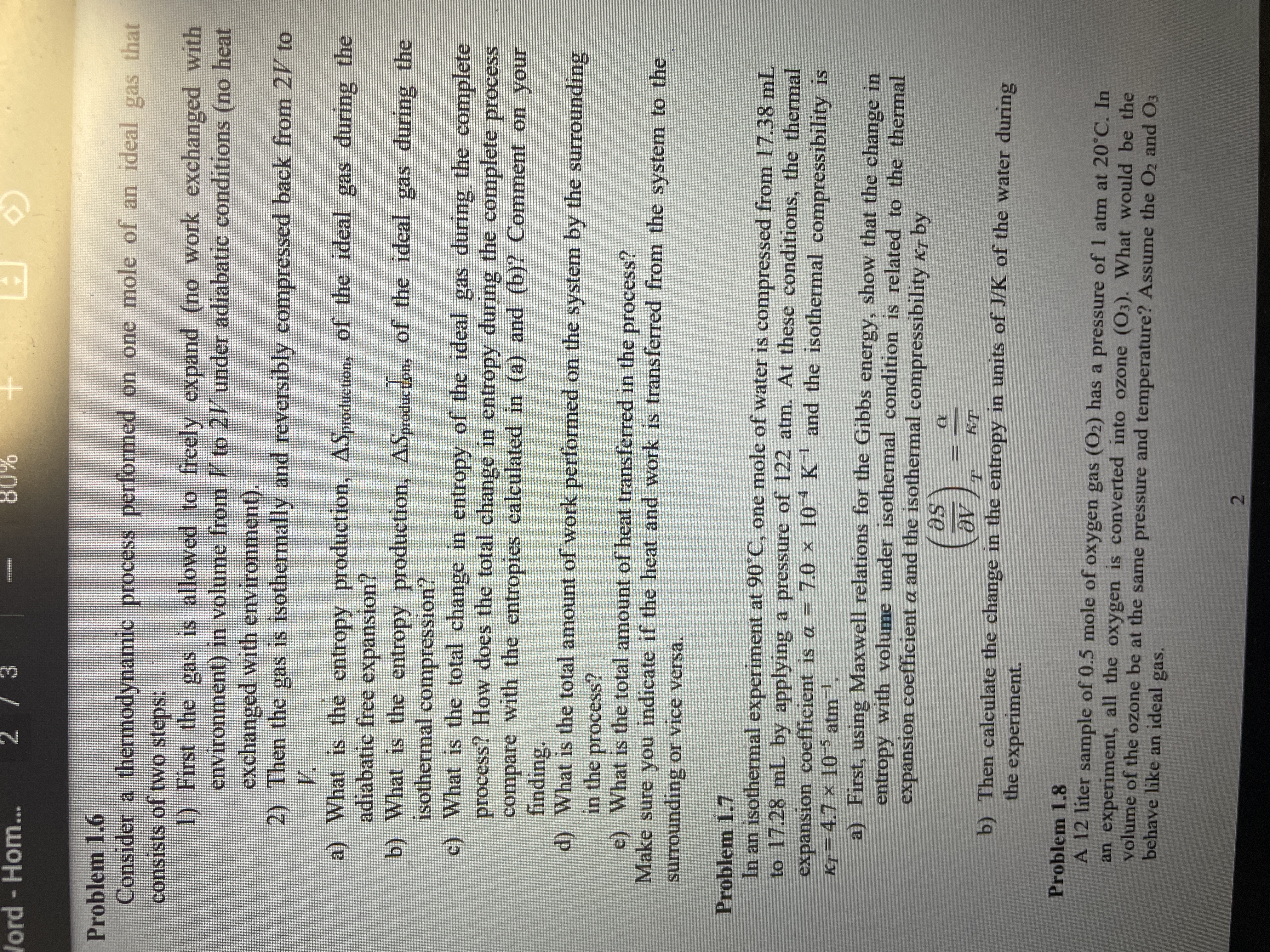
lord - Hom... 2 3 80% Problem 1.6 Consider a thermodynamic process performed on one mole of an ideal gas that consists of two steps: 1) First the gas is allowed to freely expand (no work exchanged with environment) in volume from / to 21 under adiabatic conditions (no heat exchanged with environment). 2) Then the gas is isothermally and reversible compressed back from 21 to a) What is the entropy production, ASproduction, of the ideal gas during the adiabatic free expansion? b) What is the entropy production, ASproduction, of the ideal gas during the isothermal compression? c) What is the total change in entropy of the ideal gas during the complete process? How does the total change in entropy during the complete process compare with the entropies calculated in (a) and (b)? Comment on your finding. d) What is the total amount of work performed on the system by the surrounding in the process? e) What is the total amount of heat transferred in the process? Make sure you indicate if the heat and work is transferred from the system to the surrounding or vice versa. Problem 1.7 In an isothermal experiment at 90'C, one mole of water is compressed from 17.38 mL to 17.28 mL by applying a pressure of 122 atm. At these conditions, the thermal expansion coefficient is a = 7.0 x 10 * K and the isothermal compressibility is KT = 4.7 x 10 5 atm-1. a) First, using Maxwell relations for the Gibbs energy, show that the change in entropy with volume under isothermal condition is related to the thermal expansion coefficient a and the isothermal compressibility ky by as av KT b) Then calculate the change in the entropy in units of J/K of the water during the experiment. Problem 1.8 A 12 liter sample of 0.5 mole of oxygen gas (O2) has a pressure of 1 atm at 20 C. In an experiment, all the oxygen is converted into ozone (03). What would be the volume of the ozone be at the same pressure and temperature? Assume the O2 and O3 behave like an ideal gas
Step by Step Solution
There are 3 Steps involved in it

Get step-by-step solutions from verified subject matter experts
 Study Help