





Question: lQuestion :- For this assignment you have to perform Matrix operations (Addition, Subtraction, Multiplication, Determinant, Transpose and Inverse]. For each of the above mentioned operation
lQuestion :- For this assignment you have to
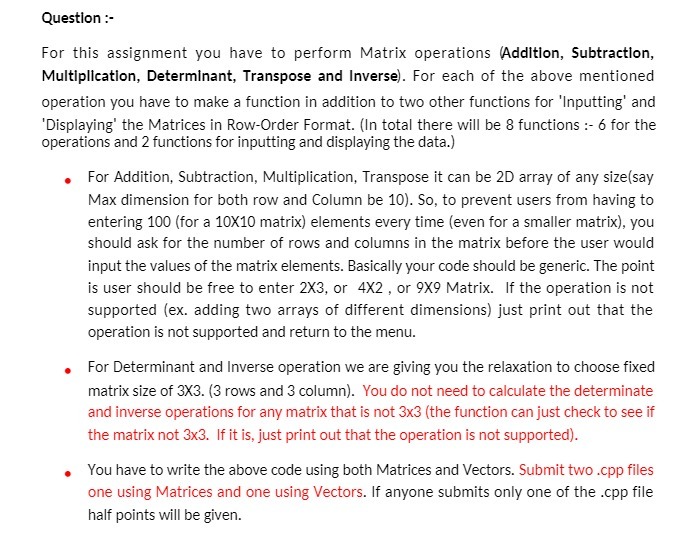
lQuestion :- For this assignment you have to perform Matrix operations (Addition, Subtraction, Multiplication, Determinant, Transpose and Inverse]. For each of the above mentioned operation you have to make a function in addition to two other functions for 'Inputting' and 'Displaying' the Matrices in RowOrder Format. [In total there will be 8 functions : a for the operations and 2 functions for inputting and displaying the data.) For Addition, Subtraction, Multiplication, Transpose it can be 2D array of any sizeisay Max dimension for both row and Column be 1D}. So, to prevent users from haying to entering 100 {for a 1DK1D matrix} elements every time [even for a smaller matrix}, you should ask for the number of rows and columns in the matrix before the user would input the values of the matrix elements. Basically your code should be generic. The point is user should be free to enter 21423, or 43112 , or 9K9 Matrix. If the operation is not supported {ex. adding two arrays of different dimensions} just print out that the operation is not supported and return to the menu. For Determinant and Inverse operation we are giving you the relaxation to choose fixed matrix size of 31423. {3 rows and 3 column}. You do not need to calculate the determinate and inverse operations for any matrix that is not 3x3 {the function can just check to see if the matrix not 3x3. If it is, just print out that the operation is not supported). You have to write the above code using both Matrices and 1|.l'ectors. Submit two .cpp files one using Matrices and one using Vectors. If anyone submits only one of the .cpp file half points will be given

Step by Step Solution

There are 3 Steps involved in it

1 Expert Approved Answer
Step: 1 Unlock blur-text-image

Question Has Been Solved by an Expert!

Get step-by-step solutions from verified subject matter experts

Step: 2 Unlock
Step: 3 Unlock

Students Have Also Explored These Related Mathematics Questions!