







Question: LSAT PREP 101 Section 1 Your repTest 101 / Section 1 Directions Passage Only View Find Text. Type Here U DDP AA =Section Time Remaining:
LSAT PREP 101 Section 1
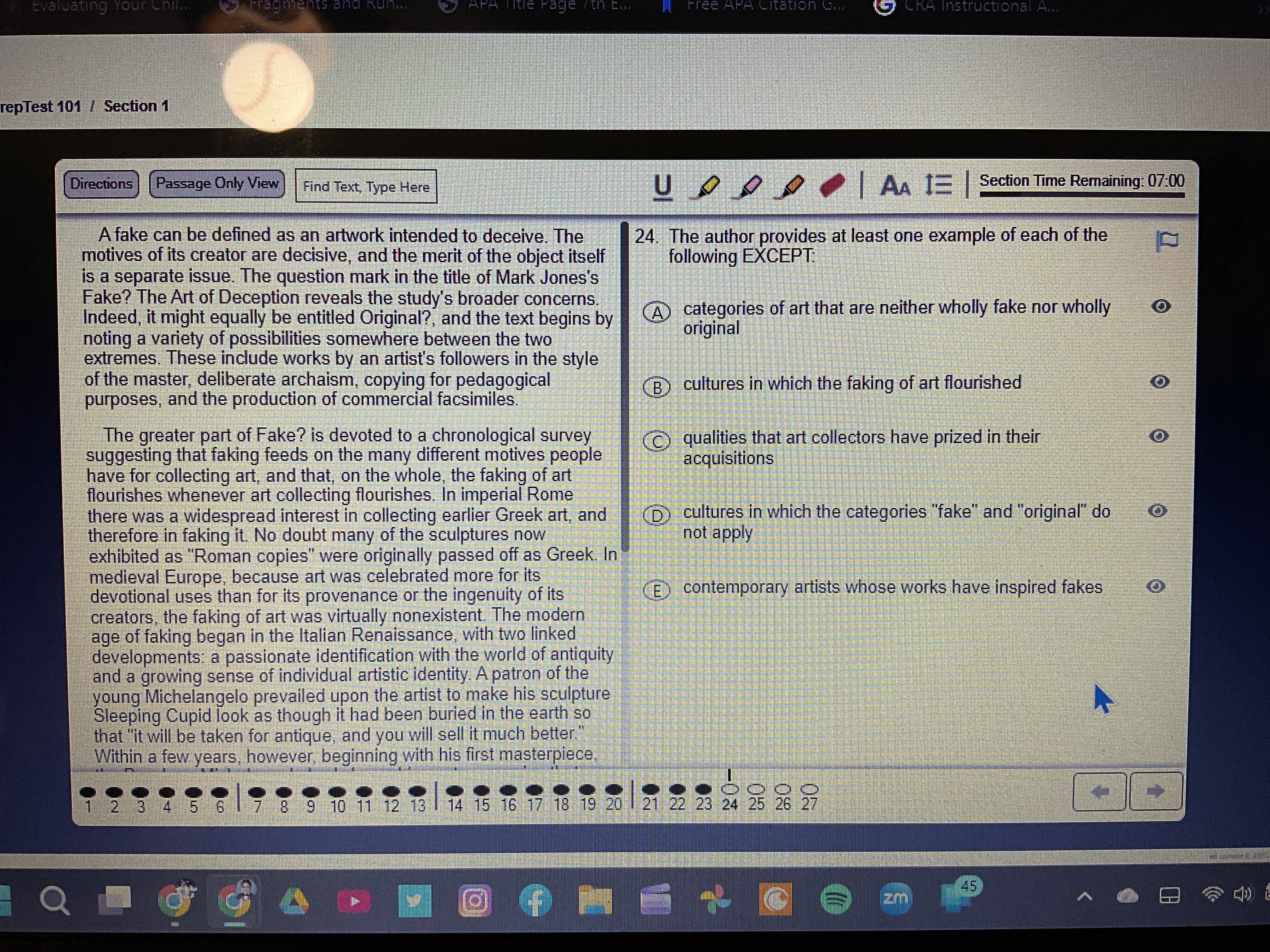 Your repTest 101 / Section 1 Directions Passage Only View Find Text. Type Here U DDP AA =Section Time Remaining: 07:00 A fake can be defined as an artwork intended to deceive. The 24. The author provides at least one example of each of the motives of its creator are decisive, and the merit of the object itself following EXCEPT: is a separate issue. The question mark in the title of Mark Jones's Fake? The Art of Deception reveals the study's broader concerns. Indeed, it might equally be entitled Original?, and the text begins by A categories of art that are neither wholly fake nor wholly O noting a variety of possibilities somewhere between the two original extremes. These include works by an artist's followers in the style of the master, deliberate archaism, copying for pedagogical B cultures in which the faking of art flourished O purposes, and the production of commercial facsimiles. The greater part of Fake? is devoted to a chronological survey qualities that art collectors have prized in their O suggesting that faking feeds on the many different motives people acquisitions have for collecting art, and that, on the whole, the faking of art flourishes whenever art collecting flourishes. In imperial Rome there was a widespread interest in collecting earlier Greek art, and D cultures in which the categories "fake" and "original" do O therefore in faking it. No doubt many of the sculptures now not apply exhibited as "Roman copies" were originally passed off as Greek. In medieval Europe, because art was celebrated more for its devotional uses than for its provenance or the ingenuity of its E contemporary artists whose works have inspired fakes O creators, the faking of art was virtually nonexistent. The modern age of faking began in the Italian Renaissance, with two linked developments: a passionate identification with the world of antiquity and a growing sense of individual artistic identity. A patron of the young Michelangelo prevailed upon the artist to make his sculpture Sleeping Cupid look as though it had been buried in the earth so that "it will be taken for antique, and you will sell it much better." Within a few years, however, beginning with his first masterpiece. 21 22 23 242 15 26 NO Q OF O 45
Step by Step Solution
There are 3 Steps involved in it
1 Expert Approved Answer
Step: 1 Unlock

Question Has Been Solved by an Expert!
Get step-by-step solutions from verified subject matter experts
Step: 2 Unlock
Step: 3 Unlock
 Study Help