



Question: M 8.6 & M 8.8: compute 50 samples instead of 20. M 8.10 Write MATLAB code to implement the algorithm of Eq. (8.102) to compute
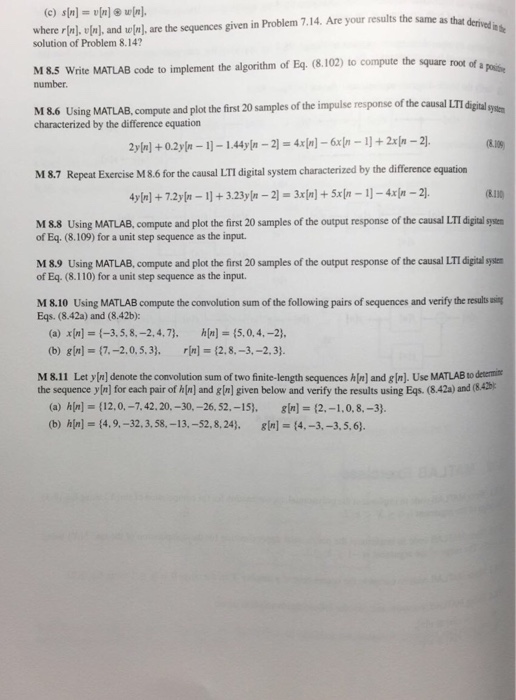
Write MATLAB code to implement the algorithm of Eq. (8.102) to compute the squareroot of a positive number. Using MATLAB, compute and plot the first 20 samples of the impulse response of the causal LTI digital system characterized by the difference equation 2y[n] + 0.2y[n - 1] - 1.44y[n - 2] = 4x[n] - 6x[n - 1] + 2x[n - 2]. Repeat Exercise M8.6 for the causal LTI digital system characterized by the difference equation. 4y[n] + 7.2y[n - 1] + 3.23y[n - 2] = 3x[n] + 5x[n - 1] - 4x[n - 2]. Using MATLAB, compute and plot the first 20 samples of the output response of the causal LTI digital of Eq. (8.109) for a unit step sequence as the input. Using MATLAB, compute and plot the first 20 samples of the output response of the causal LTI digital system of Eq. (8.110) for a unit step sequence as the input. Using MATLAB compute the convolution sum of the following pairs of sequences and verify the results using Eqs. (8.42a) and (8.42b): (a) x[n] = {-3, 5, 8, -2, 4, 7} h[n] = {5, 0, 4 - 2}, (b) g[n] = {7, -2, 0, 5, 3} r[n] = {2, 8, -3, -2, 3}. Let y[n] denote the convolution sum of two finite-length sequences h[n] and g[n]. Use MATLAB to determine the sequence y[n] for each pair of h[n] and g[n] given below and verify the results using Eqs. (8.42a) and (8.42b): (a) h[n] = {12, 0, -7, 42, 20, -30, -26, 52, 15} g[n] = {2, -1, 0, 8, -3}. (b) h[n] = (4, 9, -32, 3, 58, -13, 52, 8, 24}, g[n] = {4, -3, -3, 5, 6}
Step by Step Solution
There are 3 Steps involved in it

Get step-by-step solutions from verified subject matter experts