Question: m Assignment PDP P2 ch6.pdf C Get Homework Help With Chego X G How do factor conditions differ + - 2 Q 3 0 File
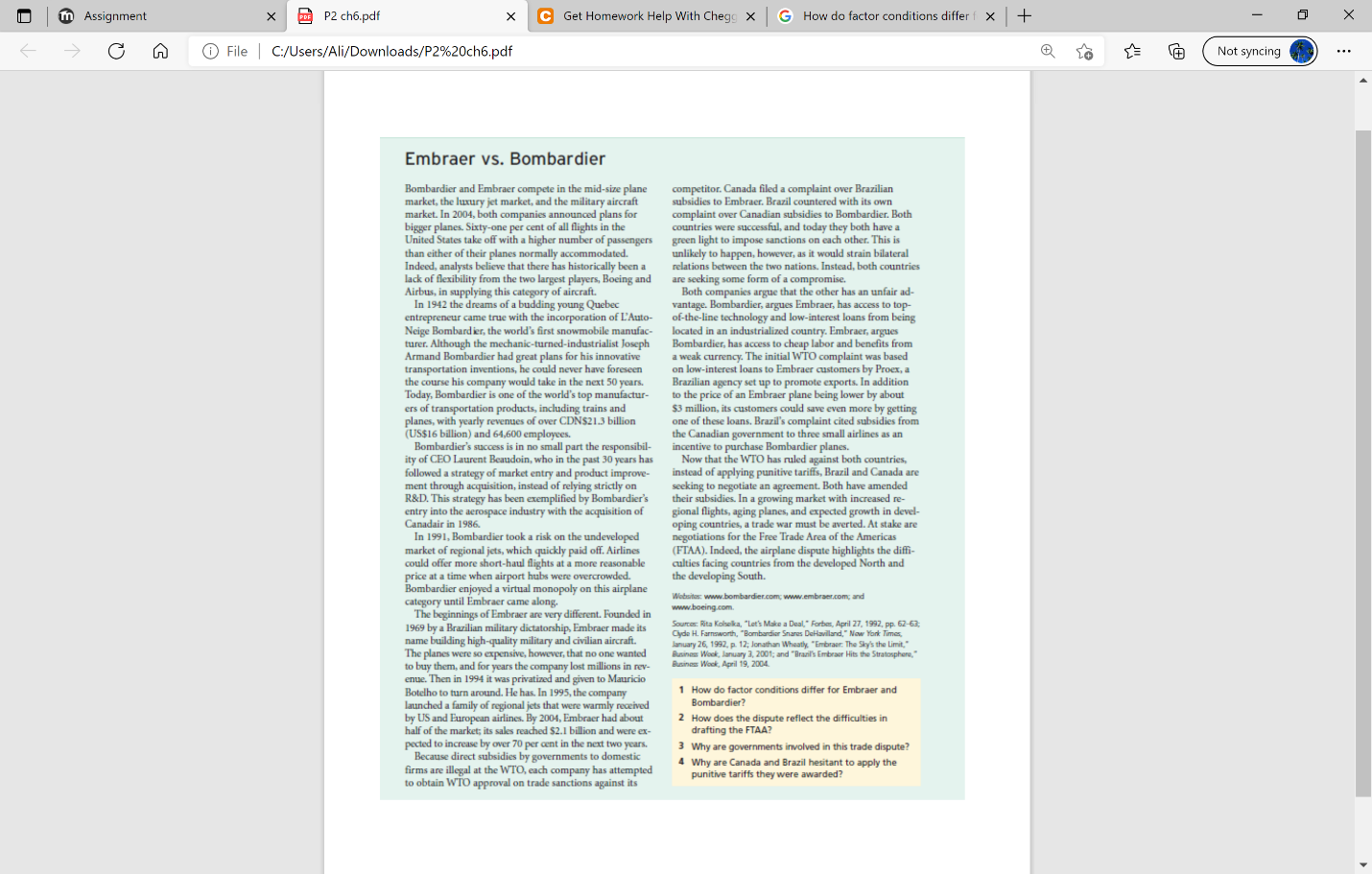
m Assignment PDP P2 ch6.pdf C Get Homework Help With Chego X G How do factor conditions differ + - 2 Q 3 0 File C:/Users/Ali/Downloads/P2%20ch6.pdf of Not syncing Embraer vs. Bombardier Bombardier and Embraer compete in the mid-size plane market, the luxury jet market, and the military aircraft market. In 2004, both companies announced plans for bigger planes. Sixty-one per cent of all flights in the United States take off with a higher number of passengers than either of their planes normally accommodated. Indeed, analysts believe that there has historically been a lack of flexibility from the two largest players, Boeing and Airbus, in supplying this category of aircraft In 1942 the dreams of a budding young Quebec entrepreneur came true with the incorporation of L'Auto- Neige Bombardier, the world's first snowmobile manufac- turer. Although the mechanic-turned-industrialist Joseph Armand Bombardier had great plans for his innovative transportation inventions, he could never have foreseen the course his company would take in the next 50 years. Today, Bombardier is one of the world's top manufactur- ers of transportation products, including trains and planes, with yearly revenues of over CDNS21.3 billion (US$16 billion) and 64,600 employees. Bombardier's success is in no small part the responsibil- ity of CEO Laurent Beaudoin, who in the past 30 years has followed a strategy of market entry and product improve ment through acquisition, instead of relying strictly on R&D. This strategy has been exemplified by Bombardier's entry into the aerospace industry with the acquisition of Canadair in 1986 In 1991, Bombardier took a risk on the undeveloped market of regional jets, which quickly paid off. Airlines could offer more short-haul flights at a more reasonable price at a time when airport hubs were overcrowded. Bombardier enjoyed a virtual monopoly on this airplane category until Embraer came along, The beginnings of Embraer are very different. Founded in 1969 by a Brazilian military dictatorship, Embraer made its name building high-quality military and civilian aircraft. The planes were so expensive, however, that no one wanted to buy them, and for years the company lost millions in rev- enue. Then in 1994 it was privatized and given to Mauricio Botelho to turn around. He has. In 1995, the company launched a family of regional jets that were warmly received by US and European airlines. By 2004, Embraer had about half of the market; its sales reached $2.1 billion and were ex- pected to increase by over 70 per cent in the next two years. Because direct subsidies by governments to domestic firms are illegal at the WTO, each company has attempted to obtain WTO approval on trade sanctions against its competitor. Canada filed a complaint over Brazilian subsidies to Embraer. Brazil countered with its own complaint over Canadian subsidies to Bombardier. Both countries were successful, and today they both have a green light to impose sanctions on each other. This is unlikely to happen, however, as it would strain bilateral relations between the two nations. Instead, both countries are seeking some form of a compromise. Both companies argue that the other has an unfair ad- vantage. Bombardier, argues Embraer, has access to top- of-the-line technology and low-interest loans from being located in an industrialized country. Embraer, argues Bombardier, has access to cheap labor and benefits from a weak currency. The initial WTO complaint was based on low-interest loans to Embraer customers by Proex, a Brazilian agency set up to promote exports. In addition to the price of an Embraer plane being lower by about $3 million, its customers could save even more by getting one of these loans. Brazil's complaint cited subsidies from the Canadian government to three small airlines as an incentive to purchase Bombardier planes. Now that the WTO has ruled against both countries, instead of applying punitive tariffs, Brazil and Canada are seeking to negotiate an agreement. Both have amended their subsidies. In a growing market with increased re- gional flights, aging planes, and expected growth in devel- oping countries, a trade war must be averted. At stake are negotiations for the Free Trade Area of the Americas (FTAA). Indeed, the airplane dispute highlights the diffi- culties facing countries from the developed North and the developing South Website: www.bombardier.com, www.embraer.com and www.boeing.com Source: Rita Kolska, "Let's Make a Deal, Forbes, April 27, 1992, pp. 62-63 Clyde H. Farnsworth, "Bombardier Shares De Havilland." Now York Times, January 26, 1992, p. 12; Jonathan Wheatly. "Embraer: The Sky's the limit," Business Wook, January 2, 2001; and "Brazil's Embraer Hits the Stratosphere, Business Wook, April 19, 2004 1 How do factor conditions differ for Embraer and Bombardier? 2 How does the dispute reflect the difficulties in drafting the FTAA? 3 Why are governments involved in this trade dispute? 4 Why are Canada and Brazil hesitant to apply the punitive tariffs they were awarded? m Assignment PDP P2 ch6.pdf C Get Homework Help With Chego X G How do factor conditions differ + - 2 Q 3 0 File C:/Users/Ali/Downloads/P2%20ch6.pdf of Not syncing Embraer vs. Bombardier Bombardier and Embraer compete in the mid-size plane market, the luxury jet market, and the military aircraft market. In 2004, both companies announced plans for bigger planes. Sixty-one per cent of all flights in the United States take off with a higher number of passengers than either of their planes normally accommodated. Indeed, analysts believe that there has historically been a lack of flexibility from the two largest players, Boeing and Airbus, in supplying this category of aircraft In 1942 the dreams of a budding young Quebec entrepreneur came true with the incorporation of L'Auto- Neige Bombardier, the world's first snowmobile manufac- turer. Although the mechanic-turned-industrialist Joseph Armand Bombardier had great plans for his innovative transportation inventions, he could never have foreseen the course his company would take in the next 50 years. Today, Bombardier is one of the world's top manufactur- ers of transportation products, including trains and planes, with yearly revenues of over CDNS21.3 billion (US$16 billion) and 64,600 employees. Bombardier's success is in no small part the responsibil- ity of CEO Laurent Beaudoin, who in the past 30 years has followed a strategy of market entry and product improve ment through acquisition, instead of relying strictly on R&D. This strategy has been exemplified by Bombardier's entry into the aerospace industry with the acquisition of Canadair in 1986 In 1991, Bombardier took a risk on the undeveloped market of regional jets, which quickly paid off. Airlines could offer more short-haul flights at a more reasonable price at a time when airport hubs were overcrowded. Bombardier enjoyed a virtual monopoly on this airplane category until Embraer came along, The beginnings of Embraer are very different. Founded in 1969 by a Brazilian military dictatorship, Embraer made its name building high-quality military and civilian aircraft. The planes were so expensive, however, that no one wanted to buy them, and for years the company lost millions in rev- enue. Then in 1994 it was privatized and given to Mauricio Botelho to turn around. He has. In 1995, the company launched a family of regional jets that were warmly received by US and European airlines. By 2004, Embraer had about half of the market; its sales reached $2.1 billion and were ex- pected to increase by over 70 per cent in the next two years. Because direct subsidies by governments to domestic firms are illegal at the WTO, each company has attempted to obtain WTO approval on trade sanctions against its competitor. Canada filed a complaint over Brazilian subsidies to Embraer. Brazil countered with its own complaint over Canadian subsidies to Bombardier. Both countries were successful, and today they both have a green light to impose sanctions on each other. This is unlikely to happen, however, as it would strain bilateral relations between the two nations. Instead, both countries are seeking some form of a compromise. Both companies argue that the other has an unfair ad- vantage. Bombardier, argues Embraer, has access to top- of-the-line technology and low-interest loans from being located in an industrialized country. Embraer, argues Bombardier, has access to cheap labor and benefits from a weak currency. The initial WTO complaint was based on low-interest loans to Embraer customers by Proex, a Brazilian agency set up to promote exports. In addition to the price of an Embraer plane being lower by about $3 million, its customers could save even more by getting one of these loans. Brazil's complaint cited subsidies from the Canadian government to three small airlines as an incentive to purchase Bombardier planes. Now that the WTO has ruled against both countries, instead of applying punitive tariffs, Brazil and Canada are seeking to negotiate an agreement. Both have amended their subsidies. In a growing market with increased re- gional flights, aging planes, and expected growth in devel- oping countries, a trade war must be averted. At stake are negotiations for the Free Trade Area of the Americas (FTAA). Indeed, the airplane dispute highlights the diffi- culties facing countries from the developed North and the developing South Website: www.bombardier.com, www.embraer.com and www.boeing.com Source: Rita Kolska, "Let's Make a Deal, Forbes, April 27, 1992, pp. 62-63 Clyde H. Farnsworth, "Bombardier Shares De Havilland." Now York Times, January 26, 1992, p. 12; Jonathan Wheatly. "Embraer: The Sky's the limit," Business Wook, January 2, 2001; and "Brazil's Embraer Hits the Stratosphere, Business Wook, April 19, 2004 1 How do factor conditions differ for Embraer and Bombardier? 2 How does the dispute reflect the difficulties in drafting the FTAA? 3 Why are governments involved in this trade dispute? 4 Why are Canada and Brazil hesitant to apply the punitive tariffs they were awarded









 Study Help