Question: m BD 1/24 PROJECT MUSE Indigenous Circuits: Navajo Women and the Racialization of Early Electronic Manufacture Lisa Nakamura American Quarterly, Volume 66, Number 4, December
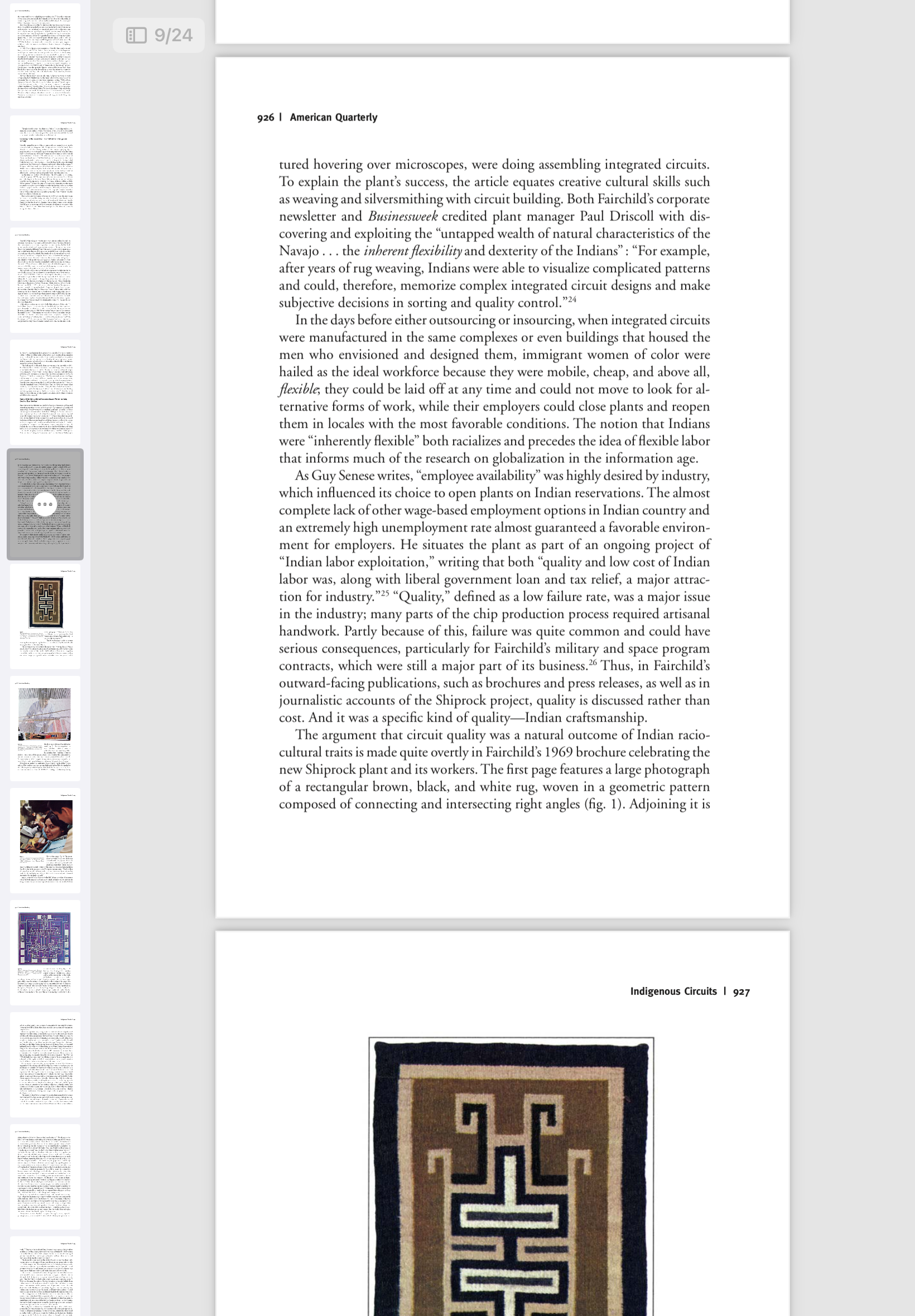
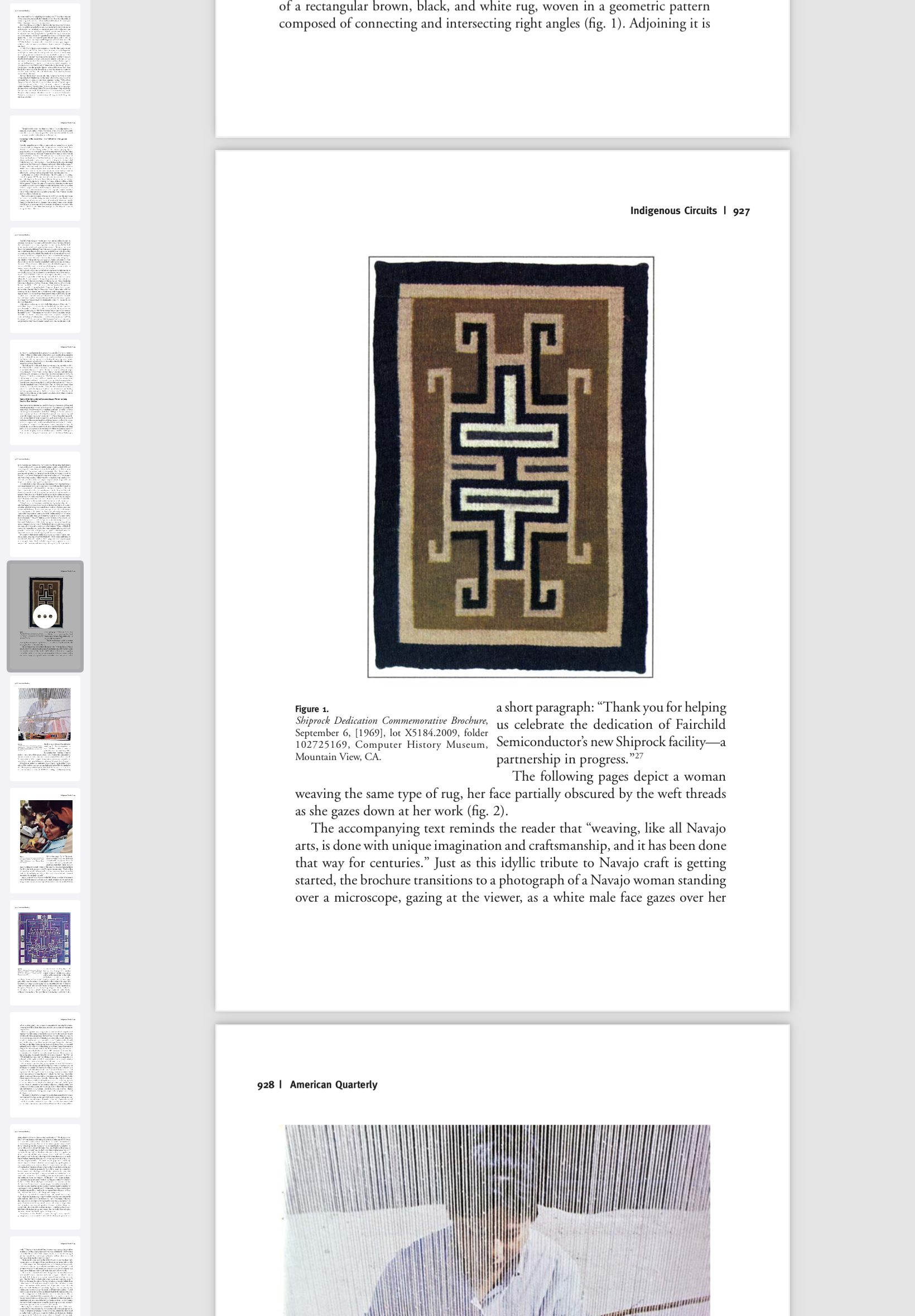
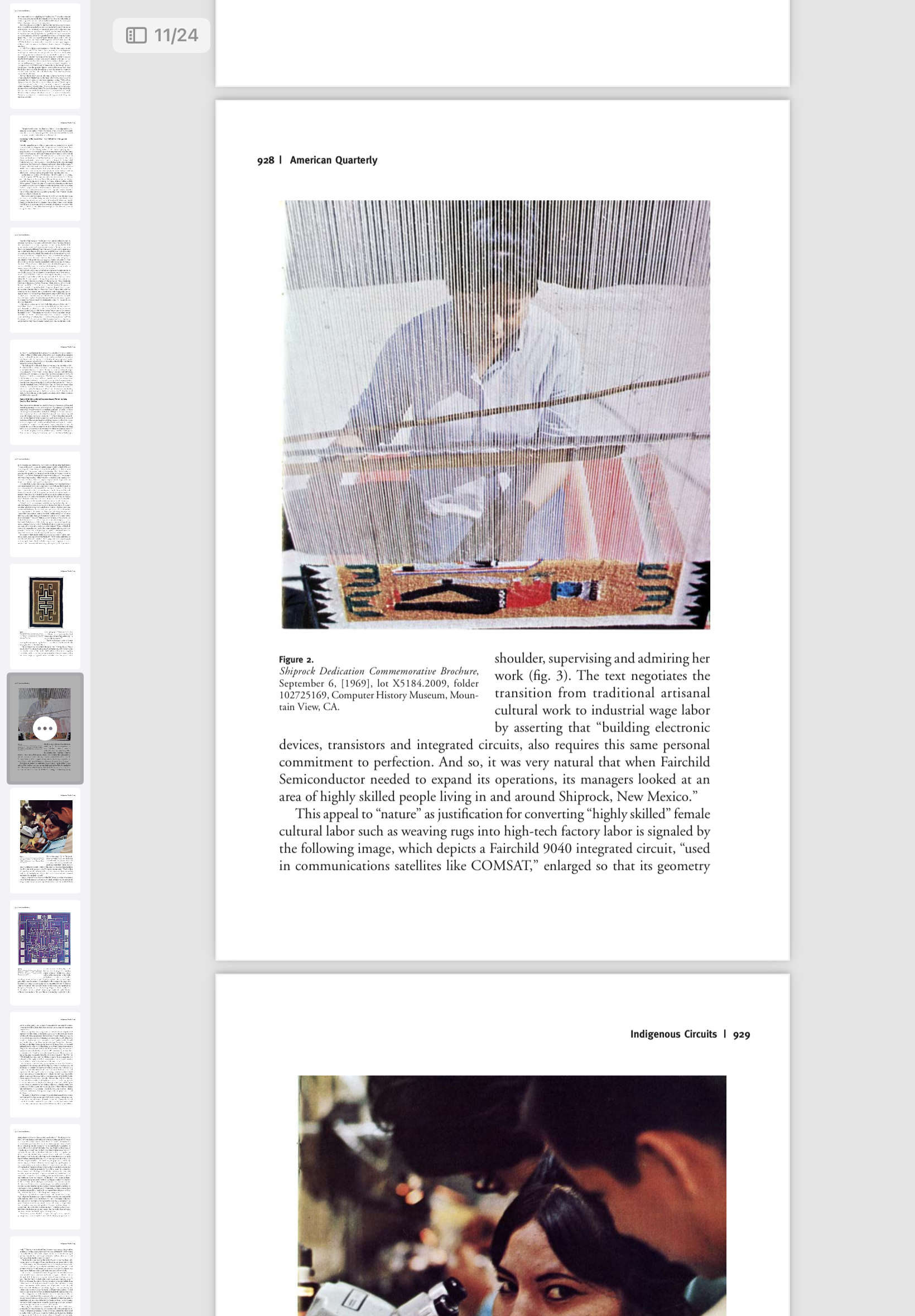
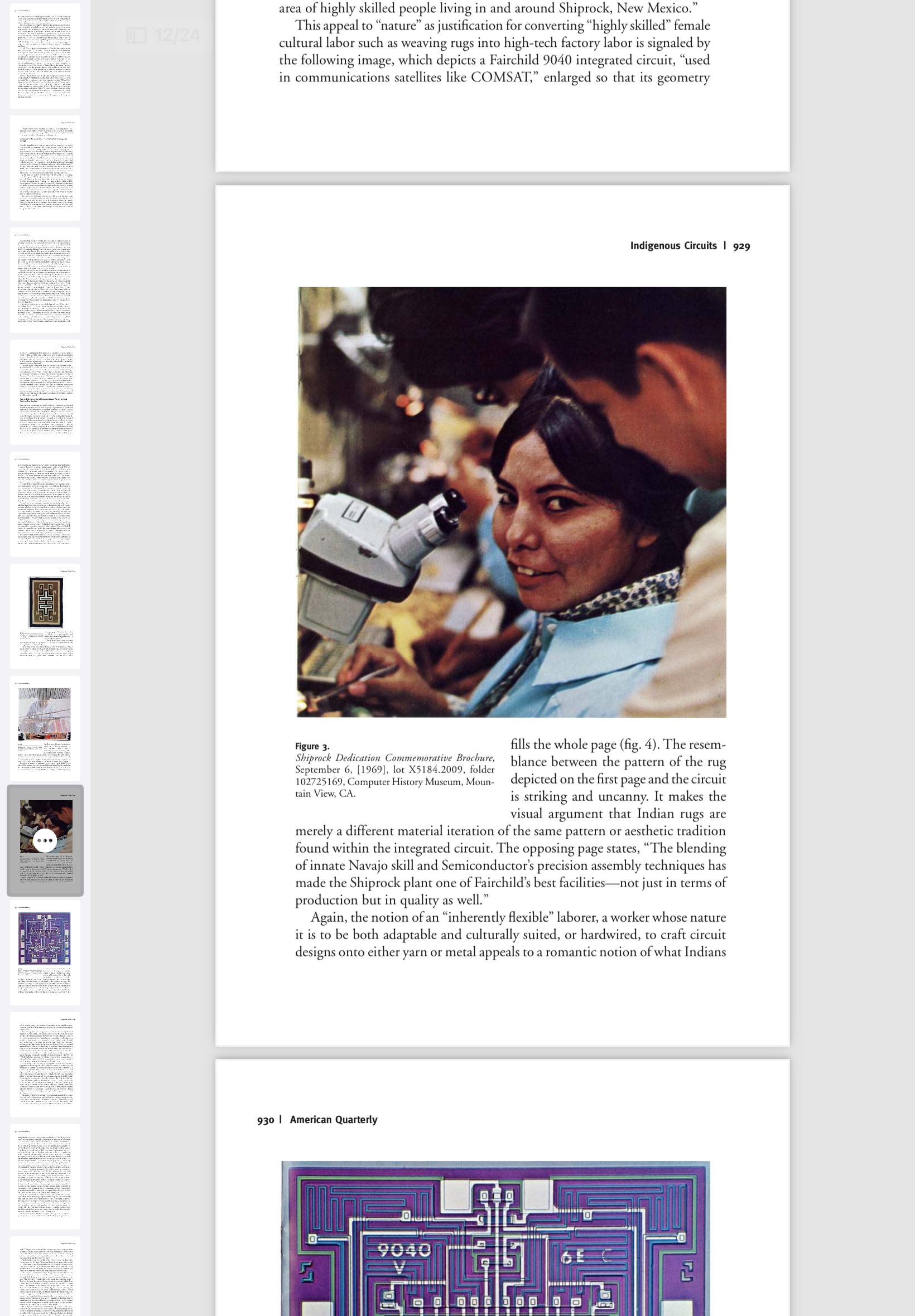
m BD 1/24 PROJECT MUSE Indigenous Circuits: Navajo Women and the Racialization of Early Electronic Manufacture Lisa Nakamura American Quarterly, Volume 66, Number 4, December 2014, pp. 919-941 (Article) Published by The Johns Hopkins University Press DOI: 10.1353/aq.2014.0070 + For additional information about this article http://muse.jhu.edu/journals/aq/summary/v066/66.4.nakamura.html Access provided by University of Michigan @ Ann Arbor (21 Jan 2015 01:32 GMT) Indigenous Circuits | 919 Indigenous Circuits: Navajo Women and the Racialization of Early Electronic Manufacture Lisa NakamuraIndigenous Circuits | 919 Indigenous Circuits: Navajo Women and the Racialization of Early Electronic Manufacture Lisa Nakamura onna Haraway's foundational cyberfeminist essay \"A Cyborg Mani- festo\" is followed by an evocative subtitle: \"An Ironic Dream of a Common Language for Women in the Integrated Circuit.\" She writes, \"The nimble fingers of 'Oriental' women, the old fascination of little Anglo-Saxon Victorian girls with doll's houses, women's enforced attention to the small take on quite new dimensions in this world. There might be a cyborg Alice taking account of these new dimensions. Ironically, it might be the un- natural cyborg women making chips in Asia and spiral dancing in Santa Rita jail whose constructed unities will guide effective oppositional strategies.\"" In this passage Haraway draws our attention to the irony that some must labor invisibly for others of us to feel, if not actually be, free and empowered through technology use: technoscience is, indeed, an integrated circuit, one that both separates and connects laborers and users, and while both genders benefit from cheap computers, it is the flexible labor of women of color, either outsourced or insourced, that made and continue to make this possible.? Haraway's critical perspective on digital technology's possibilities and op- portunities for intersectional feminism expresses itself in this essay by standing readerly expectation on its head. She wants to remind us forcefully of digital technology's costs as well as its benefits. This piece is often read as a celebra- tion of a newly extended and enhanced cyborg body, one made more powerful by technology, an understandable result given that some of the piece's most memorable quotations, such as \"I'd rather be a cyborg than a goddess,\" imply a kind of transcendence through technology use that appeals to the digitally identified. Haraway's Marxian insistence on materiality rather than just virtuality in the \"Cyborg Manifesto\"on the gendering and racializing of bodies as well as on computer hardware itselfanticipated many of the concerns at the center of media archacology and platform studies in the twenty-first century. Tiziana 2014 The American Studies Association 920 | American Quarterly Terranova, whose focus on the Internet as a site of digital labor brings us back to the material realm of bodies and exploitation, extends this interrogation into the way that labor is commodified and extracted, often without compensa- tion for the laborer, within digital culture.? For Haraway, the women of color workers who create the material circuits and other digital components that allow content to be created are all integrated within the \"circuit\" of technocul- ture. Their bodies become part of digital platforms by providing the human labor needed to make them. Really looking at digital media, not only secing its images but seeing into it, into the histories of its platforms, both machinic and human, is absolutely necessary for us to understand how digital labor is configured today. How can we take up Haraway's injunction to be guided by women of color's labor in the digital industries to form \"effective oppositional strategies?\" Woman of color feminism's theoretical framework has much to offer digital B i o * 1 1 + 1= 1 raAa 1 1 1 * 1 1 eee 920 | American Quarterly Terranova, whose focus on the Internet as a site of digital labor brings us back to the material realm of bodies and exploitation, extends this interrogation into the way thar labor is commodified and extracted, often withour compensa- tion for the laborer, within digital culture.\" For Haraway, the women of color workers who create the material circuits and other digital components that allow content to be created are all integrated within the \"circuit\" of technocul- ture. Their bodies become part of digital platforms by providing the human labor needed to make them. Really looking at digital media, not only seeing its images but seeing inzo it, into the histories of its platforms, both machinic and human, is absolutely necessary for us to understand how digital labor is configured today. How can we take up Haraway's injunction to be guided by women of color's labor in the digital industries to form \"effective oppositional strategies?\" Woman of color feminism's theoretical framework has much to offer digital media studies, particularly in light of the emphasis on the physical and mate- rial aspects of computing that media archaeology has brought to the field. The media archaeologist Wolfgang Ernst makes an eloquent case for studying the specificity of media artifacts through their histories and forms of production.* When we look at the history of digital devices, it is quite clear that the burden of digital media's device production is borne disproportionately by the women of color who make them. \"Ethical hardware\" organizations like the \"Raise Hope for Congo,\" conflict-free cell phone and laptop campaigns, and gamic texts like Molleindustria's \"Phone Game\" invite us to question and challenge the human cost of computing and mobile telephony. References to \"nimble fingers\" as a digital resource appear in many accounts of how women of color were understood by and actively recruited to work in the electronics industry in this period. As Jefferson Cowie writes, the \"nimble fingers\" phrase was applied to Latino women working in maquiladoras for RCA and other electronics firms, including Fairchild. According to Karen Hossfeld, by the eighties in Silicon Valley, electronic assembly had become not just women's work but women of color's work.* This essay focuses on a group of women of color who are almost never associated with electronic manufacture or the digital revolutionNavajo women. The archive of visual materials that document the history and indus- trial strategy of Fairchild Semiconductor, the most influential and pioneer- ing electronics company in Silicon Valley's formative years, documents their participation through visual and discursive means, albeit never in their own voices. Fairchilds internal documents, such as company newsletters, and its public ones, such as brochures, along with Bureau of Indian Affairs press Indigenous Circuits | 921 releases and journalistic coverage by magazines such as Business Week, paint a picture of Navajo women workers as uniquely suited by temperament, culture, and gender as ideal predigital digital workers.\" My reading of these materials reveals how Fairchild produced a racial and cultural argument for recruiting young female workers in the electronics, and later digital device production industries, from among the Navajo population. As Cowie writes of young Mexican women working for RCA: \"Management's standard explanation for its preference for young female workers typically rested on the idea that women's mental and physical characteristics made them peculiarly suited to the intricacies of electrical assembly work. Similarly, the hundreds of Navajo women who worked at the Fairchild semiconductor plant in Shiprock, New Mexico, on Navajo land were understood through the lens of specific \"mental and physical characteristics\" such as docility, manual dexter- ity, and affective investment in native material craft. The visual rhetoric that described their unique aptitude for the work drew heavily on existing ideas of Indians as creative cultural handworkers. A rlace evaminatian af haw Navain wamen'e lahar wac evnlaited ac a vicnal its public ones, such as brochures, along with Bureau of Indian Attairs press e @ 4/24 Indigenous Circuits | 921 releases and journalistic coverage by magazines such as Business Week, paint a picture of Navajo women workers as uniquely suited by temperament, culture, and gender as ideal predigital digital workers.\" My reading of these materials reveals how Fairchild produced a racial and cultural argument for recruiting young female workers in the electronics, and later digital device production industries, from among the Navajo population. As Cowie writes of young Mexican women working for RCA: \"Management's standard explanation for its preference for young female workers typically rested on the idea that women's mental and physical characteristics made them peculiarly suited to the intricacies of electrical assembly work. Similarly, the hundreds of Navajo women who worked at the Fairchild semiconductor plant in Shiprock, New Mexico, on Navajo land were understood through the lens of specific \"mental and physical characteristics\" such as docility, manual dexter- ity, and affective investment in native material craft. The visual rhetoric that described their unique aptitude for the work drew heavily on existing ideas of Indians as creative cultural handworkers. A close examination of how Navajo women's labor was exploited as a visual and symbolic resource as well as a material good shows us how indigenous women's labor producing circuits in a state-of-the-art factory on an Indian reservation came to be understood as affective labor, or a \"labor of love.\" In her work on women's affective labor in digital media usage, Kylie Jarrett uses the term womens work \"to designate the social, reproductive work typically differentiated from productive economics of the industrial workplace.\" A 1969 Fairchild brochure celebrates Indian women circuit makers as culture workers who produced circuits as part of the \"reproductive\" labor of expressing Navajo culture, rather than merely for wages. The Anomalous Narrative of Indigenous Workers at Fairchild Semiconductor The story of Fairchild's plant on Navajo land is not part of a narrative of development that fits comfortably into the history of the digital industries. Though documentary histories of Fairchild abound, and no history of Silicon Valley fails to mention the company, the Shiprock plant is rarely discussed in these accounts, or at best appears as a footnote or a brief mention or digression from the story of outsourcing production to Southeast Asia."\" The company was regarded as a pioneer because of its willingness to take risks, to invent new manufacturing processes, and to venture onto foreign shores in search of cheap labor, an act that \"helped to launch the PC revolution, which begot 922 | American Quarterly the commercial Internet, which begot everything else.\""! Fairchild's trajectory of sourcing labor domestically from female workers of color in the sixties, to outsourcing in the seventies, and eventually to offshoring in Asia was a path followed by many other electronics companies. Since Fairchild was one of the first chip manufacturers to outsource produc- tion to Asia, this is recognized as an epochal event in the history of computing, an innovation that permitted the remarkable growth of the electronics and eventually the computing and personal digital device industry. However, the history of offshore outsourcing to Asia runs parallel with chip fabrication proj- ects within and across US borders, specifically on Navajo land and in Mexico, respectively. In 1964 the Bracero Program officially ended, and in 1965 the Border Industrialization Program (BIP) began on the US-Mexico border. By 197 e e e t Opcrating plants new manufacturing processes, and to venture onto foreign shores in search of cheap labor, an act that \"helped to launch the PC revolution, which begot 922 | American Quarterly the commercial Internet, which begot everything else.\""! Fairchild's trajectory of sourcing labor domestically from female workers of color in the sixties, to outsourcing in the seventies, and eventually to offshoring in Asia was a path followed by many other electronics companies. Since Fairchild was one of the first chip manufacturers to outsource produc- tion to Asia, this is recognized as an epochal event in the history of computing, an innovation that permitted the remarkable growth of the electronics and eventually the computing and personal digital device industry. However, the history of offshore outsourcing to Asia runs parallel with chip fabrication proj- ects within and across US borders, specifically on Navajo land and in Mexico, respectively. In 1964 the Bracero Program officially ended, and in 1965 the Border Industrialization Program (BIP) began on the USMexico border. By 1973 Fairchild and other semiconductor manufacturers were operating plants in Mexico under this program, in addition to plants in Singapore, Hong Kong, and Seoul. In 1962 Charlie Sporck, a top executive at Fairchild Semiconductor and, later, president and CEO of National Semiconductor, two of the largest and most important manufacturers of integrated circuits, knew that the industry was \"running into limitations as to where we could sell the product.\""* The majority of the \"product\" was being sold to the military, and Sporck realized that Fairchild needed to reduce labor costs in order to break into the \"vast consumer market out there\" for electronic devices, such as calculators, games, and eventually personal computers. In an interview recorded as part of the \"Silicon Genesis: An Oral History of Semiconductor Technology\" project, Sporck recalls how the quest for cheaper labor and lower overhead drove Fairchild to open a plant in Hong Kong, a move that pioneered electronics manufacture outsourcing to this and other locales in Southeast Asia, Mexico, and Southern California. However, the interview takes an odd turn. As Sporck warms to his work of explaining how Fairchild started the \"mad rush into Southeast Asia by all companies\" in the sixties, the interviewer interrupts, asking, \"Well, did you also go to Shiprock, New Mexico to the Indian reservation?\" Sporck replies, \"Yeah, that's not one of the . . .\" The interviewer continues, \"I noticed you didn't bring that up.\" Sporck replies, \"No, we did, that was at the, just about the time we went to Portland, Maine. We looked elsewhere in Shiprock, looked like a possibility and we did locate down there. It never worked out, though. We were really screwing up the whole societal structure at the Indian tribe. You know, the women were making money and the guys were drinking it up and it was a failure.\" Indigenous Circuits | 923 Though Sporck depicts the plant as a \"failure,\" it was depicted as a tre- mendous success during its years of operation. In fact, the archive of materials about the plant depicts it as doing well because it was in line with the \"societal structure of the tribe,\" rather than in conflict with it. Insourcing on the Reservation: Fairchild's Move to Indigenous Territory Fairchild opened its state-of-the-art semiconductor assembly plant on the twenty-five-thousand-square-mile Navajo reservation in Shiprock, New Mexico, in 1965. The plant grew from a pilot project employing fifty-five people to a thirty-three-thousand-square-foot integrated-circuit manufacturing We were really screwing up the whole societal structure at the Indian tribe. You know, the women were making money and the guys were drinking it up and it was a failure." Indigenous Circuits | 923 Though Sporck depicts the plant as a "failure," it was depicted as a tre- mendous success during its years of operation. In fact, the archive of materials about the plant depicts it as doing well because it was in line with the "societal structure of the tribe," rather than in conflict with it. Insourcing on the Reservation: Fairchild's Move to Indigenous Territory Fairchild opened its state-of-the-art semiconductor assembly plant on the twenty-five-thousand-square-mile Navajo reservation in Shiprock, New Mexico, in 1965. The plant grew from a pilot project employing fifty-five people to a thirty-three-thousand-square-foot integrated-circuit manufacturing facility where hundreds of Navajo women and some men worked on circuit assembly between 1965 and 1975; while accounts as to the exact number of Navajo employed vary, in 1966 Fairchild was the "largest of several electronics plants now located in Indian areas," and "at its height, the plant provided work for more than 1,000 Navajos. . . . Fairchild became the largest industrial employer in New Mexico and the largest employer of Indians in the country."14 The plant, which operated twenty-four hours a day, was owned by the Navajo Tribal Council and leased by Fairchild for $6,000 a month.'s It boasted a very low failure rate-5 percent, in contrast to rates in the twentieth percentile at other plants-and received several awards for its innovative practices. As the historian Colleen O'Neill writes, "In 1974, prior to its closing, Fairchild employed 922 Navajos, most of whom were women. Fairchild was one of the largest employers of Navajo labor on the reservation, second only to public sector employees, including the Bureau of Indian Affairs and the Navajo nation."1 In most histories of Silicon Valley, domestic manufacture is assumed to have given way to foreign manufacture starting in the sixties, when the first large plants in Asia and Mexico opened. Widening the perspective on outsourcing to include insourcing practices like the production of semiconduc tors on Navajo land provides a valuable perspective from which to view the material culture of computing Reservations provided spaces of exception to US laws on minimum wage; in this way they were like foreign countries, but in other ways American my- thologies around Indianness gave these workers a desirable identity as culturally foreign yet familiar. Likewise, American Indian history tends to include the Fairchild plant as an example of failed economic development or as part of the history of the American Indian Movement's protests, but does not connect it to digital culture or history. 924 | American Quarterly Fairchild's Shiprock plant was far more than just an outlier. Instead, the company represented it as a new and innovative model for cheap domestic electronics manufacture: insourcing rather than outsourcing. In Fairchild's promotional materials and in journalistic accounts, Navajo workers were always represented as different from white workers, as possessing innate racial and cultural traits that could be enhanced or rehabilitated to produce chips accurately, quickly, and painlessly. The visual archive of promotional materials, brochures, annual reports, and press releases about the Fairchild Shiprock plant and its workers reveals how electronics assembly work became both gendered and identified with specific racialized qualities. Analysis of documents from cribe plan924 | American Quarterly Fairchild's Shiprock plant was far more than just an outlier. Instead, the company represented it as a new and innovative model for cheap domestic electronics manufacture: insourcing rather than outsourcing. In Fairchild's promotional materials and in journalistic accounts, Navajo workers were always represented as different from white workers, as possessing innate racial and cultural traits that could be enhanced or rehabilitated to produce chips accurately, quickly, and painlessly. The visual archive of promotional materials, brochures, annual reports, and press releases about the Fairchild Shiprock plant and its workers reveals how electronics assembly work became both gendered and identified with specific racialized qualities. Analysis of documents from the period that describe the plant's remarkable early success and its eventual closure in 1975 reveal potent and durable claims and beliefs about gender, race, and particular labor styles that would quickly be appropriated to describe the Asian women workers who eventually replaced them. How and why did the most advanced semiconductor manufacturer in the world build a state-of-the-art electronics assembly plant on a Navajo reserva- tion in 19652 A 1969 Fairchild news release explains that the plant was \"the culmination of joint efforts of the Navajo People, the U.S. Bureau of Indian Affairs (B.I.A), and Fairchild.\" Though cheap, plentiful workers and tax ben- efits helped lure electronics companies to the reservation, Navajo leadership helped push the project forward; Raymond Nakai, chairman of the Navajo Nation from 1963 to 1971, and the self-styled first \"modern\" Navajo leader, was instrumental in bringing Fairchild to Shiprock. He spoke fervently about the necessity of transforming the Navajo as a \"modern\" Indian tribe, and what better way to do so than to put its members to work making chips, potent signs of futurity that were no bigger than a person's fingernail? The incongruity of this form of laborthe creation of the most advanced devices the world had yet known, tiny bits of matter that could tell a satellite where to point, by women who were conceived of as irredeemably primitivewas not lost on the tribes themselves. In his address dedicating the newly built Shiprock plant, Nakai said, \"It is a brilliant chapter that we write here in the dedication of this magnificent plant. It signals the real and early industrialization of the Navajo reservation. It marks the advancement of the Navajo nation from an Agrarian Nation to an Industrial Nation.\""\" This attempt to rebrand the Navajo as modern through their labor within electronics manufacture seems designed to counter the notion of Indians as \"suffering from a racial inability to advance,\" as Philip Deloria puts it." This new notion of the Navajo as \"Industrial\" produced a complicated identity whose formation relied on the idea that the tribe could Indigenous Circuits | 925 be modern, even hypermodern, precisely as a result of being distinctively Indian. Indian-identified traits and practices such as painstaking attention to craft and an affinity for metalwork and textiles were deployed to position the Navajo on the cutting edge of a technological moment precisely because of their possession of a racialized set of creative cultural skills in traditional, premodern artisanal handwork. The building of the Shiprock plant was very much in line with the 1961 Task Force on Indian Affairs recommendations, which urged that reservations attract light industry as part of the \"key to the economic and social compe- tency program,\" which would \"increase Indian economic self-sufficiency, and eventually terminate all services from the federal government to Native Americans.\""\" As Peter Iverson writes, \"The Navajo sought to lure other large- scale industry with cheap land leases, favorable construction arrangements, and a trainable work force. Two major firms accepted the Navajos' invitation: Fairchild Semiconductor and the General Dynamics corporation.\" In turn, Fairchild benefited from a $700,000 loan from the Navajo to finance plant build-out, free equipment from the BIA supplied from \"federal excess property rnvivman ? asrame laser hasslsr vrana feaadans fenna vanl acrara tavran and Bindias their labor within electronics manufacture seems designed to counter the 8/24 notion of Indians as "suffering from a racial inability to advance," as Philip Deloria puts it. This new notion of the Navajo as "Industrial" produced a complicated identity whose formation relied on the idea that the tribe could Indigenous Circuits | 925 be modern, even hypermodern, precisely as a result of being distinctively Indian. Indian-identified traits and practices such as painstaking attention to craft and an affinity for metalwork and textiles were deployed to position the Navajo on the cutting edge of a technological moment precisely because of their possession of a racialized set of creative cultural skills in traditional, premodern artisanal handwork. The building of the Shiprock plant was very much in line with the 1961 Task Force on Indian Affairs recommendations, which urged that reservations attract light industry as part of the "key to the economic and social compe- tency program," which would "increase Indian economic self-sufficiency, and eventually terminate all services from the federal government to Native Americans."19 As Peter Iverson writes, "The Navajo sought to lure other large- scale industry with cheap land leases, favorable construction arrangements, and a trainable work force. Two major firms accepted the Navajos' invitation: Fairchild Semiconductor and the General Dynamics corporation."20 In turn, Fairchild benefited from a $700,000 loan from the Navajo to finance plant build-out, free equipment from the BIA supplied from "federal excess property sources," a very low hourly wage, freedom from real estate taxes, and funding for training programs supported by Department of Labor." These factors all mattered, but in the end, product quality was what kept the plant in business and allowed it to expand. Race and Gender as Digital Resource: Navajo Women as Early Creative Class Workers Semiconductor manufacture was performed using a microscope and required painstaking attention to detail, excellent eyesight, high standards of quality, and intense focus. Not all who started to work there continued-as Jim Tutt, a Navajo process engineer who worked at Fairchild until 1974, put it, "It was tedious work under a microscope. They couldn't handle it, some of them, [because they had to spend] so many hours a day looking at it."22 Despite these daunting condi- tions, the hundreds of Navajo women who stayed on excelled at this work, and the industrial discourse produced by and about the plant attributed its success to the female gender of its workers as well as Indian racial traits. At Fairchild, the preference for women assembly workers was so strong that men were ef- fectively shut out of the vast majority of jobs at the Fairchild plant, and Nakai had to work hard to pressure the company into hiring more men at the plant. 23 A Fairchild company newsletter published a story titled "Fairchild Shiprock: A Success Story," citing the "tremendous job" that the Navajo "ladies," pic- 926 | American Quarterly tured hovering over microscopes, were doing assembling integrated circuits. To explain the plant's success, the article equates creative cultural skills such as weaving and silversmithing with circuit building. Both Fairchild's corporate newsletter and Businessweek credited plant manager Paul Driscoll with dis- covering and exploiting the "untapped wealth of natural characteristics of the Navajo . . . the inherent flexibility and dexterity of the Indians" : "For example, after years of rug weaving, Indians were able to visualize complicated patterns and could, therefore, memorize complex integrated circuit designs and make subjective decisions in sorting and quality control."24926 | American Quarterly tured hovering over microscopes, were doing assembling integrated circuits. To explain the plant's success, the article equates creative cultural skills such as weaving and silversmithing with circuit building. Both Fairchild's corporate newsletter and Businessweek credited plant manager Paul Driscoll with dis- covering and exploiting the \"untapped wealth of natural characteristics of the Navajo . . . the inherent flexibility and dexterity of the Indians\": \"For example, after years of rug weaving, Indians were able to visualize complicated patterns and could, therefore, memorize complex integrated circuit designs and make subjective decisions in sorting and quality control.\" In the days before either outsourcing or insourcing, when integrated circuits were manufactured in the same complexes or even buildings that housed the men who envisioned and designed them, immigrant women of color were hailed as the ideal workforce because they were mobile, cheap, and above all, Slexible; they could be laid off at any time and could not move to look for al- ternative forms of work, while their employers could close plants and reopen them in locales with the most favorable conditions. The notion that Indians were \"inherently flexible\" both racializes and precedes the idea of flexible labor that informs much of the research on globalization in the information age. As Guy Senese writes, \"employee availability\" was highly desired by industry, which influenced its choice to open plants on Indian reservations. The almost complete lack of other wage-based employment options in Indian country and an extremely high unemployment rate almost guaranteed a favorable environ- ment for employers. He situates the plant as part of an ongoing project of \"Indian labor exploitation,\" writing that both \"quality and low cost of Indian labor was, along with liberal government loan and tax relief, a major attrac- tion for industry.\" \"Quality,\" defined as a low failure rate, was a major issue in the industry; many parts of the chip production process required artisanal handwork. Partly because of this, failure was quite common and could have serious consequences, particularly for Fairchild's military and space program contracts, which were still a major part of its business.\" Thus, in Fairchild's outward-facing publications, such as brochures and press releases, as well as in journalistic accounts of the Shiprock project, quality is discussed rather than cost. And it was a specific kind of qualityIndian craftsmanship. The argument that circuit quality was a natural outcome of Indian racio- cultural traits is made quite overtly in Fairchild's 1969 brochure celebrating the new Shiprock plantand its workers. The first page features a large photograph of a rectangular brown, black, and white rug, woven in a geometric pattern composed of connecting and intersecting right angles (fig. 1). Adjoining it is Indigenous Circuits | 927 of a rectangular brown, black, and white rug, woven in a geometric pattern composed of connecting and intersecting right angles (fig. 1). Adjoining it is Indigenous Circuits | 927 ... Figure 1. a short paragraph: "Thank you for helping Shiprock Dedication Commemorative Brochure, us celebrate the dedication of Fairchild September 6, [1969], lot X5184.2009, folder 102725169, Computer History Museum, Semiconductor's new Shiprock facility-a Mountain View, CA. partnership in progress."27 The following pages depict a woman weaving the same type of rug, her face partially obscured by the weft threads as she gazes down at her work (fig. 2). The accompanying text reminds the reader that "weaving, like all Navajo arts, is done with unique imagination and craftsmanship, and it has been done that way for centuries." Just as this idyllic tribute to Navajo craft is getting started, the brochure transitions to a photograph of a Navajo woman standing over a microscope, gazing at the viewer, as a white male face gazes over her 928 | American QuarterlyBD 11/24 928 | American Quarterly Figure 2. shoulder, supervising and admiring her Shiprock Dedication Commemorative Brochure, September 6, [1969], lot X5184.2009, folder work (fig. 3). The text negotiates the 102725169, Computer History Museum, Moun- transition from traditional artisanal tain View, CA. cultural work to industrial wage labor by asserting that "building electronic devices, transistors and integrated circuits, also requires this same personal commitment to perfection. And so, it was very natural that when Fairchild Semiconductor needed to expand its operations, its managers looked at an area of highly skilled people living in and around Shiprock, New Mexico." This appeal to "nature" as justification for converting "highly skilled" female cultural labor such as weaving rugs into high-tech factory labor is signaled by the following image, which depicts a Fairchild 9040 integrated circuit, "used in communications satellites like COMSAT," enlarged so that its geometry Indigenous Circuits | 929area of highly skilled people living in and around Shiprock, New Mexico.\" Thisappeal to \"nature\" as justification for converting \"highly skilled\" female cultural labor such as weaving rugs into high-tech factory labor is signaled by the following image, which depicts a Fairchild 9040 integrated circuit, \"used in communications satellites like COMSAT,\" enlarged so that its geometry Indigenous Circuits | 929 Figure 3. fills the whole page (fig. 4). The resem- St Do oz B, lance becween the patten of the rug 102725169, Computer History Museum, Moun- dCPICK'd on the first page and the circuit taify View, CA. is striking and uncanny. It makes the visual argument that Indian rugs are merely a different material iteration of the same parttern or aesthetic tradition found within the integrated circuit. The opposing page states, \"The blending of innate Navajo skill and Semiconductor's precision assembly techniques has made the Shiprock plant one of Fairchild's best facilitiesnot just in terms of production but in quality as well.\" Again, the notion of an \"inherently flexible\" laborer, a worker whose nature it is to be both adaptable and culturally suited, or hardwired, to craft circuit designs onto either yarn or metal appeals to a romantic notion of what Indians 930 | American Quarterly it is to be both adaptable and culturally suited, or hardwired, to craft circuit designs onto either yarn or metal appeals to a romantic notion of what Indians 930 | American Quarterly 9040 V Figure 4. are and the role that they play in US Shiprock Dedication Commemorative Brochure, September 6, [1969], lot X5184.2009, folder histories of technology. This nostalgic 102725169, Computer History Museum, appeal to Indian identity as a unique Mountain View, CA. and valuable commodity in the world of high-tech manufacture, as both a vanishing resource and an example of and participant in the nation's unstop- pable drive toward modernity, is completed on the brochure's last page. The brochure's last image is a photograph of the sun setting behind the majestic Shiprock Mountain, the namesake for the Navajo reservation, superimposed by a poem, "Song of the Earth Spirit, Origin Legend." The text reads, "it is lovely indeed, it is lovely indeed / I, I am the spirit within the earth / The feet of the earth are my feet / The legs of the earth are my legs," and so forth. It is ... Indigenous Circuits | 931 safe to say that poetry is not a standard convention for industrial brochures. Including it solidified claims that circuit manufacture was naturally indigenous people's work. It was an opportune year to argue for the spiritual and natural qualities of high-tech manufacturing. Counterculture gurus such as the poet Gary Snyder and the publishing entrepreneur Stewart Brand viewed Indians as a curative to the anomie and alienation of American corporate culture, and Indians were already perceived as intimately connected to nature.2 Snyder identified himself as a "Buddhist shaman" and Brand's multimedia show "America Needs Indians," performed at the Trips Festival in San Francisco's Fillmore West, used material gathered from his visits with Indians living on the Warm Springs Reservation in Oregon. Brand would go on to found the Whole Earth Catalog ouslye meem mhee s e e mn e e e e e haesas e eae aspus Seeas M e eeen e Indigenous Circuits | 931 safe to say that poetry is not a standard convention for industrial brochures. Including it solidified claims that circuit manufacture was naturally indigenous people's work. It was an opportune year to argue for the spiritual and natural qualities of high-tech manufacturing. Counterculture gurus such as the poet Gary Snyder and the publishing entreprencur Stewart Brand viewed Indians as a curative to the anomie and alienation of American corporate culture, and Indians were already perceived as intimately connected to nature.\" Snyder identified himself as a \"Buddhist shaman\" and Brand's multimedia show \"America Needs Indians,\" performed at the Trips Festival in San Francisco's Fillmore West, used material gathered from his visits with Indians living on the Warm Springs Reservation in Oregon. Brand would go on to found the Whole Earth Catalog, a tremendously important series of books that defined the DIY movement for counterculture enthusiasts in the United States, which spun off the most influential early on- line community, the Sausalito-based Internet service provider \"The Well,\" or \"Whole Earth "Lectronic Link,\" solidifying the move \"from counterculture to cyberculture\" during the last half of the twentieth century, a cultural formation that Fred Turner documents in his book of the same name.\"\" Depicting electronics manufacture as a high-tech version of blanket weav- ing performed by willing and skillful indigenous women served two goals: it permitted the incursion of factories into Indian reservations to be seen as a continuation of rather than a break from \"traditional\" Indian activities, and it pioneered the blurring of the line between wage labor and creative-cultural labor; one seamlessly became the other. Indeed, one may have replaced the other: the new eight-hour workday altered many aspects of family life for the Navajo people who worked at Fairchild. However, the 1969 Fairchild bro- chure and other materials describing the plant assert that replacing rugs with circuits is, rather than a cultural loss or, worse yet, a form of cultural imperi- alism, instead an extension of an existing, indigenous cultural practice; it is culture work for the nascent information age. It posits that indigenous design informed electronic circuit designa kind of colonialism in reversedespite the lack of involvement of indigenous people in the company's research and development arm. The argument that Navajo women were good at their assembly jobs because they were good blanket weavers and jewelry makers appears throughout con- temporary accounts of the plant. Journalistic accounts, BIA press releases, and Fairchild internal documents alike depicted Indians as the first informational- ized \"creative class\" workers, to use Richard Florida's influential formulation, 932 | American Quarterly doing what they loved well because they loved doing it.*\" Florida argues that jobs in software design, engineering, and even haircutting appeal far more to carly twenty-first-century workers than jobs in the traditional industries such as manufacturing not only because of the intrinsic pleasure involved with the act of making but also because of the personal freedom acceded to the worker. Silicon Valley, along with Austin, Texas, and North Carolina's Research Triangle, are archetypal \"creative class\" cities where workers create \"content,\" and by implication, culture. Members of the creative class are happy because they are creatively fulfilled, not just because they are well paid. The seed of this argument can be found in the Shiprock brochure that depicts naturally happy workers, expressing their creativity by creating electronic artifacts that resemble indigenous artifacts. The brochure's photographs of satisfied Navajo women busy at their looms and microscopes was especially appealing given the 932 | American Quarterly doing what they loved well because they loved doing it.*\" Florida argues that jobs in software design, engineering, and even haircutting appeal far more to carly twenty-first-century workers than jobs in the traditional industries such as manufacturing not only because of the intrinsic pleasure involved with the act of making bur also because of the personal freedom acceded to the worker. Silicon Valley, along with Austin, Texas, and North Carolina's Research Triangle, are archetypal \"creative class\" cities where workers create \"content,\" and by implication, culture. Members of the creative class are happy because they are creatively fulfilled, not just because they are well paid. The seed of this argument can be found in the Shiprock brochure that depicts naturally happy workers, expressing their creativity by creating electronic artifacts that resemble indigenous artifacts. The brochure's photographs of satisfied Navajo women busy at their looms and microscopes was especially appealing given the intense competition between states and non-US countries to attract industry by offering freedom from taxes and, most importantly, freedom from labor unions. It was also a fortuitous moment for Fairchild to assert the connections between nature and technology, specifically electronics manufacturing: chip manufacture is a notoriously dirty business, and workers at Fairchild and other semiconductor manufacturers were falling victim to pollution-related disease and starting to blame the company. \"By the mid-1970s, reports of chemi- cal exposures among production workers had begun to surface\" in San Jose, California.\" Given the already high rates of pollution on the reservation from the extraction of resources such as uranium, gas, coal, and oil, semiconductor manufacture continued the ongoing practice of environmental degradation in a spot renowned for its natural beauty.\"* Ultimately, the Navajo nation failed to benefit economically as much as it had expected from the plant and was left to deal with the detritus and its long-term consequences. Navajo identity had a heavy burden to bear. In the face of concerns about high-tech pollution, increasingly empowered labor organizations, and a newly politicized and visible American Indian civil rights movement, indigenous electronic workers at Shiprock were pressed into service as examples of the peaceful coexistence and integration of the past and the future, the primitive and the modern, creativity and capitalism. They were cited as evidence that digital workthe work of the hand and its digitscould be painlessly trans- ferred from the indigenous cultural context into the world of technological commercial innovation, benefiting both in the process. Navajos were described by their managers as having \"patience, respect for s private property (hence a low theft rate), lack of militancy, and pride in their Indigenous Circuits | 933 work.\" They were the ideal workforce, because in contrast to striking workers in other parts of the country, they could not relocate; Fairchild's 1969 brochure claims that \"the real value of this progress lies in the creation of meaningful jobs for those who have not had jobs, jobs which will keep them in the land they love and among the people they know.\" The immobility and vulnerability of the Navajo worker was rhetorically respun into an act of purposeful and care-driven cultural preservation on the part of the corporation. The original rationale for bringing industry to the reservation, which was to gradually eliminate federal support from the federal S government to Native Americans, was represented as part of a plan to help them stay on their reservations and retain their ancestral homelands. The benefits of a trained and seasoned indigenous labor force that was new to industrial forms of labor wete not lost on managers at other factories in Shiprock. As C. J. Jameson, manager of General Dynamics's Shiprock plant, LNAYAJUS WLIL ULOLLIULG Uy LILIL LHAaELIS a0 1Ay iing Paticiict, 1Lopiet 1us private property (hence a low theft rate), lack of militancy, and pride in their (O 16/24 Indigenous Circuits | 933 work.\" They were the ideal workforce, because in contrast to striking workers in other parts of the country, they could not relocate; Fairchild's 1969 brochure claims that \"the real value of this progress lies in the creation of meaningful jobs for those who have not had jobs, jobs which will keep them in the land they love and among the people they know.\" The immobility and vulnerability of the Navajo worker was rhetorically respun into an act of purposeful and care-driven cultural preservation on the part of the corporation. The original rationale for bringing industry to the reservation, which was to gradually eliminate federal support from the federal government to Native Americans, was represented as part of a plan to help them stay on their reservations and retain their ancestral homelands. The benefits of a trained and seasoned indigenous labor force that was new to industrial forms of labor were not lost on managers at other factories in Shiprock. As C. ]. Jameson, manager of General Dynamics's Shiprock plant, said, \"They don't have the bad habits people have in more industrial areas.\"* This is an eloquent illustration of how racialization works; prior beliefs about Indians as unreliable workers unsuited for modern form of labor are trans- formed into assertions of the positive value of \"primitive\" habits. This shift demonstrates the fluidity and mutability of gender and race stereotyping; Indians were described as careful, docile, and hardworking when it helped their managers to understand and explain productivity through an ethniclens. This strategy was one of the first iterations of an exceptionally effective argument to justify digital labor exploitation by depicting it as an outlet for the expression of cultural and racial identity. Attention to detail and pattern, careful handcraft, stoicism, and flexibility are made, not bornas Cowie writes, they are invoked in response to the needs of global capital to travel, to justify manufacturing a product in the cheapest place possible. Race and gender are themselves forms of flexible capital. When it helps create a compelling narrative that justifies, even celebrates, the yoking of corporate in- terests to indigenous governance, Navajo women are understood and perceived as docile, flexible, and natural electronics workers, and indigenous identities change as a result. And when it does not, they are changed back accordingly. Latinas and Asian, African American, and, later, Indian women were all viewed as having \"nimble fingers and passive personalities.\"** American Indian women, as well as Mexican women working in maquiladoras, were described in much the same way as \"Orientals\": as ideal workers in the digital industries, because of their experience with fine crafting of jewelry and textiles. In our present day and for the past few decades, Asian fingers have been \"nimble,\" but in the sixties 934 | American Quarterly and seventies, Navajo women's fingers were envisioned this way. In this case, it can be seen how racializationthe understanding of a specific population as possessing traits and behaviors that belong to a race, not an individualis a process, not a product. Rug weaving is the linchpin of the Shiprock brochure's visual argument that Navajos were natural circuit assembly workers. It is mentioned in every publication that attempts to explain the plant's success. Unlike silversmithing, jewelry making, and other indigenous Navajo practices that were cited as an argument for why and how Indians were so good at their work, rug weaving was a specifically female activity. As Benny Klain discovered during his interviews with indigenous rug and blanket weavers in his documentary Weaving Worlds (INNRY weaving wac a ralinhle canrce af nereanal incame for wamen durine (0 17/24 934 | American Quarterly and seventies, Navajo women's fingers were envisioned this way. In this case, it can be seen how racializationthe understanding of a specific population as possessing traits and behaviors that belong to a race, not an individualis a process, not a product. Rug weaving is the linchpin of the Shiprock brochure's visual argument that Navajos were natural circuit assembly workers. It is mentioned in every publication thatattempts to explain the plant's success. Unlike silversmithing, jewelry making, and other indigenous Navajo practices that were cited as an argument for why and how Indians were so good at their work, rug weaving was a specifically female activity. As Benny Klain discovered during his interviews with indigenous rug and blanket weavers in his documentary Weaving Worlds (2008), weaving was a reliable source of personal income for women during hard times as well as an important creative outlet and spiritual practice, and as one weaver explained, it \"kept us fed.\" Yet at the same time, the low prices offered by Indian trading post owners and traveling rug buyers guaranteed that Indian women weavers\" labor was not compensated fairly; it is still a potent emblem of the exploitation of indigenous women''s knowledge and labor. In addition, Navajo weaving had a particularly complex cultural identity. According to Jennifer Denetdale, it had a double status as both authentic and inauthentic; many believed Navajo weaving to be a cultural appropriation of Pueblo weaving, a nonindigenous skill \"learned\" from another tribe that was thus imitative or polluting. Denetdale reads weaving as an important \"intel- lectual tradition,\" as does Angela Haas in her essay \"Wampum as Hypertext.\"* The affinity and historical links among weaving, digital computing, and women figures centrally throughout cyberfeminist theory, most famously \"A Cyborg Manifesto.\" Silicon Valley business discourse created an archive of materials that represented Navajo women as \"natural\" cyborgs, indeed, as embodying nature itself using silicon as their medium. The cyberfeminist theorist Sadie Plant completes the circuit between weaving as indigenous practice and soft- ware production: \"Textiles themselves are very literally the software linings of all technology. . . . it is their microprocesses which underlie it all: the spindle and the wheel used in spinning yarn are the basis of all later axles, wheels, and rotations; the interlaced threads of the loom compose the most abstract processes of fabrication.\" The discourse about Fairchild's Shiprock operation described Navajo women's affinity for electronics manufacture as both reflecting and satisfying, an intrinsic gendered and racialized drive toward intricacy, detail, and qual- ity, and the women who performed this labor did so for the same reason that Indigenous Circuits | 935 women have performed factory labor for centuriesto survive. The liberal discourse of the seventies assuaged its conscience in consigning vulnerable populations like Native Americans to this type of labor by suturing the work itself to an emergent discourse of multiculturalism. How could this type of labor be exploitative when it was already so much like the \"native\" cultural produc- tion that Indians had done for centuries without pay, the original \"free labor,\" such as weaving blankets? Thus it was semiconductor and electronics manufacture, among the most tedious of jobs in the long supply chain that produces our digital media de- vices and the vast array of technologies we use today, that was redefined and envisioned as ereative labor, labor that women do to express themselves. In a BIA news release titled \"Industries Turn to Indians for Precision Workers,\" the writer claims, \"The Indian, with a natural affinity for precision work, is equally at home as a high-climbing steel structural worker and as a weaver of intricate Indigenous Circuits | 935 women have performed factory labor for centuriesto survive. The liberal discourse of the seventies assuaged its conscience in consigning vulnerable populations like Native Americans to this type of labor by suturing the work itself to an emergent discourse of multiculturalism. How could this type of labor be exploitative when it was already so much like the \"native\" cultural produc- tion that Indians had done for centuries without pay, the original \"free labor,\" such as weaving blankets? Thus it was semiconductor and electronics manufacture, among the most tedious of jobs in the long supply chain that produces our digital media de- vices and the vast array of technologies we use today, that was redefined and envisioned as ereative labor, labor that women do to express themselves. In a BIA news release titled \"Industries Turn to Indians for Precision Workers,\" the writer claims, \"The Indian, with a natural affinity for precision work, is equally at home as a high-climbing steel structural worker and as a weaver of intricate designs. Somewhere between the two extremes lies electronic factory work, which calls for skill that is rooted in pride of workmanship.* Semiconductor manufacture was made to seem like an act of Navajo cultural preservation as well as a bid for economic survival. Navajo women did not make circuits because their brains naturally \"thought\" in patterns of right-angle colors and shapes. They did not make them well because they had inherent Indian virtues such as stoicism, pride in crafts- womanship, or an inherent and inborn manual dexterity. And Fairchild did not employ Navajo women because of these traits. These traits were identified after the company learned about the tax incentives available to subsidize the project, the lack of unions and other employment options in the area, and the generous donation of heavy equipment given by the US government gratis as part of an incentive to develop \"light industry\" as an \"occupational education\" for Indians. Though in 1969 Fairchild's presidentand CEO Dr. C. Lester Hogan stated, \"In the next several years we expect to see expansion of this nearly all Navajo operated plant, concurrent with future development of the Shiprock com- munity and increased opportunities for all Navajos,\" this was not to be. The production of advanced electronic components by Navajo women was to be a time-limited project, running from 1965 to 1975. After 1975, when the plant was taken over by American Indian Movement members lead by Russell Means and Fairchild closed it, the Navajo were no longer the digital model minority. Fairchild cited the unstable labor environment as the reason, but many suspected that this had to do with a desire to move all operations offshore, 936 | American Quarterly where wages were even lower than they were in Navajo country, and workers less inclined to protest conditions. In the wake of the Alcatraz Occupation (1969-71) and the Wounded Knee incident (1973), the American Indian Movement (AIM) was perceived as a militant group and certainly not one that industries wanted to tangle with directly. The reasons stated for the occupation cited worker layoffs, but others speculated that AIM's desire to unionize a famously never-unionized indus- try contributed to the closure as well.\"\" Two conflicting views of indigenous womenas inherently digital workers who could \"see complex patterns and effortlessly, perfectly, and \"naturally\" re-create them on miniature circuits, and as militant aiders and abettors of militant men or, worse yet, as themselves militantcollided in this moment. While some Navajo mourn the closure to this day, imagining a Navajo Silicon Valley, others are relieved that the reserva- tion was saved from this fate.\" e e A N eee 936 | American Quarterly where wages were even lower than they were in Navajo country, and workers less inclined to protest conditions. In the wake of the Alcatraz Occupation (1969-71) and the Wounded Knee incident (1973), the American Indian Movement (AIM) was perceived as a militant group and certainly not one that industries wanted to tangle with directly. The reasons stated for the occupation cited worker layoffs, but others speculated that AIM's desire to unionize a famously never-unionized indus- try contributed to the closure as well.*\" Two conflicting views of indigenous womenas inherently digital workers who could \"see complex patterns\" and effortlessly, perfectly, and \"naturally\" re-create them on miniature circuits, and as militant aiders and abettors of militant men or, worse yet, as themselves militantcollided in this moment. While some Navajo mourn the closure to this day, imagining a Navajo Silicon Valley, others are relieved that the reserva- tion was saved from this fate.\" Race and Digital Platforms In Indians in Unexpected Places, Deloria writes that the American custom of imagining Indians in terms of \"primitivism, technological incompetence, physical distance, and cultural difference\" has remained \"familiar currency in contemporary dealings with Native people.\"" Fairchild's argument for the unique benefits afforded to hypermodern technologies by indigenous women exploited this currency to paint a new and appealing picture of both Indians and electronic culture as intimately joined rather than on opposite poles. In Nick Montfort and Ian Bogost's immensely useful definition from Rac- ing the Beam, a platform is \"whatever the programmer takes for granted when developing, and whatever, from another side, the user is required to have working in order to use particular software.\"** The present essay is concerned with that \"whatever,\" the material conditions that are usually invisible to the user and are necessary for digital media device creation. The existence of cheap, female labor is absolutely taken for granted as a precondition of digital media's existence, for as Montfort and Bogost show us in their cultural history of the Atari VCS game platform, software is always a response to hardware and its constraints. Chief among these constraints is, and has always been, expense. As Lisa Parks claims, there are excellent reasons to read female labor as an indispensible part of a communication platform, for the resources that they afford are \"taken for granted\" by developers, users, and the whole circuit of digital media commerce and development.* Innovation and development are Indigenous Circuits | 937 impossible without access to hardware that can be produced flexibly, cheaply, and consistently, as it was on Navajo land from 1965 to 1975. Montfort and Bogost supply a useful taxonomy of digital media that lists five layers of the digital device usage that scholars must pay attention to: reception, the interface, form/function, code, and platform. They claim that the first two have received by far the most critical attention, and they are right. Software studies came into being as a field that splintered off from new media studies precisely because of many scholars'\" understandable frustration with methods that treated new media as purely visual texts rather than as also procedural ones. Montfort and Bogost, Wendy Chun, Alex Galloway, and Kathryn Hayles remind us that the digital does as well as appears.* Reading visual representations available to us through computer interfaces or remediations of other visual forms without attending to software's procedural codes.its hardware. its infrasuructures its histories. and its racial and gender farmatinnc ic ta mice the naint nf what the dicital ic Tfthe nlatfarm ic definad ; - . digital media commerce and development.* Innovation and development are (O 20/24 Indigenous Circuits | 937 impossible without access to hardware that can be produced flexibly, cheaply, and consistently, as it was on Navajo land from 1965 to 1975. Montfort and Bogost supply a useful taxonomy of digital media that lists five layers of the digital device usage that scholars must pay attention to: reception, the interface, form/function, code, and platform. They claim that the first two have received by far the most critical attention, and they are right. Software studies came into being as a field that splintered off from new media studies precisely because of many scholars' understandable frustration with methods that treated new media as purely visual texts rather than as also procedural ones. Montfort and Bogost, Wendy Chun, Alex Galloway, and Kathryn Hayles remind us that the digital does as well as appears. Reading visual representations available to us through computer interfaces or remediations of other visual forms without attending to software's procedural codes, its hardware, its infrastructures, its histories, and its racial and gender formations is to miss the point of what the digital is. If the platform is defined as what is taken for granted, scholarship that \"examines the relationship between platforms and creative expression\" corrects the tendency to forget that digital media is \"more than screen-deep,\" as Chun elegantly phrases it.\"? Digital media has always had what Ted Friedman calls the \"beige box prob- lem\": advertisers had a terrible time marketing a product that looked so dull: there was seemingly nothing to see.\" In the 1997 \"Intel Inside\" campaign, an extremely durable advertising effort that lent a distinctive style and story to microprocessor manufacturing, human figures fully covered in \"bunny suits,\" or clean suits, danced and capered to catchy music. The Intel \"bunny people\" proved very popular, appearing both as live dancers at electronics show keynote addresses and as stuffed dolls, and the name was trademarked. Many digital devices manufactured by companies that used Intel chips shipped with paper stickers that reminded the consumer that there was \"Intel Inside,\" a claim that had to be taken on faith, since most consumers had no desire and ideally no need to examine the contents of their devices. However, if we look inside computing hardware, we will not see dancing bunny-suited clean room work- ers, happily making chips for free. Instead we see Asian women, Latinas, and Navajo women and other women of color. Looking inside digital culture means both looking back in time to the roots of the computing industry and the specific material production practices that positioned race and gender as commodities in electronics factories. This labor is temporally hidden, within a very early period of digital computing history, and hidden spatially. We must look to locales and bodies not com- 938 | American Quarterly monly associated with these technologies, in out of the way places, to see how race operates as a key aspect of digital platform production. Digital labor is usually hidden from users in closed factories in
Step by Step Solution
There are 3 Steps involved in it
1 Expert Approved Answer
Step: 1 Unlock
Question Has Been Solved by an Expert!
Get step-by-step solutions from verified subject matter experts
Step: 2 Unlock
Step: 3 Unlock
Students Have Also Explored These Related Business Writing Questions!









 Study Help