







Question: M Course Modules X i % Homework 2.de x E] Macroeconomic X m Hulu Free Triall' X m Subscribe to Sin x 3 one explanation
![M Course Modules X i % Homework 2.de x E] Macroeconomic](https://s3.amazonaws.com/si.experts.images/answers/2024/06/667872693e374_6416678726911a98.jpg)
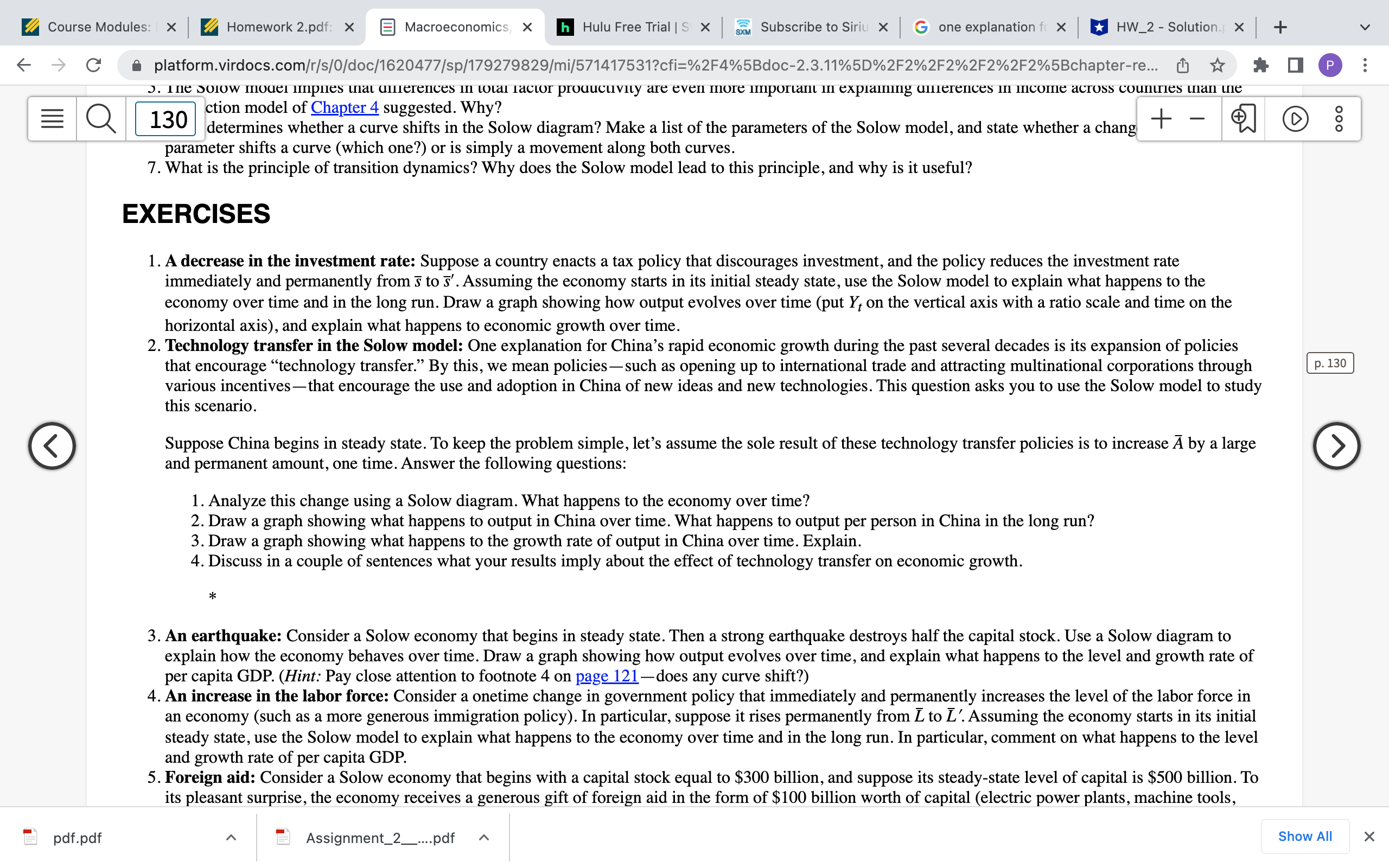
M Course Modules X i % Homework 2.de x E] Macroeconomic X m Hulu Free Triall' X m Subscribe to Sin x 3 one explanation X i u HW_2-So|ution X i + v 6 C' a platform.virdocs.com/r/s/0/doc/1620477/5p/179279829/mi/5714'l7531?c:%2F4%SBdoc2.3.11%5D%2F2%2F2%2F2%2F2%SBchapterre... m fr 3. l] a 5 J. 1116 DUlUW IIIUUCI llllpllCS [Hal UlllCICIlUCb 111 \"ll?\" LaCLUI pruuucuvuy 'dIC CVCII HlUl'C lIIlpUl'laL lll explaining UlllCICIICCS lIl lllCUlIlC 'dCIUSS CUUIILHCS Ulall Ulc = Q ction model of niter4 suggested. Why? + _ 68 8 = determines whether a curve shifts in the Solow diagram? Make a list of the parameters of the Solow model, and state whether a Chang 0 parameter shifts a curve (which one?) or is simply a movement along both curves. 7. What is the principle of transition dynamics? Why does the Solow model lead to this principle, and why is it useful? EXERCISES 1. A decrease in the investment rate: Suppose a country enacts a tax policy that discourages investment, and the policy reduces the investment rate immediately and permanently from E to E'.Assuming the economy starts in its initial steady state, use the Solow model to explain what happens to the economy over time and in the long run. Draw a graph showing how output evolves over time (put Y, on the vertical axis with a ratio scale and time on the horizontal axis), and explain what happens to economic growth over time. 2. Technology transfer in the Solow model: One explanation for China's rapid economic growth during the past several decades is its expansion of policies that encourage \"technology transfer.\" By this, we mean policiessuch as opening up to international trade and attracting multinational corporations through various incentivesathat encourage the use and adoption in China of new ideas and new technologies. This question asks you to use the Solow model to study this scenario. @ Suppose China begins in steady state. To keep the problem simple, let's assume the sole result of these technology transfer policies is to increase A by a large @ and permanent amount, one time. Answer the following questions: 1. Analyze this change using a Solow diagram. What happens to the economy over time? 2. Draw a graph showing what happens to output in China over time. What happens to output per person in China in the long run? 3. Draw a graph showing what happens to the growth rate of output in China over time. Explain. 4. Discuss in a couple of sentences what your results imply about the effect of technology transfer on economic growth. * 3. An earthquake: Consider a Solow economy that begins in steady state. Then a strong earthquake destroys half the capital stock. Use a Solow diagram to explain how the economy behaves over time. Draw a graph showing how output evolves overtime, and explain what happens to the level and growth rate of per capita GDP. (Hint: Pay close attention to footnote 4 on p_agel#does any curve shift?) 4. An increase in the labor force: Consider a onetime change in government policy that immediately and permanently increases the level of the labor force in an economy (such as a more generous immigration policy). In particular, suppose it rises permanently from Z to Z'. Assuming the economy starts in its initial steady state, use the Solow model to explain what happens to the economy over time and in the long run. In particular, comment on what happens to the level and growth rate of per capita GDP. 5. Foreign aid: Consider a Solow economy that begins with a capital stock equal to $300 billion, and suppose its steady-state level of capital is $500 billion. To its pleasant surprise, the economy receives a generous gift of foreign aid in the form of $100 billion worth of capital (electric power plants, machine tools, pdf.pdf A - Assignment_2_....pdf A ShowAII ><
Step by Step Solution
There are 3 Steps involved in it

Get step-by-step solutions from verified subject matter experts
 Study Help