







Question: m There are many different root-finding algorithms in the literature. In this project, we will concentrate on one of the simplest such techniques, called the
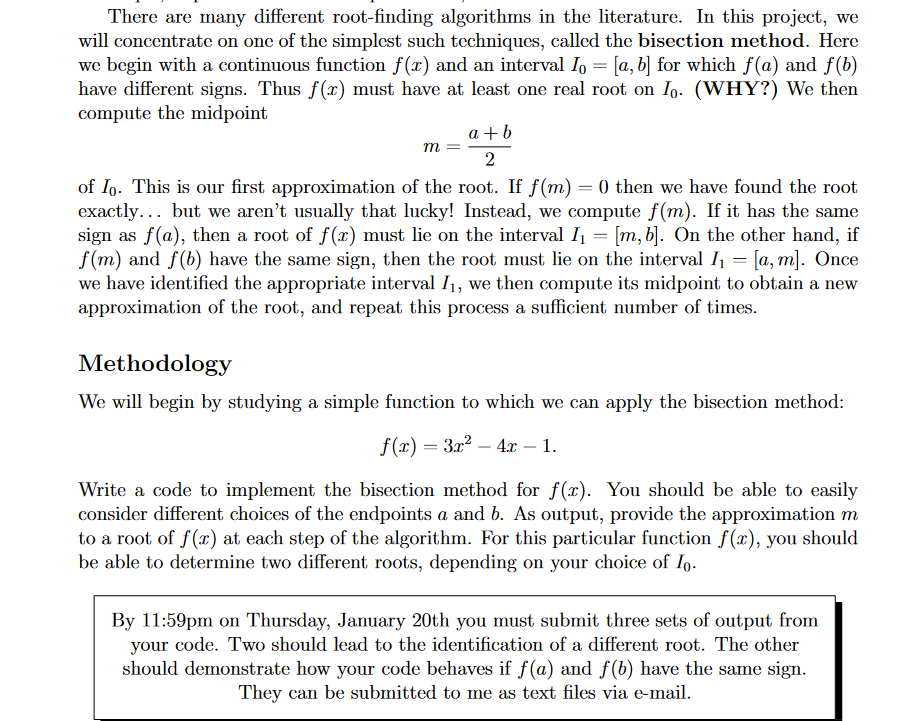
m There are many different root-finding algorithms in the literature. In this project, we will concentrate on one of the simplest such techniques, called the bisection method. Here we begin with a continuous function f(x) and an interval Io = [a, b] for which f(a) and f(6) have different signs. Thus f(x) must have at least one real root on 10. (WHY?) We then compute the midpoint a+b 2 of 1o. This is our first approximation of the root. If f(m) = 0 then we have found the root exactly... but we aren't usually that lucky! Instead, we compute f(m). If it has the same sign as f(a), then a root of f() must lie on the interval I1 = [m,b]. On the other hand, if f(m) and f(b) have the same sign, then the root must lie on the interval I1 = [a, m). Once we have identified the appropriate interval 11, we then compute its midpoint to obtain a new approximation of the root, and repeat this process a sufficient number of times. Methodology We will begin by studying a simple function to which we can apply the bisection method: f(1) = 3.r 4.1 1. Write a code to implement the bisection method for f(). You should be able to easily consider different choices of the endpoints a and b. As output, provide the approximation m to a root of f(x) at each step of the algorithm. For this particular function f(x), you should be able to determine two different roots, depending on your choice of lo. By 11:59pm on Thursday, January 20th you must submit three sets of output from your code. Two should lead to the identification of a different root. The other should demonstrate how your code behaves if f(a) and f(b) have the same sign. They can be submitted to me as text files via e-mail
Step by Step Solution
There are 3 Steps involved in it

Get step-by-step solutions from verified subject matter experts
 Study Help