







Question: M. Wallace 8.6 Parametric Equations YA C Imagine that a particle moves along the curve C as shown in Figure 1. It is impossible to
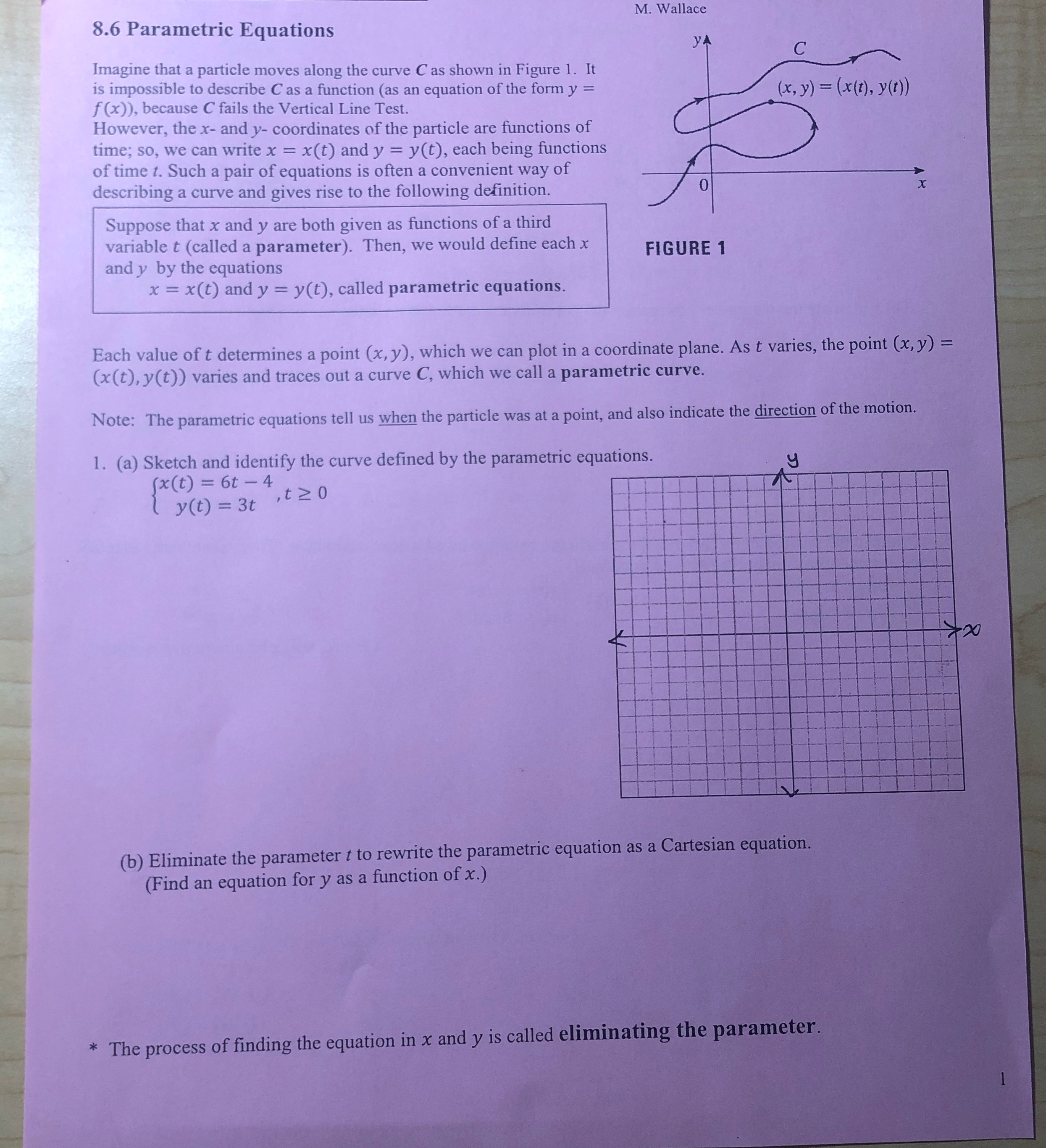
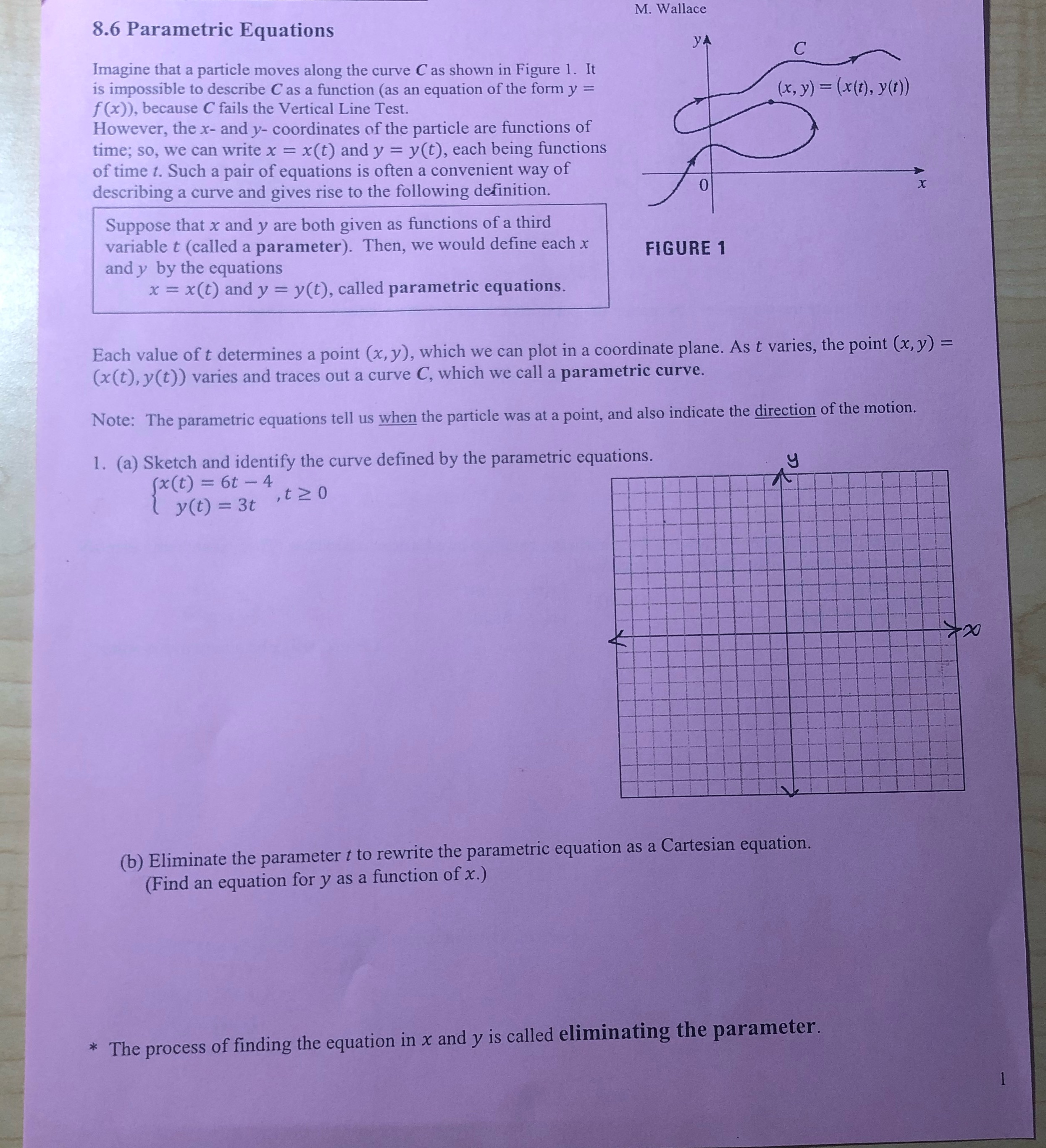
M. Wallace 8.6 Parametric Equations YA C Imagine that a particle moves along the curve C as shown in Figure 1. It is impossible to describe C as a function (as an equation of the form y = (x, y) = (x(1), y(t) ) f(x)), because C fails the Vertical Line Test. However, the x- and y- coordinates of the particle are functions of time; so, we can write x = x(t) and y = y(t), each being functions of time t. Such a pair of equations is often a convenient way of describing a curve and gives rise to the following definition. Suppose that x and y are both given as functions of a third variable t (called a parameter). Then, we would define each x FIGURE 1 and y by the equations x = x(t) and y = y(t), called parametric equations. Each value of t determines a point (x, y), which we can plot in a coordinate plane. As t varies, the point (x, y) = (x(t), y(t)) varies and traces out a curve C, which we call a parametric curve. Note: The parametric equations tell us when the particle was at a point, and also indicate the direction of the motion. 1. (a) Sketch and identify the curve defined by the parametric equations. Sx(t) = 6t-4 ly (t ) = 3t ,t20 Xx (b) Eliminate the parameter t to rewrite the parametric equation as a Cartesian equation. (Find an equation for y as a function of x.) * The process of finding the equation in x and y is called eliminating the parameter
Step by Step Solution
There are 3 Steps involved in it

Get step-by-step solutions from verified subject matter experts
 Study Help