







Question: MAC 281-Final Extra Credit A complete graph with 6 nodes has the following edge lengths: 11,2): 3 (2,3); 5 (3,5}: 4 {1,3}:3 (2,4): 5 (3,63:
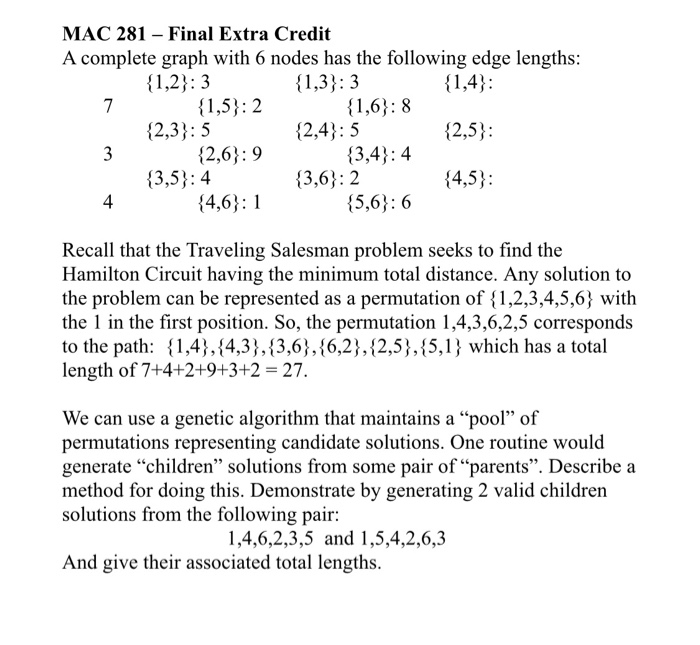
MAC 281-Final Extra Credit A complete graph with 6 nodes has the following edge lengths: 11,2): 3 (2,3); 5 (3,5}: 4 {1,3}:3 (2,4): 5 (3,63: 2 22A 5A 11,63: 8 13,4): 4 5,63: 6 11,5): 2 12,5}: 2,63:9 {45 }: 4 Recall that the Traveling Salesman problem seeks to find the Hamilton Circuit having the minimum total distance. Any solution to the problem can be represented as a permutation of {1,2,3,4,5,63 with the 1 in the first position. So, the permutation 1,4,3,6,2,5 corresponds to the path: {1,4),14,3),(3,6;,56,2),12,5),{5,1; which has a total length of +4+2+9+3+2 27. We can use a genetic algorithm that maintains a "pool" of permutations representing candidate solutions. One routine would generate "children" solutions from some pair of "parents". Describe a method for doing this. Demonstrate by generating 2 valid children solutions from the following pair 1,4,6,2,3,5 and 1,5,4,2,6,3 And give their associated total lengths
Step by Step Solution
There are 3 Steps involved in it

Get step-by-step solutions from verified subject matter experts
 Study Help