







Question: macro question on OLG model 2. (10 points) Consider the OLG model we studied in class. There is no population growth and no technological progress.
macro question on OLG model
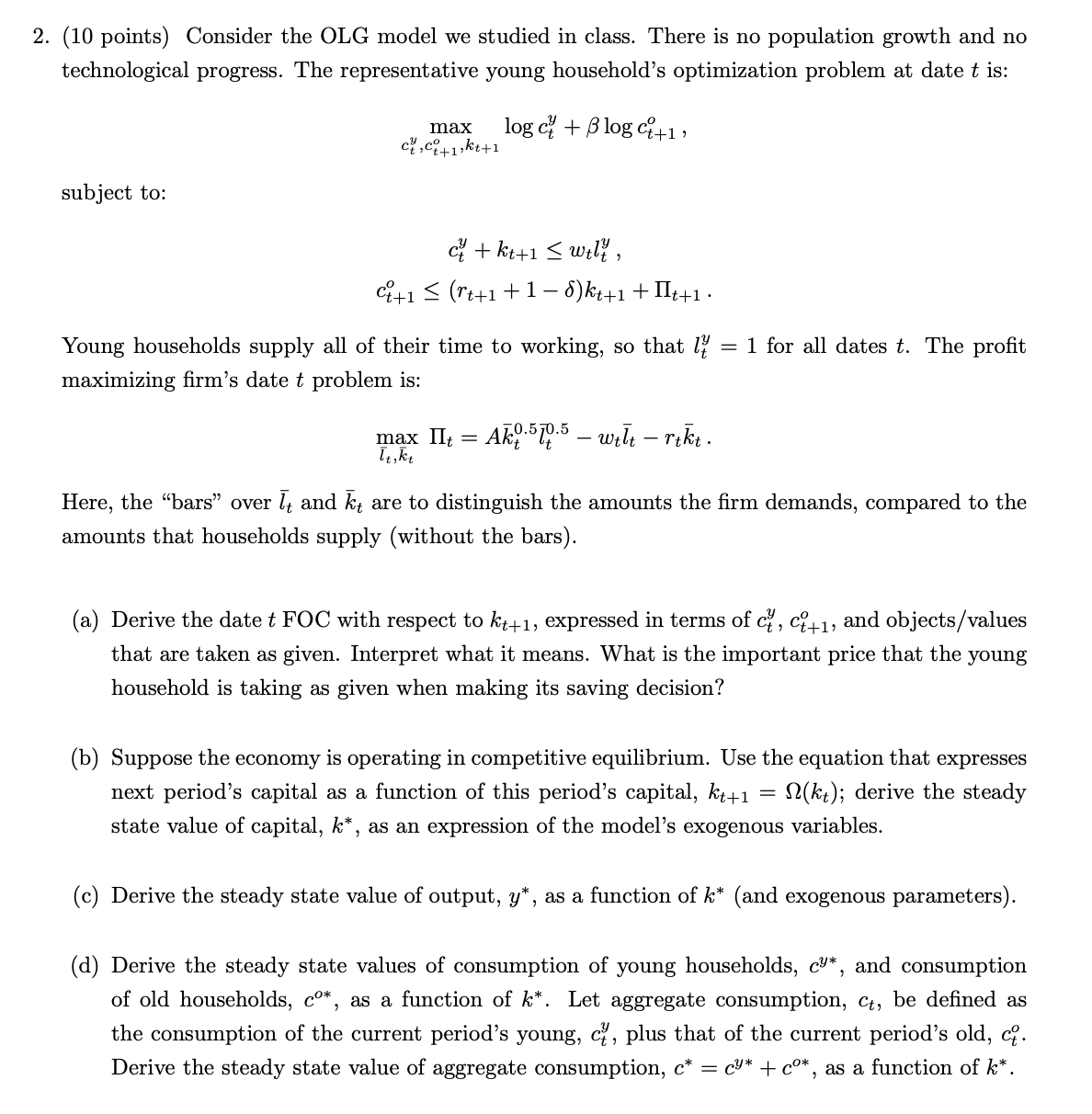
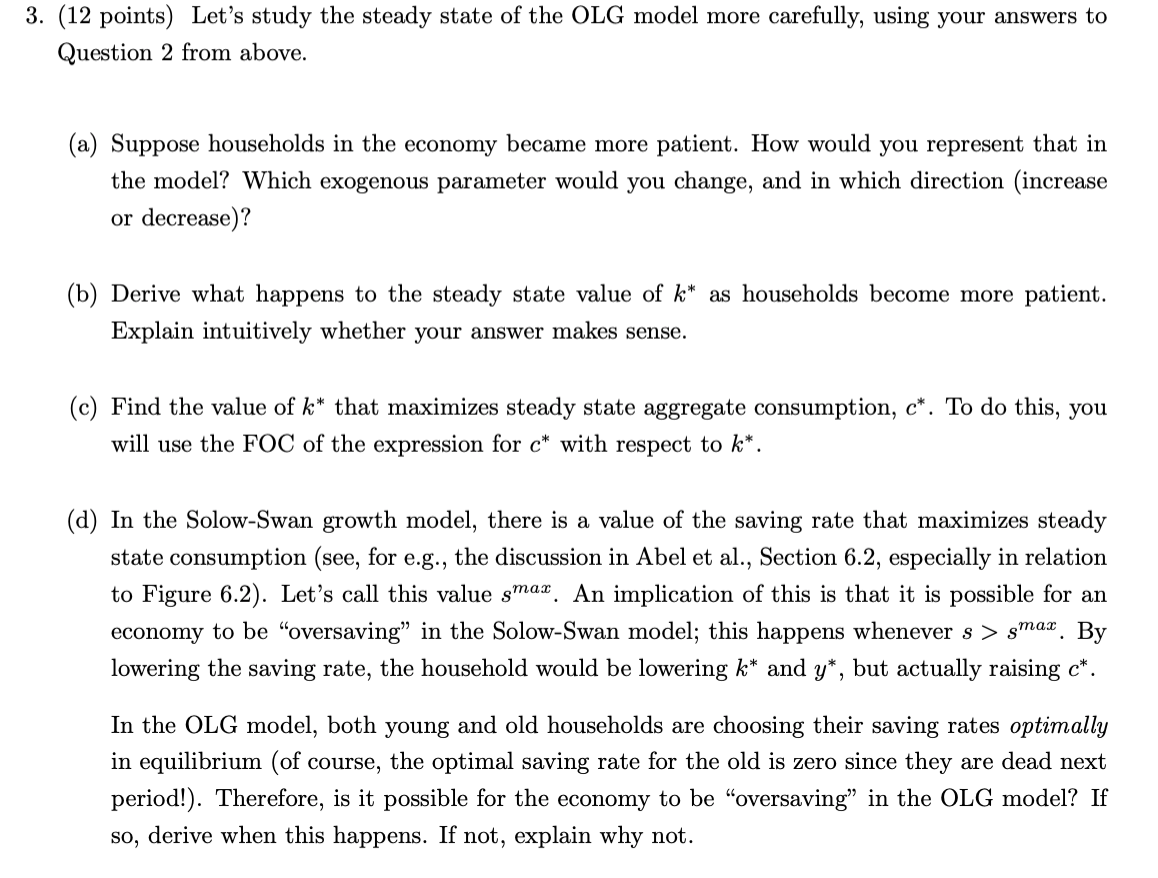
2. (10 points) Consider the OLG model we studied in class. There is no population growth and no technological progress. The representative young household's optimization problem at date i; is: max 10363f +Blogc=+u c?,cf+1,k:g+1 subject to: C? + kt+1 S 140:5? , C+1 S (\"+1 'l' 1 _ 5)kt+1 +Ht+1 . Young households supply all of their time to working, so that l? = 1 for all dates t. The prot maximizing rm's date t problem is: [faEX H; = AEE535 ngt TEE; . Here, the \"bars\" over it and 16, are to distinguish the amounts the rm demands, compared to the amounts that households supply (without the bars). (a) Derive the date 1; F00 with respect to let\3. (12 points) Let's study the steady state of the OLG model more carefully, using your answers to Question 2 from above. (a) ((0 Suppose households in the economy became more patient. How would you represent that in the model? Which exogenous parameter would you change, and in which direction (increase or decrease)? Derive what happens to the steady state value of k'\" as households become more patient. Explain intuitively whether your answer makes sense. Find the value of k* that maximizes steady state aggregate consumption, 0*. To do this, you will use the FOG of the expression for 0* with respect to k\". In the Solow-Swan growth model, there is a value of the saving rate that maximizes steady state consumption (see, for e.g., the discussion in Abel et al., Section 6.2, especially in relation to Figure 6.2). Let's call this value 5\"\". An implication of this is that it is possible for an economy to be \"oversaving\" in the Solow-Swan model; this happens whenever s > 3\"\". By lowering the saving rate, the household would be lowering k'\" and 3;\
Step by Step Solution
There are 3 Steps involved in it

Get step-by-step solutions from verified subject matter experts
 Study Help