



Question: Macroeconomic factors have an important effect on both the general level of interest rates and the shape of the yield curve. These primary factors are:
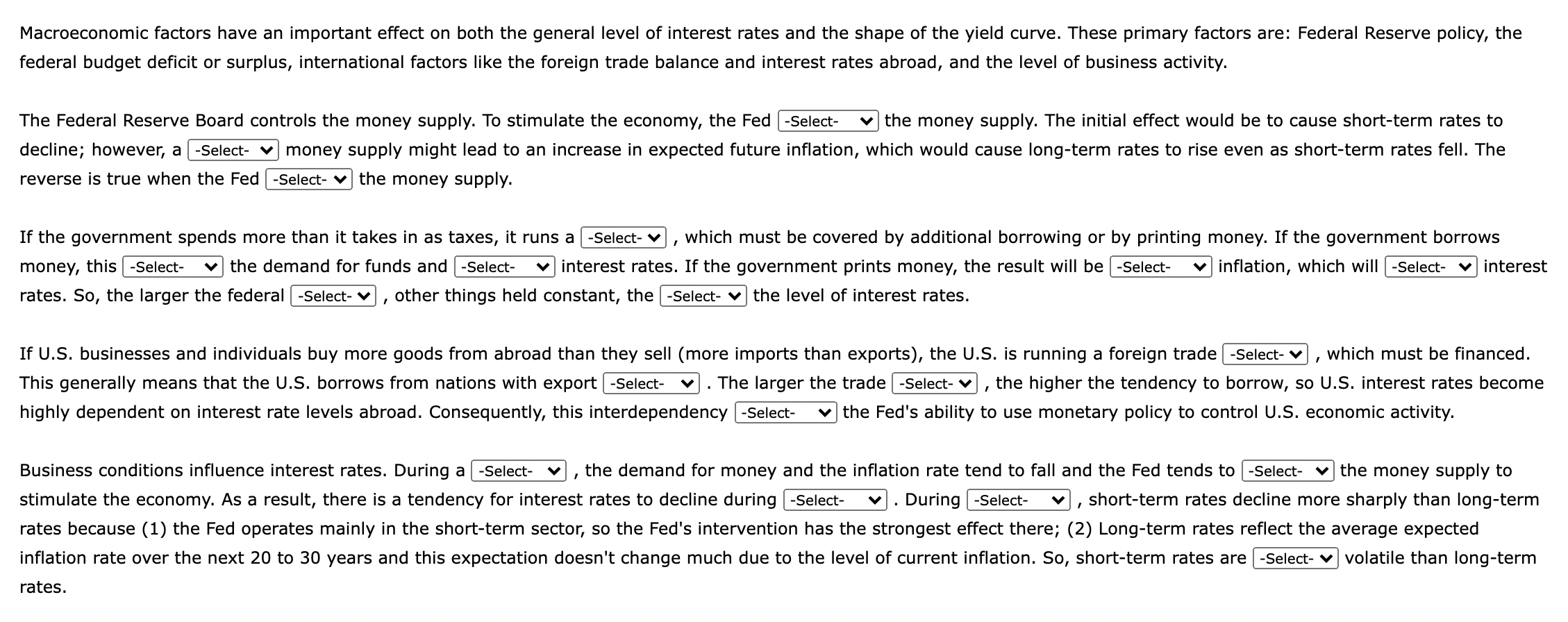
Macroeconomic factors have an important effect on both the general level of interest rates and the shape of the yield curve. These primary factors are: Federal Reserve policy, the federal budget deficit or surplus, international factors like the foreign trade balance and interest rates abroad, and the level of business activity. The Federal Reserve Board controls the money supply. To stimulate the economy, the Fed -Select- v the money supply. The initial effect would be to cause short-term rates to decline; however, a -Select- v money supply might lead to an increase in expected future inflation, which would cause long-term rates to rise even as short-term rates fell. The reverse is true when the Fed -Select- v the money supply. I If the government spends more than it takes in as taxes, it runs a -Select- V which must be covered by additional borrowing or by printing money. If the government borrows money, this -Select- v the demand for funds and -Select- v interest rates. If the government prints money, the result will be -Select- v inflation, which will -Select- vinterest rates. So, the larger the federal ( -Select- v other things held constant, the -Select- v the level of interest rates. If U.S. businesses and individuals buy more goods from abroad than they sell (more imports than exports), the U.S. is running a foreign trade -Select- v which must be financed. This generally means that the U.S. borrows from nations with export -Select- . The larger the trade -Select- v the higher the tendency to borrow, so U.S. interest rates become highly dependent on interest rate levels abroad. Consequently, this interdependency -Select- the Fed's ability to use monetary policy to control U.S. economic activity. / . 1 Business conditions influence interest rates. During a -Select- the demand for money and the inflation rate tend to fall and the Fed tends to -Select- v the money supply to stimulate the economy. As a result, there is a tendency for interest rates to decline during -Select- During -Select- short-term rates decline more sharply than long-term rates because (1) the Fed operates mainly in the short-term sector, so the Fed's intervention has the strongest effect there; (2) Long-term rates reflect the average expected inflation rate over the next 20 to 30 years and this expectation doesn't change much due to the level of current inflation. So, short-term rates are -Select- v volatile than long-term rates
Step by Step Solution
There are 3 Steps involved in it

Get step-by-step solutions from verified subject matter experts