



Question: Macroeconomic theory; 2. Consider a Solow-type growth model with the following production function as well as the other equations in Model 1g. Y = KH=
Macroeconomic theory;
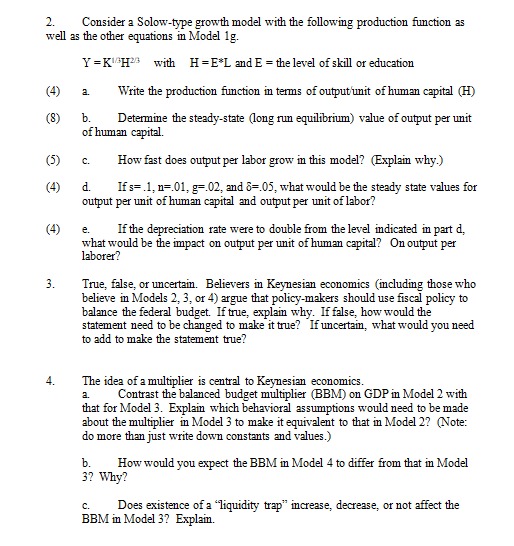
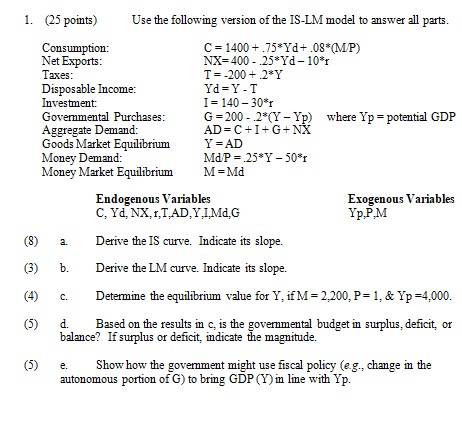
2. Consider a Solow-type growth model with the following production function as well as the other equations in Model 1g. Y = KH= with H=E*L and E = the level of skill or education (4) a. Write the production function in terms of output unit of human capital (H) (8) b. Determine the steady-state (long run equilibrium) value of output per unit of human capital. C. How fast does output per labor grow in this model? (Explain why.) (4) d. If s= . 1, n=.01, g=.02, and 6=.05, what would be the steady state values for output per unit of human capital and output per unit of labor? (4) e. If the depreciation rate were to double from the level indicated in part d, what would be the impact on output per unit of human capital? On output per laborer? 3. True, false, or uncertain. Believers in Keynesian economics (mcluding those who believe in Models 2, 3, or 4) argue that policy-makers should use fiscal policy to balance the federal budget. If true, explain why. If false, how would the statement need to be changed to make it true? If uncertain, what would you need to add to make the statement true? 4. The idea of a multiplier is central to Keynesian economics. a. Contrast the balanced budget multiplier (BBM) on GDP in Model 2 with that for Model 3. Explain which behavioral assumptions would need to be made about the multiplier in Model 3 to make it equivalent to that in Model 2? (Note: do more than just write down constants and values.) b. How would you expect the BBM in Model 4 to differ from that in Model 3? Why? C. Does existence of a "liquidity trap" increase, decrease, or not affect the BBM in Model 3? Explain.1. (25 points) Use the following version of the IS-LM model to answer all parts. Consumption: C = 1400 + .75*Yd+.08*(M/P) Net Exports: NX=400 - .25*Yd - 10*r Taxes: T =-200 + .2*Y Disposable Income: Yd =Y - T Investment: I = 140-30#r Governmental Purchases: G =200 - .2*(Y - Yp) where Yp =potential GDP Aggregate Demand: AD=C+I+G+NX Goods Market Equilibrium Y =AD Money Demand: Md/P =.25*Y -50*r Money Market Equilibrium M =Md Endogenous Variables Exogenous Variables C, Yd, NX, r, T.AD, Y,I,Md,G Yp.P.M (8) a. Derive the IS curve. Indicate its slope. 3) b. Derive the LM curve. Indicate its slope. (4) C. Determine the equilibrium value for Y, if M = 2,200, P=1, & Yp =4,000. ()) d. Based on the results in c, is the governmental budget in surplus, deficit, or balance? If surplus or deficit, indicate the magnitude. (0) e. Show how the government might use fiscal policy (eg., change in the autonomous portion of G) to bring GDP (Y) in line with Yp
Step by Step Solution
There are 3 Steps involved in it

Get step-by-step solutions from verified subject matter experts