



Question: Macroeconomics, Problem Set #3 Due: Friday, October 26, 2017 The questions below are due at the beginning of class If you believe your handwriting
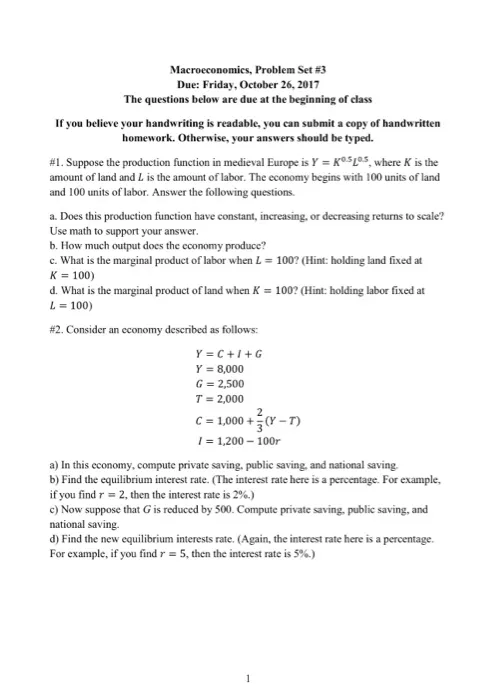
Macroeconomics, Problem Set #3 Due: Friday, October 26, 2017 The questions below are due at the beginning of class If you believe your handwriting is readable, you can submit a copy of handwritten homework. Otherwise, your answers should be typed. #1. Suppose the production function in medieval Europe is Y = K05L0s, where K is the amount of land and L is the amount of labor. The economy begins with 100 units of land and 100 units of labor. Answer the following questions. a. Does this production function have constant, increasing, or decreasing returns to scale? Use math to support your answer. b. How much output does the economy produce? c. What is the marginal product of labor when L = 100? (Hint: holding land fixed at K = 100) d. What is the marginal product of land when K = 100? (Hint: holding labor fixed at L = 100) #2. Consider an economy described as follows: Y=C+I+G Y = 8,000 G = 2,500 T = 2,000 2 C = 1,000+ (Y-T) /= 1,200-100r a) In this economy, compute private saving, public saving, and national saving. b) Find the equilibrium interest rate. (The interest rate here is a percentage. For example, if you find r = 2, then the interest rate is 2%.) c) Now suppose that G is reduced by 500. Compute private saving, public saving, and national saving. d) Find the new equilibrium interests rate. (Again, the interest rate here is a percentage. For example, if you find r = 5, then the interest rate is 5%.)
Step by Step Solution
There are 3 Steps involved in it
Problem 1 Medieval European Production Function a Returns to Scale The production function exhibits ... View full answer

Get step-by-step solutions from verified subject matter experts