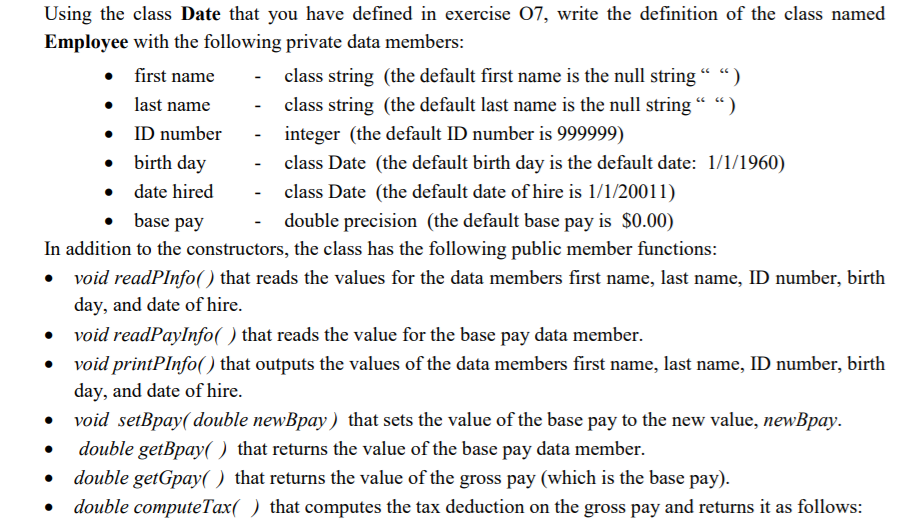
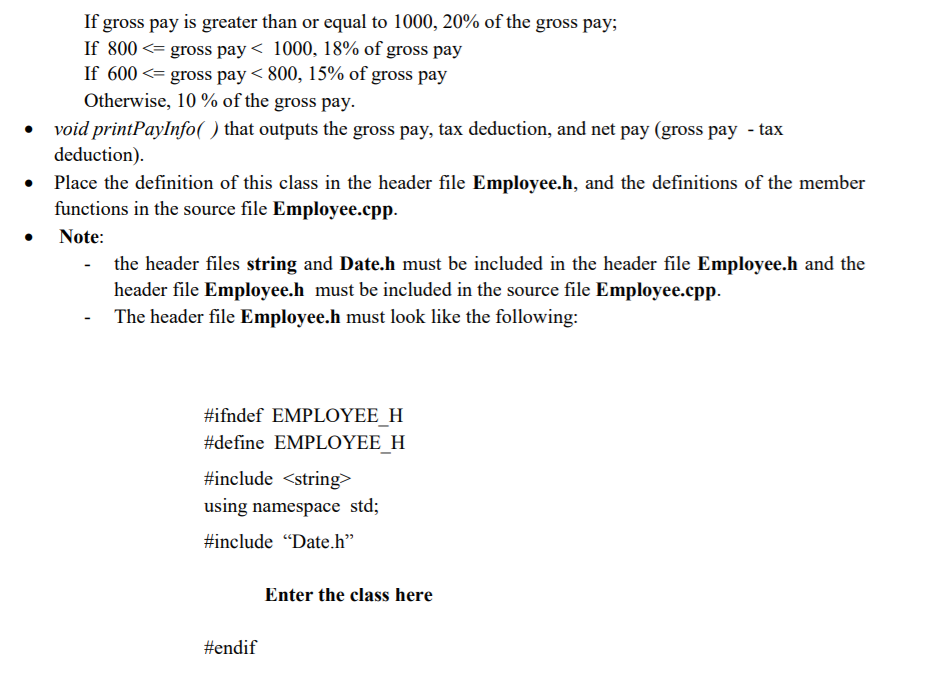
Question: *main.cpp* *Date.h* *Date.cpp* In C++ please . birth day base pay Using the class Date that you have defined in exercise 07, write the definition
*main.cpp*
*Date.h*
*Date.cpp*
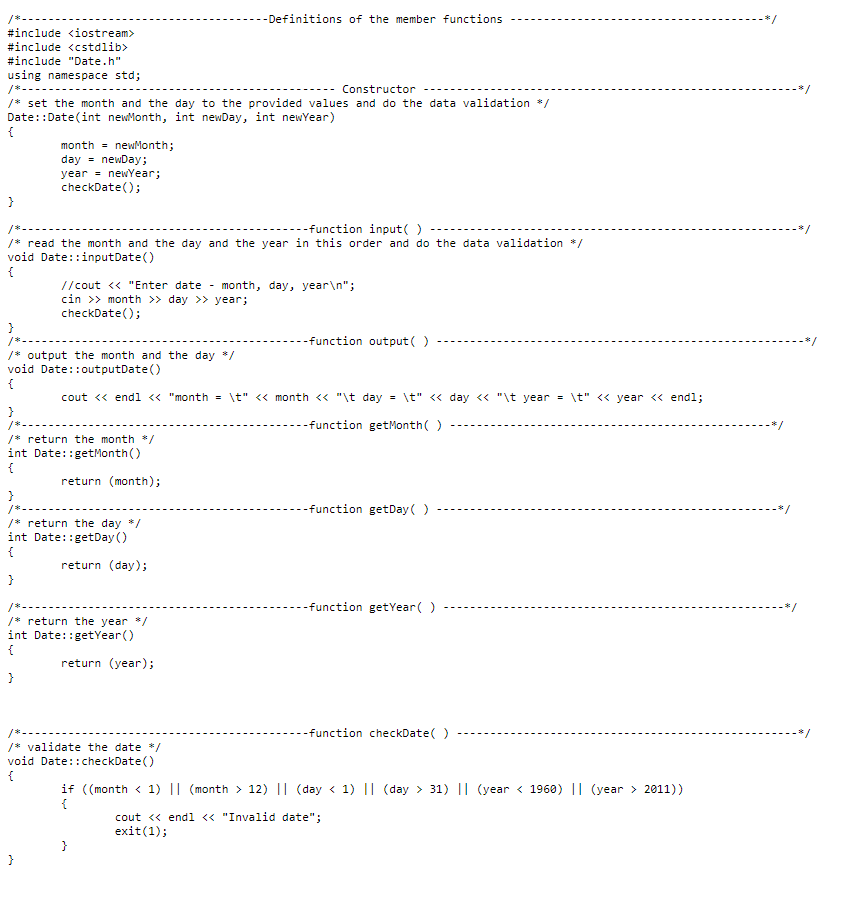
In C++ please
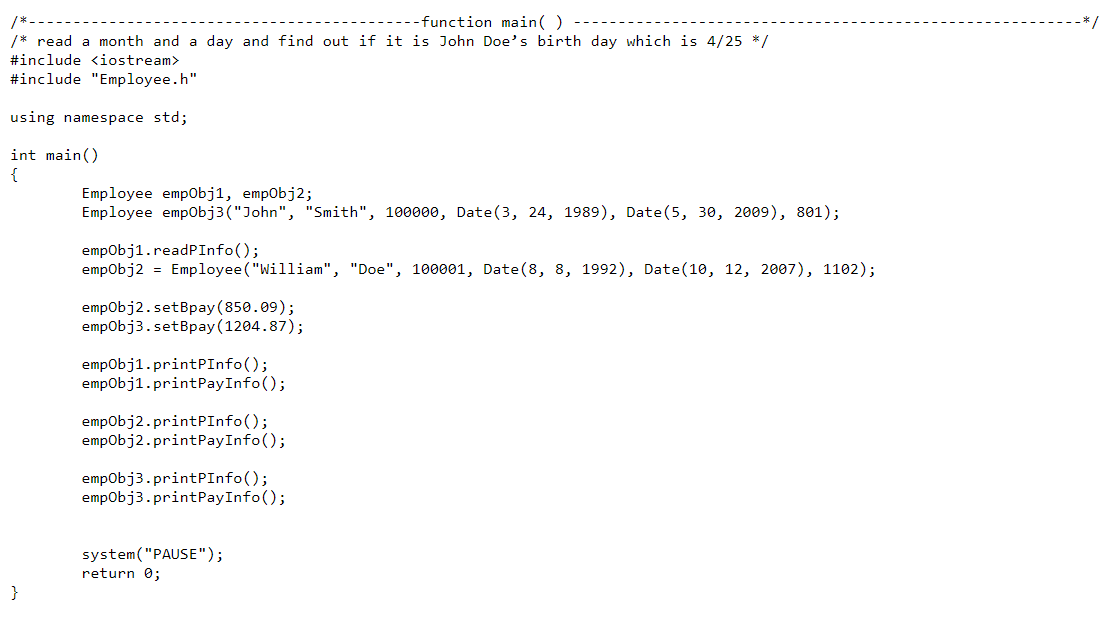
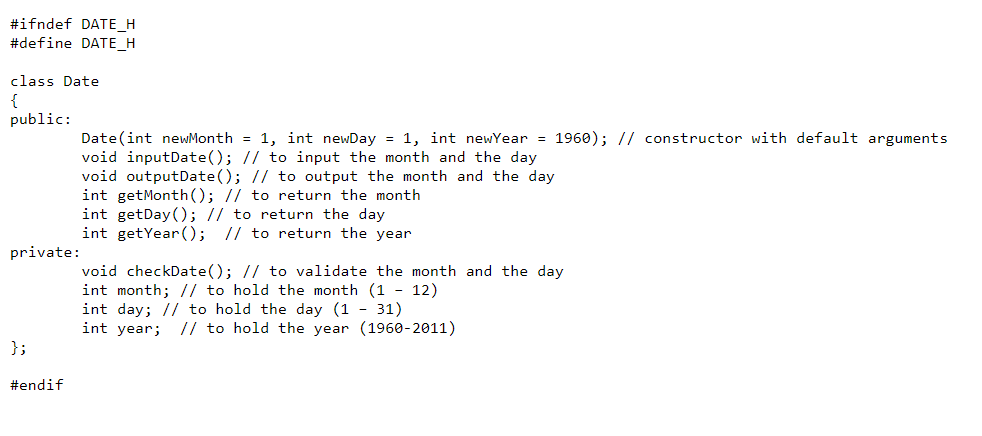
. birth day base pay Using the class Date that you have defined in exercise 07, write the definition of the class named Employee with the following private data members: first name class string (the default first name is the null string) last name class string (the default last name is the null string) ID number integer (the default ID number is 999999) class Date (the default birth day is the default date: 1/1/1960) date hired - class Date (the default date of hire is 1/1/20011) double precision (the default base pay is $0.00) In addition to the constructors, the class has the following public member functions: void readPInfo() that reads the values for the data members first name, last name, ID number, birth day, and date of hire. void readPayInfo() that reads the value for the base pay data member. void printPInfo() that outputs the values of the data members first name, last name, ID number, birth day, and date of hire. void setBpay( double newBpay) that sets the value of the base pay to the new value, newBpay. double getBpay() that returns the value of the base pay data member. double getGpay() that returns the value of the gross pay (which is the base pay). double computeTax( ) that computes the tax deduction on the gross pay and returns it as follows: If gross pay is greater than or equal to 1000, 20% of the gross pay; If 800 using namespace std; #include "Date.h Enter the class here #endif */ -- function main() /* read a month and a day and find out if it is John Doe's birth day which is 4/25 */ #include #include "Employee.h" using namespace std; int main() { Employee empobj1, empobj2; Employee empobj3("John", "Smith", 100000, Date(3, 24, 1989), Date(5, 30, 2009), 801); empobj1.readPInfo(); empobj2 = Employee("William", "Doe", 100001, Date(8, 8, 1992), Date(10, 12, 2007), 1102); empobj2.setBpay (850.09); empobj3.setBpay (1204.87); empObj1.printPInfo(); empobj1.printPayInfo(); empobj2.printPInfo(); empobj2.printPayInfo(); empObj3.printPInfo(); empObj3.printPayInfo(); system("PAUSE"); return 0; } #ifndef DATE_H #define DATE_H class Date { public: Date(int newMonth = 1, int newDay = 1, int newYear = 1960); // constructor with default arguments void inputDate(); // to input the month and the day void outputDate(); // to output the month and the day int getMonth(); // to return the month int getDay(); // to return the day int getYear(); // to return the year private: void checkDate(); // to validate the month and the day int month; // to hold the month (1 - 12) int day; // to hold the day (1 - 31) int year; // to hold the year (1960-2011) }; #endif */ / -- Definitions of the member functions #include #include #include "Date.h" using namespace std; Constructor /* set the month and the day to the provided values and do the data validation */ Date::Date(int newMonth, int newDay, int newYear) { month - newMonth; day = newDay; year = newYear; checkDate(); } --function input) /* read the month and the day and the year in this order and do the data validation */ void Date::inputDate() { //cout > month >> day >> year; checkDate(); ---function output) /* output the month and the day */ void Date:: outputDate() { cout 12) || (day 31) II (year 2011) { cout using namespace std; #include "Date.h Enter the class here #endif */ -- function main() /* read a month and a day and find out if it is John Doe's birth day which is 4/25 */ #include #include "Employee.h" using namespace std; int main() { Employee empobj1, empobj2; Employee empobj3("John", "Smith", 100000, Date(3, 24, 1989), Date(5, 30, 2009), 801); empobj1.readPInfo(); empobj2 = Employee("William", "Doe", 100001, Date(8, 8, 1992), Date(10, 12, 2007), 1102); empobj2.setBpay (850.09); empobj3.setBpay (1204.87); empObj1.printPInfo(); empobj1.printPayInfo(); empobj2.printPInfo(); empobj2.printPayInfo(); empObj3.printPInfo(); empObj3.printPayInfo(); system("PAUSE"); return 0; } #ifndef DATE_H #define DATE_H class Date { public: Date(int newMonth = 1, int newDay = 1, int newYear = 1960); // constructor with default arguments void inputDate(); // to input the month and the day void outputDate(); // to output the month and the day int getMonth(); // to return the month int getDay(); // to return the day int getYear(); // to return the year private: void checkDate(); // to validate the month and the day int month; // to hold the month (1 - 12) int day; // to hold the day (1 - 31) int year; // to hold the year (1960-2011) }; #endif */ / -- Definitions of the member functions #include #include #include "Date.h" using namespace std; Constructor /* set the month and the day to the provided values and do the data validation */ Date::Date(int newMonth, int newDay, int newYear) { month - newMonth; day = newDay; year = newYear; checkDate(); } --function input) /* read the month and the day and the year in this order and do the data validation */ void Date::inputDate() { //cout > month >> day >> year; checkDate(); ---function output) /* output the month and the day */ void Date:: outputDate() { cout 12) || (day 31) II (year 2011) { cout









 Study Help