







Question: ----------------------------------------------- //MAIN.CPP #include #include #include #include #include autocompleter.h using namespace std; inline void _test(const char* expression, const char* file, int line) { cerr void interactive_mode()
-----------------------------------------------
//MAIN.CPP
#include
using namespace std;
inline void _test(const char* expression, const char* file, int line) { cerr
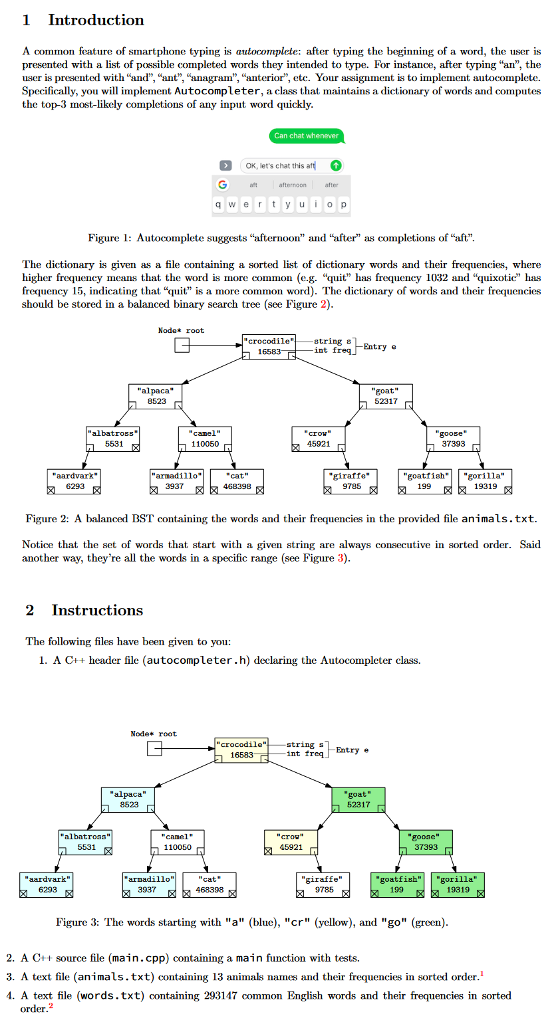
void interactive_mode() { Autocompleter words("words.txt"); vector int main() { // Uncomment line below to use your Autocompleter // interactively with words.txt as the dictionary. // // Enter a string and press Enter - the autocompletions // results from words.txt are printed. // //interactive_mode(); // Setup vector // Test constructor and size() Autocompleter animals("animals.txt"); test(animals.size() == 13); Autocompleter words("words.txt"); test(words.size() == 293147); // Test completions() animals.completions("a", R); test(R.size() == 3); test(R[0] == "alpaca"); test(R[1] == "aardvark"); test(R[2] == "albatross"); animals.completions("b", R); test(R.size() == 0); animals.completions("c", R); test(R.size() == 3); test(R[0] == "cat"); test(R[1] == "camel"); test(R[2] == "crow"); animals.completions("d", R); test(R.size() == 0); animals.completions("e", R); test(R.size() == 0); animals.completions("f", R); test(R.size() == 0); animals.completions("g", R); test(R.size() == 3); test(R[0] == "goat"); test(R[1] == "goose"); test(R[2] == "gorilla"); animals.completions("aa", R); test(R.size() == 1); test(R[0] == "aardvark"); animals.completions("al", R); test(R.size() == 2); test(R[0] == "alpaca"); test(R[1] == "albatross"); animals.completions("an", R); test(R.size() == 0); animals.completions("bo", R); test(R.size() == 0); animals.completions("da", R); test(R.size() == 0); animals.completions("go", R); test(R.size() == 3); test(R[0] == "goat"); test(R[1] == "goose"); test(R[2] == "gorilla"); animals.completions("cro", R); test(R.size() == 2); test(R[0] == "crow"); test(R[1] == "crocodile"); animals.completions("goat", R); test(R.size() == 2); test(R[0] == "goat"); test(R[1] == "goatfish"); animals.completions("gir", R); test(R.size() == 1); test(R[0] == "giraffe"); animals.completions("croc", R); test(R.size() == 1); test(R[0] == "crocodile"); animals.completions("crow", R); test(R.size() == 1); test(R[0] == "crow"); animals.completions("", R); test(R.size() == 3); test(R[0] == "cat"); test(R[1] == "camel"); test(R[2] == "goat"); animals.completions("CAT", R); test(R.size() == 0); animals.completions("cAt", R); test(R.size() == 0); animals.completions("giraffez", R); test(R.size() == 0); animals.completions("robotron", R); test(R.size() == 0); animals.completions("Y", R); test(R.size() == 0); animals.completions("YOLO", R); test(R.size() == 0); animals.completions("!error", R); test(R.size() == 0); words.completions("a", R); test(R.size() == 3); test(R[0] == "and"); test(R[1] == "a"); test(R[2] == "are"); words.completions("b", R); test(R.size() == 3); test(R[0] == "by"); test(R[1] == "be"); test(R[2] == "but"); words.completions("c", R); test(R.size() == 3); test(R[0] == "can"); test(R[1] == "contact"); test(R[2] == "click"); words.completions("!", R); test(R.size() == 0); words.completions("ba", R); test(R.size() == 3); test(R[0] == "back"); test(R[1] == "based"); test(R[2] == "baby"); words.completions("be", R); test(R.size() == 3); test(R[0] == "be"); test(R[1] == "been"); test(R[2] == "best"); words.completions("th", R); test(R.size() == 3); test(R[0] == "the"); test(R[1] == "that"); test(R[2] == "this"); words.completions("aft", R); test(R.size() == 3); test(R[0] == "after"); test(R[1] == "afternoon"); test(R[2] == "afterwards"); words.completions("cat", R); test(R.size() == 3); test(R[0] == "categories"); test(R[1] == "category"); test(R[2] == "catalog"); words.completions("syz", R); test(R.size() == 3); test(R[0] == "syzygy"); test(R[1] == "syzygium"); test(R[2] == "syzhthsh"); words.completions("sy$", R); test(R.size() == 0); words.completions("bird", R); test(R.size() == 3); test(R[0] == "bird"); test(R[1] == "birds"); test(R[2] == "birding"); words.completions("hola", R); test(R.size() == 3); test(R[0] == "hola"); test(R[1] == "holabird"); test(R[2] == "holanda"); words.completions("word", R); test(R.size() == 3); test(R[0] == "word"); test(R[1] == "words"); test(R[2] == "wordpress"); words.completions("birdz", R); test(R.size() == 0); words.completions("yello", R); test(R.size() == 3); test(R[0] == "yellow"); test(R[1] == "yellowstone"); test(R[2] == "yellowpages"); cout //END MAIN.CPP ----------------------------------------------- //AUTOCOMPLETER.H #ifndef AUTOCOMPLETER_H #define AUTOCOMPLETER_H #include using namespace std; class Autocompleter { // For the mandatory running times below: // n is the number of strings in the dictionary. // Assume that the length of every string is O(1). public: // Creates a dictionary of strings and associated frequencies, // using the file as a source. The file is promised to have // the following format: // // string1 freq1 // string2 freq2 // ... // stringN freqN // // where string1 // Returns the number of strings in the dictionary // of possible completions. // // Must run in O(n) time. int size(); // Fills the vector T with the three most-frequent completions of x. // If x has less than three completions, // then T is filled with all completions of x. // The completions appear in T from most- to least-frequent. // // Must run in O(log(n) + k) time, // where k is the number of completions of x in the dictionary. void completions(string x, vector private: // A helper class that stores a string and a frequency. class Entry { public: string s; int freq; }; // A helper class that implements a BST node. class Node { public: Node() { left = right = nullptr; } Node(Entry e) { this->e = e; left = right = nullptr; } Entry e; Node* left; Node* right; }; // Root of the binary-search-tree-based data structure Node* root; // Optional helper methods (you'll probably want them). // Returns the root of a BST containing the elements // of the portion of a sorted vector E from index l to r. // // Should run in O(r-l) time. Node* construct_recurse(vector // Returns the size of the binary tree rooted at root. // // Should run in O(n) time. int size_recurse(Node* root); // Fills T with the three most-frequent completions of x // that are either: // -In the BST rooted at root. // -Already in T. // // Should run in O(log(n) + k), where // -n is the size of the BST rooted at root. // -k is the number of Entrys in the BST rooted at root // whose strings start with x. void completions_recurse(string x, Node* root, vector #endif //END AUTOCOMPLETER.H ----------------------------------------------- //AUTOCOMPLETER.CPP #include "autocompleter.h" // For the mandatory running times below: // n is the number of strings in the dictionary. // Assume that the length of every string is O(1). // Creates a dictionary of strings and associated frequencies, // using the file as a source. The file is promised to have // the following format: // // string1 freq1 // string2 freq2 // ... // stringN freqN // // where string1 } // Returns the number of strings in the dictionary // of possible completions. // // Must run in O(n) time. int Autocompleter::size() { return 0; } // Fills the vector T with the three most-frequent completions of x. // If x has less than three completions, // then T is filled with all completions of x. // The completions appear in T from most- to least-frequent. // // Must run in O(log(n) + k) time, // where k is the number of completions of x in the dictionary. void Autocompleter::completions(string x, vector } // Returns the size of the binary tree rooted at root. // // Should run in O(n) time. int Autocompleter::size_recurse(Node* root) { return 0; } // Fills T with the three most-frequent completions of x // that are either: // -In the BST rooted at root. // -Already in T. // // Should run in O(log(n) + k), where // -n is the size of the BST rooted at root. // -k is the number of Entrys in the BST rooted at root // whose strings start with x. void Autocompleter::completions_recurse(string x, Node* root, vector } //END AUTOCOMPLETER.CPP ----------------------------------------------- I need assistance implementing the functions in "AUTOCOMPLETER.CPP" so that my program prints "Assignment Complete."
Step by Step Solution
There are 3 Steps involved in it

Get step-by-step solutions from verified subject matter experts
 Study Help