







Question: //main.cpp #include #include treeNode.h using namespace std; int main() { TreeNode n1, n2, n3, n4; n1.left = &n2; n1.right = &n3; n2.left = &n4; cout
//main.cpp
#include
#include "treeNode.h"
using namespace std;
int main() {
TreeNode n1, n2, n3, n4;
n1.left = &n2;
n1.right = &n3;
n2.left = &n4;
cout
cout
cout
cout
return 0;
}
//treenode.cpp
#include "treeNode.h"
#include
#include
using namespace std;
TreeNode::TreeNode() : left(NULL), right(NULL) { }
int TreeNode::getHeight() {
return -1;
}
//treenode.h
#ifndef _TREENODE_H
#define _TREENODE_H
#include
#include
using namespace std;
class TreeNode {
public:
TreeNode *left;
TreeNode *right;
TreeNode();
int getHeight();
};
#endif
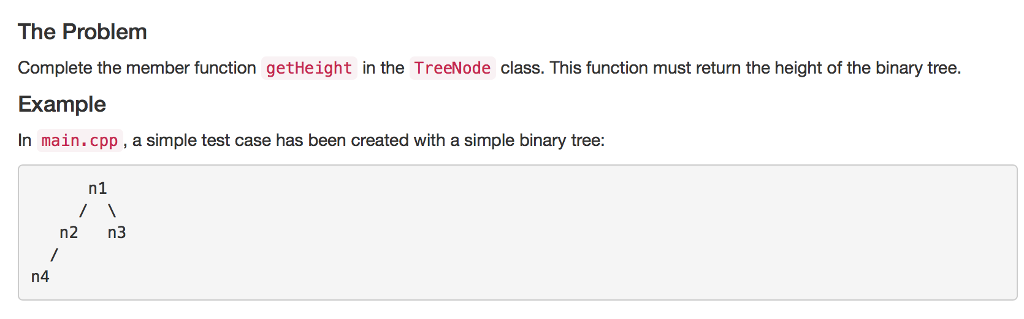
The Problem Complete the member function getHeight in the TreeNode class. This function must return the height of the binary tree. Example In main.cpp, a simple test case has been created with a simple binary tree: n1 n2 n3 n4
Step by Step Solution
There are 3 Steps involved in it

Get step-by-step solutions from verified subject matter experts
 Study Help