







Question: main.cpp #include using namespace std; int main() { // Write your main here return 0; } rectangleType.cpp #include #include #include rectangleType.h using namespace std; void
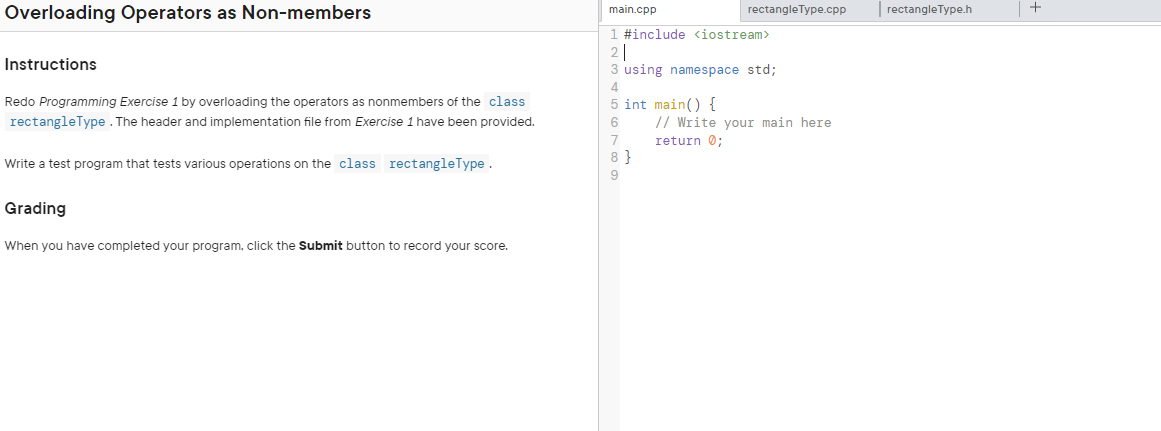
main.cpp
#include
using namespace std;
int main() {
// Write your main here
return 0;
}
rectangleType.cpp
#include
#include
#include "rectangleType.h"
using namespace std;
void rectangleType::setDimension(double l, double w)
{
if (l >= 0)
length = l;
else
length = 0;
if (w >= 0)
width = w;
else
width = 0;
}
double rectangleType::getLength() const
{
return length;
}
double rectangleType::getWidth()const
{
return width;
}
double rectangleType::area() const
{
return length * width;
}
double rectangleType::perimeter() const
{
return 2 * (length + width);
}
rectangleType::rectangleType(double l, double w)
{
setDimension(l, w);
}
rectangleType::rectangleType()
{
length = 0;
width = 0;
}
rectangleType rectangleType::operator++()
{
//increment the length and width
++length;
++width;
return *this; //return the incremented value of the object
}
rectangleType rectangleType::operator++(int u)
{
rectangleType temp = *this; //use this pointer to copy
//the value of the object
//increment the length and width
length++;
width++;
return temp; //return the old value of the object
}
rectangleType rectangleType::operator--()
{
//Decrement the length and width
assert(length != 0 && width != 0);
--length;
--width;
return *this; //return the incremented value of the object
}
rectangleType rectangleType::operator--(int u)
{
rectangleType temp = *this; //use this pointer to copy
//the value of the object
//Decrement the length and width
assert(length != 0 && width != 0);
length--;
width--;
return temp; //return the old value of the object
}
rectangleType rectangleType::operator+
(const rectangleType& rectangle) const
{
rectangleType tempRect;
tempRect.length = length + rectangle.length;
tempRect.width = width + rectangle.width;
return tempRect;
}
rectangleType rectangleType::operator-
(const rectangleType& rectangle) const
{
rectangleType tempRect;
assert(length >= rectangle.length &&
width >= rectangle.width);
tempRect.length = length - rectangle.length;
tempRect.width = width - rectangle.width;
return tempRect;
}
rectangleType rectangleType::operator*(const rectangleType& rectangle) const
{
rectangleType tempRect;
tempRect.length = length * rectangle.length;
tempRect.width = width * rectangle.width;
return tempRect;
}
bool rectangleType::operator==
(const rectangleType& rectangle) const
{
return (area() == rectangle.area());
}
bool rectangleType::operator!=
(const rectangleType& rectangle) const
{
return (area() != rectangle.area());
}
bool rectangleType::operator
(const rectangleType& rectangle) const
{
return (area()
}
bool rectangleType::operator
(const rectangleType& rectangle) const
{
return (area()
}
bool rectangleType::operator>=
(const rectangleType& rectangle) const
{
return (area() >= rectangle.area());
}
bool rectangleType::operator>
(const rectangleType& rectangle) const
{
return (area() > rectangle.area());
}
ostream& operator
const rectangleType& rectangle)
{
osObject
return osObject;
}
istream& operator>>(istream& isObject, rectangleType& rectangle)
{
isObject >> rectangle.length >> rectangle.width;
return isObject;
}
rectangleType.h
#ifndef H_rectangleType
#define H_rectangleType
#include
using namespace std;
class rectangleType
{
//Overload the stream insertion and extraction operators
friend ostream& operator
friend istream& operator>>(istream&, rectangleType &);
public:
void setDimension(double l, double w);
double getLength() const;
double getWidth() const;
double area() const;
double perimeter() const;
//Overload the arithmetic operators
rectangleType operator + (const rectangleType &) const;
rectangleType operator - (const rectangleType &) const;
rectangleType operator * (const rectangleType&) const;
//Overload the increment and decrement operators
rectangleType operator ++ (); //pre-increment
rectangleType operator ++ (int); //post-increment
rectangleType operator -- (); //pre-decrement
rectangleType operator -- (int); //post-decrement
//Overload the relational operators
bool operator == (const rectangleType&) const;
bool operator != (const rectangleType&) const;
bool operator
bool operator
bool operator >= (const rectangleType&) const;
bool operator > (const rectangleType&) const;
//constructors
rectangleType();
rectangleType(double l, double w);
protected:
double length;
double width;
};
#endif
Contact GitHub API Training Shop Blog About
2017 GitHub, Inc. Terms Privacy Security Status Help
Overloading Operators as Non-members Instructions Grading When you have completed your program, click the Submit button to record your score
Step by Step Solution
There are 3 Steps involved in it

Get step-by-step solutions from verified subject matter experts
 Study Help