







Question: make a discussion post with this and include these references: Benson-Armer, R., Otto, S.-S., Dam, N. van. (2015). Do your training efforts drive performance? McKinsey
make a discussion post with this and include these references: Benson-Armer, R., Otto, S.-S.,
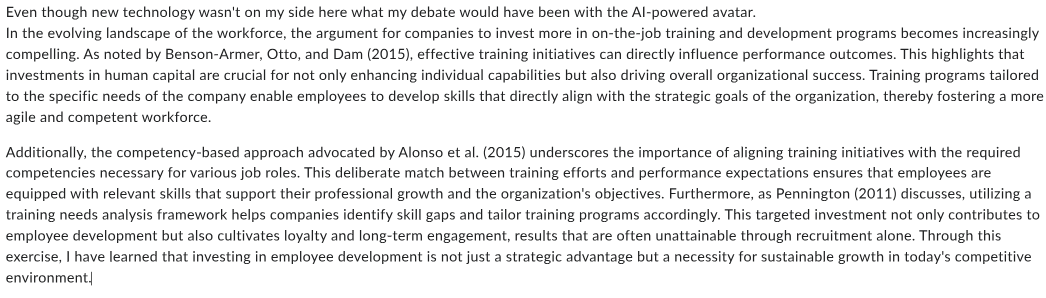 Even though new technology wasn't on my side here what my debate would have been with the Al-powered avatar. In the evolving landscape of the workforce, the argument for companies to invest more in on-the-job training and development programs becomes increasingly compelling. As noted by Benson-Armer, Otto, and Dam (2015), effective training initiatives can directly influence performance outcomes. This highlights that investments in human capital are crucial for not only enhancing individual capabilities but also driving overall organizational success. Training programs tailored to the specific needs of the company enable employees to develop skills that directly align with the strategic goals of the organization, thereby fostering a more agile and competent workforce. Additionally, the competency-based approach advocated by Alonso et al. (2015) underscores the importance of aligning training initiatives with the required competencies necessary for various job roles, This deliberate match between training efforts and performance expectations ensures that employees are equipped with relevant skills that support their professional growth and the organization's objectives. Furthermore, as Pennington (2011) discusses, utilizing a training needs analysis framework helps companies identify skill gaps and tailor training programs accordingly. This targeted investment nat only contributes to employee development but also cultivates loyalty and long-term engagement, results that are often unattainable through recruitment alone. Through this exercise, | have learned that investing in employee development is not just a strategic advantage but a necessity for sustainable growth in today's competitive environment]
Step by Step Solution
There are 3 Steps involved in it
1 Expert Approved Answer
Step: 1 Unlock

Question Has Been Solved by an Expert!
Get step-by-step solutions from verified subject matter experts
Step: 2 Unlock
Step: 3 Unlock
 Study Help