







Question: Make a flow chart for 2 & 3 Correct the flowchart on page 38 of the textbook (page 5 of Ch 01.04) Similar to our
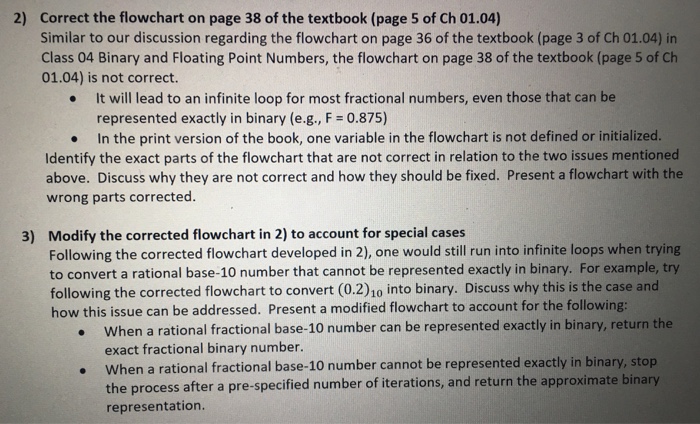
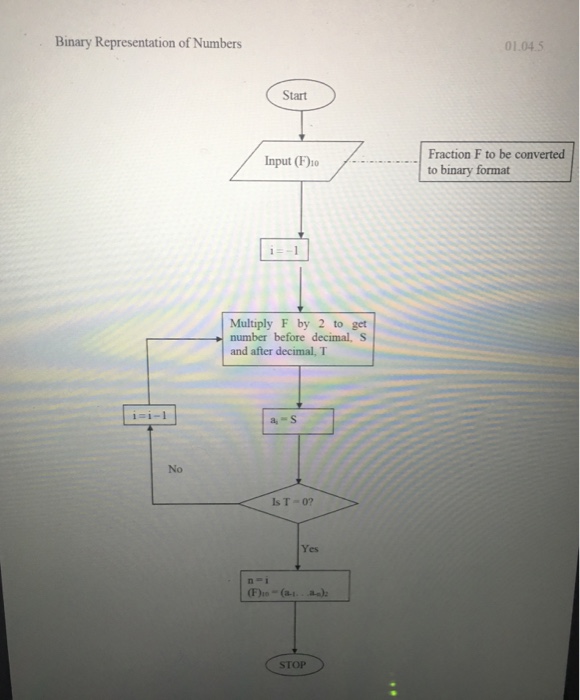
Correct the flowchart on page 38 of the textbook (page 5 of Ch 01.04) Similar to our discussion regarding the flowchart on page 36 of the textbook (page 3 of Ch 01.04) in Class 04 Binary and Floating Point Numbers, the flowchart on page 38 of the textbook (page 5 of Ch 01.04) is not correct. 2) It will lead to an infinite loop for most fractional numbers, even those that can be represented exactly in binary (e.g., F = 0.875) In the print version of the book, one variable in the flowchart is not defined or initialized. Identify the exact parts of the flowchart that are not correct in relation to the two issues mentioned above. Discuss why they are not correct and how they should be fixed. Present a flowchart with the wrong parts corrected. Modify the corrected flowchart in 2) to account for special cases Following the corrected flowchart developed in 2), one would still run into infinite loops when trying to convert a rational base-10 number that cannot be represented exactly in binary. For example, try following the corrected flowchart to convert (0.2)1o into binary. Discuss why this is the case and how this issue can be addressed. Present a modified flowchart to account for the following 3) When a rational fractional base-10 number can be represented exactly in binary, return the exact fractional binary number. When a rational fractional base-10 number cannot be represented exactly in binary, stop the process after a pre-specified number of iterations, and return the approximate binary representation
Step by Step Solution
There are 3 Steps involved in it

Get step-by-step solutions from verified subject matter experts
 Study Help