Question: make a summary Section 1: Reading The Decline of Reading [1] America is caught in a tide of indifference when it comes to literature, according
make a summary
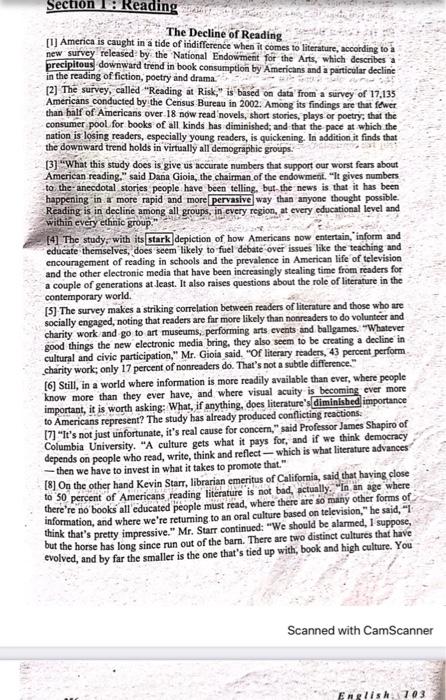
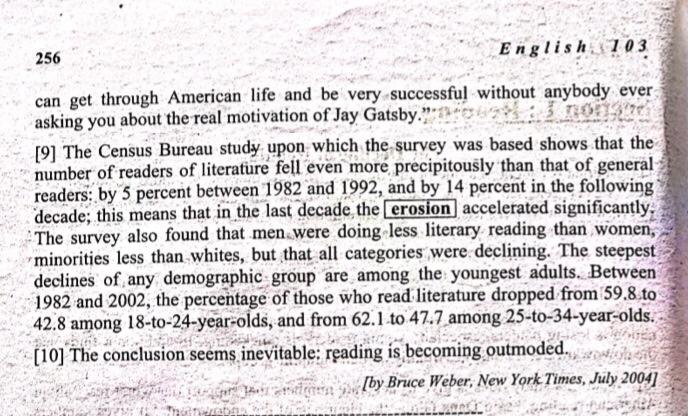
Section 1: Reading The Decline of Reading [1] America is caught in a tide of indifference when it comes to literature, according to a new survey released by the National Endowment for the Arts, which describes a precipitous downward trend in book consumption by Americans and a particular decline in the reading of fiction, poetry and drama. [2] The survey, called "Reading at Risk," is based on data from a survey of 17,135 Americans conducted by the Census Bureau in 2002. Among its findings are that fewer than half of Americans over 18 now read novels, short stories, plays or poetry, that the consumer pool for books of all kinds has diminished, and that the pace at which the nation is losing readers, especially young readers, is quickening. In addition it finds that the downward trend holds in virtually all demographic groups. (3) "What this study does is give us accurate numbers that support our worst fears about American reading." said Dana Gioia, the chairman of the endowment. "It gives numbers to the anecdotal stories people have been telling, but the news is that it has been happening in r more rapid and more pervasive way than anyone thought possible. Reading is in decline among all groups, in every region, at every educational level and within every ethnic group [4] The study with its stark depiction of how Americans now entertain," inform and educate themselves, does seem likely to fuel debate over issues like the teaching and encouragement of reading in schools and the prevalence in American life of television and the other electronic media that have been increasingly stealing time from readers for a couple of generations at least. It also raises questions about the role of literature in the contemporary world. [5] The survey makes a striking correlation between readers of literature and those who are socially engaged, noting that readers are far more likely than nonreaders to do volunteer and charity work and go to art museums, performing arts events and ballgames. "Whatever good things the new electronic media bring, they also seem to be creating a decline in cultural and civic participation," Mr. Gioia said. "or literary readers, 43 percent perform charity work; only 17 percent of nonreaders do. That's not a subtle difference." [6] Still, in a world where information is more readily available than ever, where people know more than they ever have, and where visual acuity is becoming ever more important, it is worth asking: What, if anything, does literature's diminished importance to Americans represent? The study has already produced conflicting reactions. [7] "It's not just unfortunate, it's real cause for concern," said Professor James Shapiro of Columbia University. "A culture gets what it pays for, and if we think democracy depends on people who read, write think and reflect - which is what literature advances --then we have to invest in what it takes to promote that." [8] On the other hand Kevin Start, librarian emeritus of California, said that having close to 50 percent of Americans reading literature is not bad, actually. "In an age where there're no books all educated people must read, where there are so many other forms of information, and where we're returning to an oral culture based on television," he said, "I think that's pretty impressive." Mr. Starr continued: "We should be alarmed, I suppose, but the horse has long since run out of the barn. There are two distinct cultures that have evolved, and by far the smaller is the one that's tied up with, book and high culture. You Scanned with CamScanner English 703 English 103 256 can get through American life and be very successful without anybody ever asking you about the real motivation of Jay Gatsby." 3 T [9] The Census Bureau study upon which the survey was based shows that the number of readers of literature fell even more precipitously than that of general readers: by 5 percent between 1982 and 1992, and by 14 percent in the following decade; this means that in the last decade the erosion accelerated significantly The survey also found that men were doing less literary reading than women, minorities less than whites, but that all categories were declining. The steepest declines of any demographic group are among the youngest adults. Between 1982 and 2002, the percentage of those who read literature dropped from 59.8.to 42.8 among 18-to-24-year-olds, and from 62.1 to 47.7 among 25-to-34-year-olds. [10] The conclusion seems inevitable: reading is becoming outmoded. Tente [by Bruce Weber, New York Times, July 2004]









 Study Help