







Question: Make an array containing the numbers 0,1,1,, and e, in that order. Name it interesting_numbers . Hint: How did you get the values and e


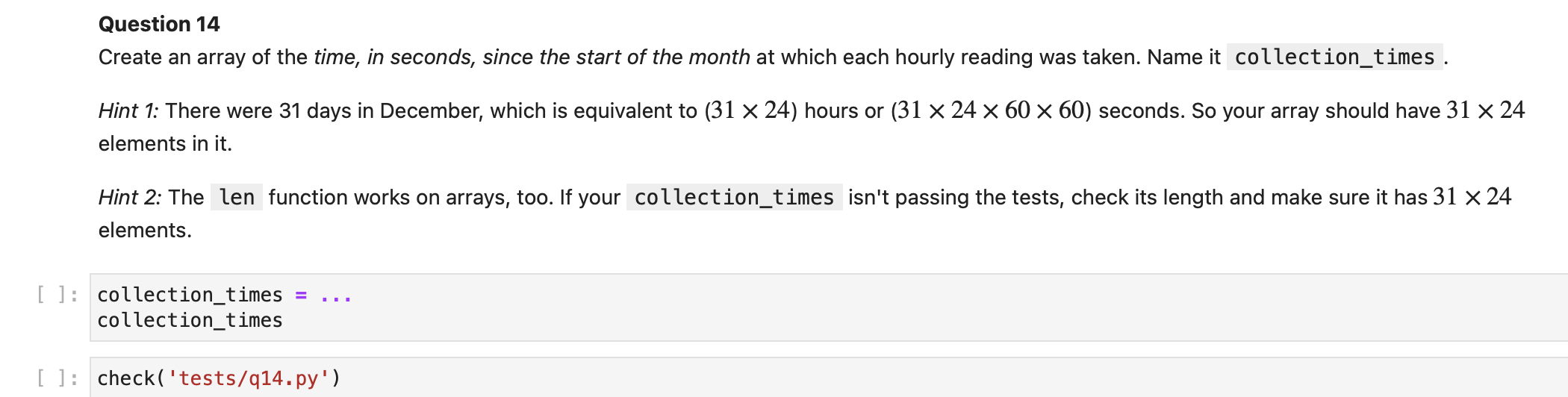
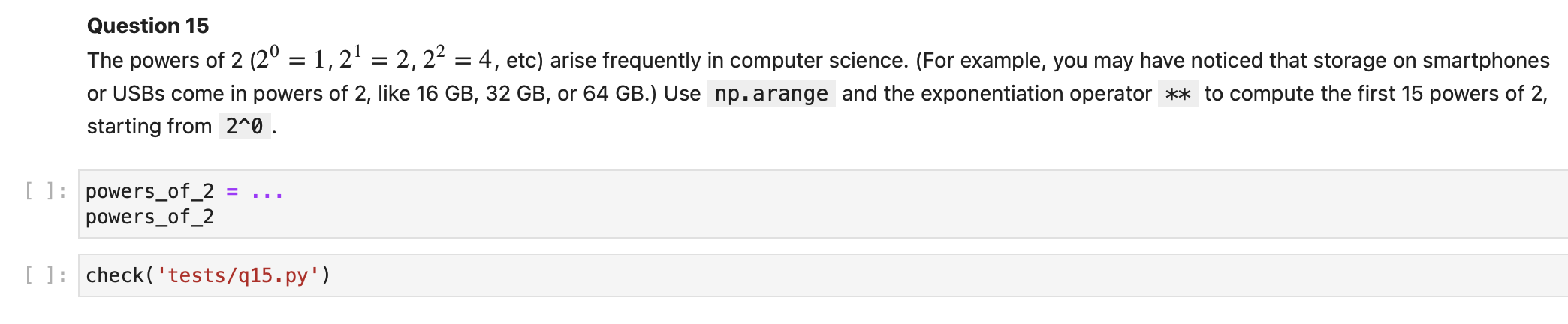
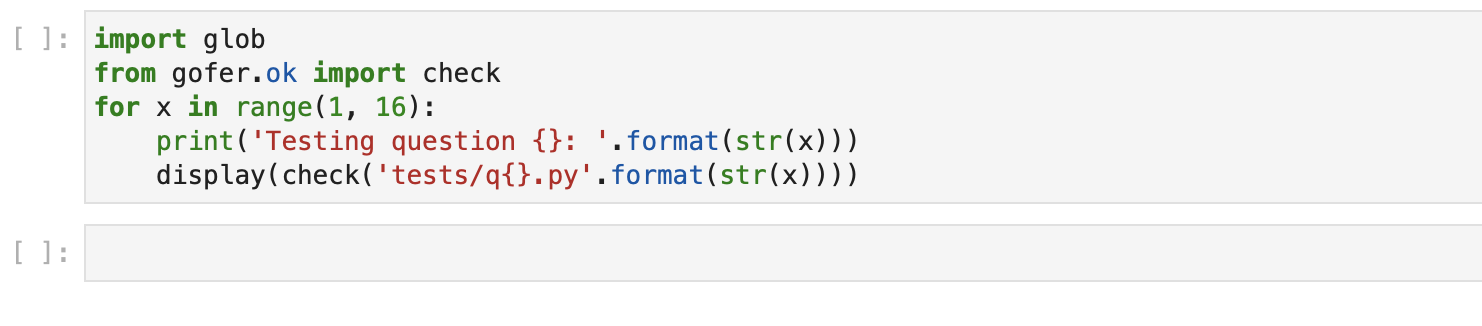
Make an array containing the numbers 0,1,1,, and e, in that order. Name it interesting_numbers . Hint: How did you get the values and e earlier? You can refer to them in exactly the same way here. interesting_numbers = interesting_numbers check('tests/q12.py' ') Question 13 Import numpy as np and then use np. arange to create an array with the multiples of 99 from 0 up to (and including) 9999 . (So its elements are 0,99,198,297, etc.) multiples_of_99 =. multiples_of_99 check ('tests/q13.py') Question 14 Create an array of the time, in seconds, since the start of the month at which each hourly reading was taken. Name it collection_times . Hint 1: There were 31 days in December, which is equivalent to (3124) hours or (31246060) seconds. So your array should have 3124 elements in it. Hint 2: The len function works on arrays, too. If your collection_times isn't passing the tests, check its length and make sure it has 3124 elements. collection_times = collection_times check('tests/q14.py') The powers of 2(20=1,21=2,22=4, etc) arise frequently in computer science. (For example, you may have noticed that storage on smartphones or USBs come in powers of 2, like 16GB,32GB, or 64GB.) Use np. arange and the exponentiation operator to compute the first 15 powers of 2, starting from 2. powers_of_2 = powers_of_2 check('tests/q15.py') ]: import glob from gofer.ok import check for x in range( 1,16) : print('Testing question \{\}: ', format (str(x))) display(check('tests/q\{ } py', format (str(x))))
Step by Step Solution
There are 3 Steps involved in it

Get step-by-step solutions from verified subject matter experts
 Study Help