Question: Make reading notes on Berkley's Principles 27- 47 from the below pic 27. A spirit is one simple, undivided, active being. Hence there can be
Make reading notes on Berkley's Principles 27- 47 from the below pic
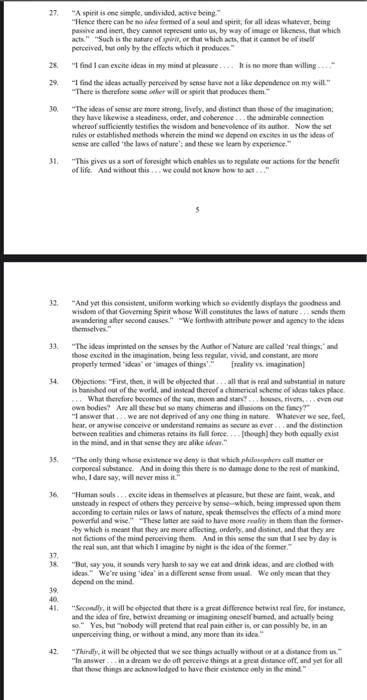
27. A spirit is one simple, undivided, active being.
Hence there can be no idea formed of a soul and spirit; for all ideas whatever, being passive and inert, they cannot represent unto us, by way of image or likeness, that which acts. Such is the nature of spirit, or that which acts, that it cannot be of itself perceived, but only by the effects which it produces.
28. I find I can excite ideas in my mind at pleasure . . . . It is no more than willing . . . .
29. I find the ideas actually perceived by sense have not a like dependence on my will.
There is therefore some other will or spirit that produces them.
30. The ideas of sense are more strong, lively, and distinct than those of the imagination; they have likewise a steadiness, order, and coherence . . . the admirable connection whereof sufficiently testifies the wisdom and benevolence of its author. Now the set rules or established methods wherein the mind we depend on excites in us the ideas of sense are called the laws of nature; and these we learn by experience.
31. This gives us a sort of foresight which enables us to regulate our actions for the benefit of life. And without this . . . we could not know how to act . . .
5
32. And yet this consistent, uniform working which so evidently displays the goodness and wisdom of that Governing Spirit whose Will constitutes the laws of nature . . . sends them awandering after second causes. We forthwith attribute power and agency to the ideas themselves.
33. The ideas imprinted on the senses by the Author of Nature are called real things; and those excited in the imagination, being less regular, vivid, and constant, are more properly termed ideas or images of things. [reality vs. imagination]
34. Objections: First, then, it will be objected that . . . all that is real and substantial in nature is banished out of the world, and instead thereof a chimerical scheme of ideas takes place. . . . What therefore becomes of the sun, moon and stars? . . . houses, rivers, . . . even our own bodies? Are all these but so many chimeras and illusions on the fancy?
I answer that . . . we are not deprived of any one thing in nature. Whatever we see, feel, hear, or anywise conceive or understand remains as secure as ever . . . and the distinction between realities and chimeras retains its full force. . . . [though] they both equally exist in the mind, and in that sense they are alike ideas.
35. The only thing whose existence we deny is that which philosophers call matter or corporeal substance. And in doing this there is no damage done to the rest of mankind, who, I dare say, will never miss it.
36. Human souls . . . excite ideas in themselves at pleasure, but these are faint, weak, and unsteady in respect of others they perceive by sense--which, being impressed upon them according to certain rules or laws of nature, speak themselves the effects of a mind more powerful and wise. These latter are said to have more reality in them than the former- -by which is meant that they are more affecting, orderly, and distinct, and that they are not fictions of the mind perceiving them. And in this sense the sun that I see by day is the real sun, ant that which I imagine by night is the idea of the former.
37.
38. But, say you, it sounds very harsh to say we eat and drink ideas, and are clothed with
ideas. Were using idea in a different sense from usual. We only mean that they
depend on the mind.
39.
40.
41. Secondly, it will be objected that there is a great difference betwixt real fire, for instance,
and the idea of fire, betwixt dreaming or imagining oneself burned, and actually being so. Yes, but nobody will pretend that real pain either is, or can possibly be, in an unperceiving thing, or without a mind, any more than its idea.
42. Thirdly, it will be objected that we see things actually without or at a distance from us. In answer . . . in a dream we do oft perceive things at a great distance off, and yet for all that those things are acknowledged to have their existence only in the mind.
27 29 "A spirit is one simple individed active being "Hence there can be no de formed of a suland spirit, for all ideas whatever, being passive and inert, they cannot represent unto us by way of image er likeness, that which acts. Such is the nature of spirit of that which acts, that it cannot be of itself perceived, but only by the effects which is producer "I find I can excite ideas in my mind at pleasure. It is no more than willing "I find the ideas actually perceived by sense have not like dependence on my will." "There therefore some other will or spirit that produces them "The ideas of some are more strong, lively, and distinct than those of the imagination: they have likewise a steadiness, order and coherence...the admirable connection whereof sufficiently testifies the wisdom and benevolence of its author. Now the set niles or established methods wherein the mind we depend on excities in us the ideas of sense are called the laws of nature and those we learn by experime." "This gives us a son of foresight which enables us to regulate our actions for the benefit of life. And without this... we could not know how to..." 30 31 132 33 "And yet this consistent, uniform working which so evidently displays the goodness and wisdom of that Governing Spirit whose will constitutes the laws of interesend them awandering after second cases. We forlwith attribute power and agency to the ideas themselves "The ideas imprinted on the senses by the Author of Nature are called "real things and those excited in the imagination, being less regular, vivid and constant, are more properly formed ideas or images of things reality vs imagination) Objection "First, then, I will be objected that all that is real and substantial in nature is banished out of the world, and instead thereof a chimerical scheme of ideas takes place What therefore becomes of the sun, moon and stars..bosex, rivers, even our wwn bodies! Are all these but so many chimeras and is on the fancy "answer that we me sot deprived of any one thing in nature. Whatever we see, feel hear, or anywise conceive or understand remains a secure as ever and the distinction between tcalities and chimeras retains its full force...theagh they both equally exist in the mind, and in that sense they mealike om." "The only thing whose existence we deny that which he call monteret Corporal substance. And in doing this there is so damage done to the rest of mankind. who. I dare say, will never miss it." "Human souls... excite ideas in themselves a pleasure, but these are faint, weak and unsteady in respect of others they perceive by sense-which, being impressed upon them according to certain rules or laws of nature, speak themselves the effects of a mind more powerful and wise." "These latter are said to have more reality in them than the former by which is meant that they are more affecting, orderly, and distinct, and that they are not fictions of the mind perceiving them. And in this sense the sun that I see by day is the real sun, that which I imagine by night is the idea of the former." "But, say you, it sounds very harsh to say we eat and drink ideas and are clothed with ideas." We're using idea in a different some from all We only mean that they depend on the mind 35 36 2 39 40 Secondly, it will be abjected that there is a great difference betwist real fire, for instance, and the idea of fire, betwixt dreaming or imagining oneself bumed, and actually being so" Yes, but nobody will pretend that real pain either is, or can possibly be in an unperceiving thing, or without a mind, any more than its idea. Thirdly, it will be objected that we see things actually without or at a distance from us "In answer in a dream we do oft perceive things at a great distance off, and yet for all that these things are acknowledged to have their existence only in the mind 42 27 29 "A spirit is one simple individed active being "Hence there can be no de formed of a suland spirit, for all ideas whatever, being passive and inert, they cannot represent unto us by way of image er likeness, that which acts. Such is the nature of spirit of that which acts, that it cannot be of itself perceived, but only by the effects which is producer "I find I can excite ideas in my mind at pleasure. It is no more than willing "I find the ideas actually perceived by sense have not like dependence on my will." "There therefore some other will or spirit that produces them "The ideas of some are more strong, lively, and distinct than those of the imagination: they have likewise a steadiness, order and coherence...the admirable connection whereof sufficiently testifies the wisdom and benevolence of its author. Now the set niles or established methods wherein the mind we depend on excities in us the ideas of sense are called the laws of nature and those we learn by experime." "This gives us a son of foresight which enables us to regulate our actions for the benefit of life. And without this... we could not know how to..." 30 31 132 33 "And yet this consistent, uniform working which so evidently displays the goodness and wisdom of that Governing Spirit whose will constitutes the laws of interesend them awandering after second cases. We forlwith attribute power and agency to the ideas themselves "The ideas imprinted on the senses by the Author of Nature are called "real things and those excited in the imagination, being less regular, vivid and constant, are more properly formed ideas or images of things reality vs imagination) Objection "First, then, I will be objected that all that is real and substantial in nature is banished out of the world, and instead thereof a chimerical scheme of ideas takes place What therefore becomes of the sun, moon and stars..bosex, rivers, even our wwn bodies! Are all these but so many chimeras and is on the fancy "answer that we me sot deprived of any one thing in nature. Whatever we see, feel hear, or anywise conceive or understand remains a secure as ever and the distinction between tcalities and chimeras retains its full force...theagh they both equally exist in the mind, and in that sense they mealike om." "The only thing whose existence we deny that which he call monteret Corporal substance. And in doing this there is so damage done to the rest of mankind. who. I dare say, will never miss it." "Human souls... excite ideas in themselves a pleasure, but these are faint, weak and unsteady in respect of others they perceive by sense-which, being impressed upon them according to certain rules or laws of nature, speak themselves the effects of a mind more powerful and wise." "These latter are said to have more reality in them than the former by which is meant that they are more affecting, orderly, and distinct, and that they are not fictions of the mind perceiving them. And in this sense the sun that I see by day is the real sun, that which I imagine by night is the idea of the former." "But, say you, it sounds very harsh to say we eat and drink ideas and are clothed with ideas." We're using idea in a different some from all We only mean that they depend on the mind 35 36 2 39 40 Secondly, it will be abjected that there is a great difference betwist real fire, for instance, and the idea of fire, betwixt dreaming or imagining oneself bumed, and actually being so" Yes, but nobody will pretend that real pain either is, or can possibly be in an unperceiving thing, or without a mind, any more than its idea. Thirdly, it will be objected that we see things actually without or at a distance from us "In answer in a dream we do oft perceive things at a great distance off, and yet for all that these things are acknowledged to have their existence only in the mind 42









 Study Help