



Question: Make sure all the math is showen and how you got the answer Background: The deflection ( delta ) of a simply - supported
Make sure all the math is showen and how you got the answer
Background: The deflection delta of a simplysupported beam of length, L under a point load P in Newtons at its
midpoint is:
delta PLEI
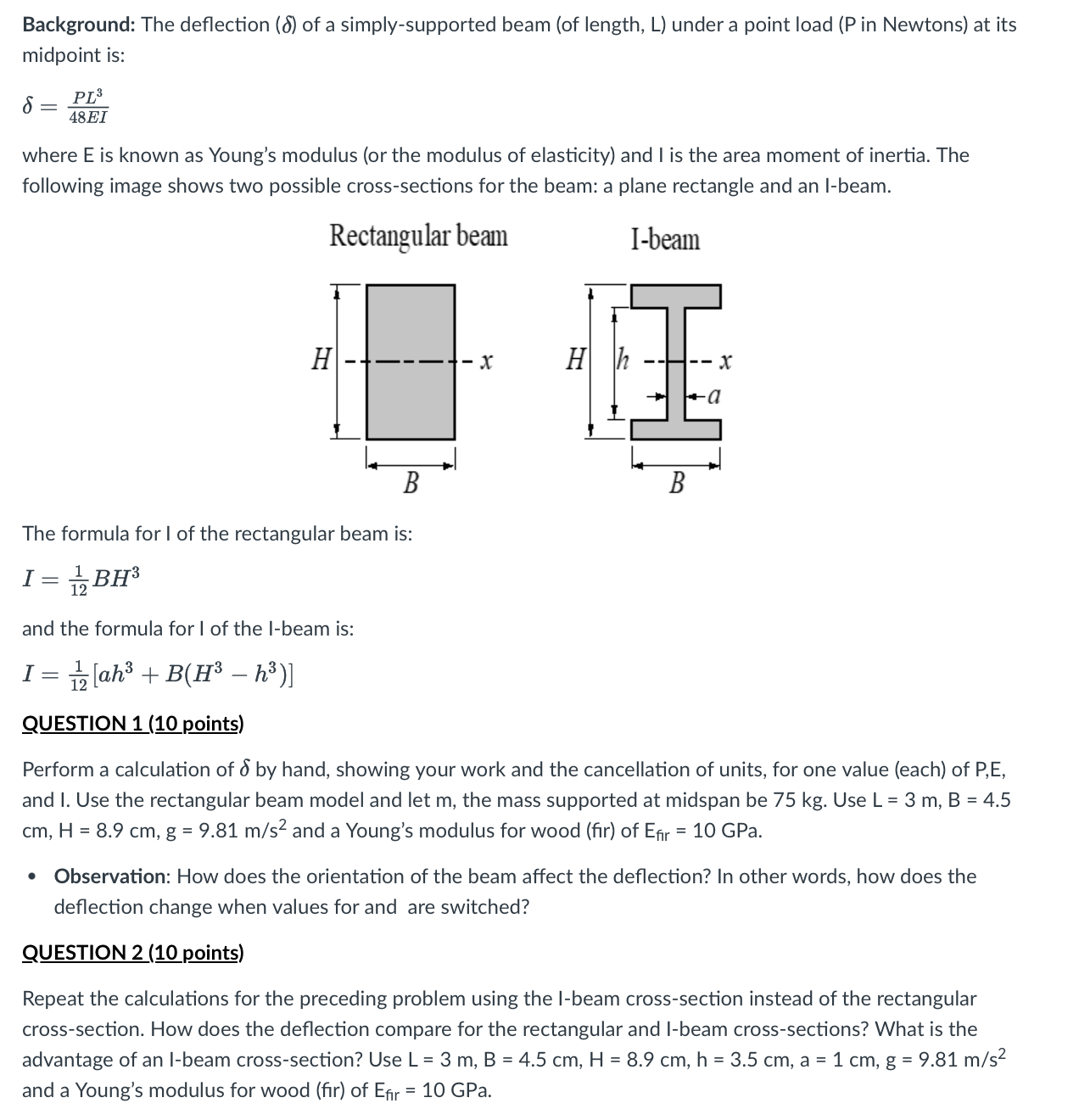
where E is known as Young's modulus or the modulus of elasticity and I is the area moment of inertia. The
following image shows two possible crosssections for the beam: a plane rectangle and an Ibeam.
Rectangular beam
Ibeam
The formula for I of the rectangular beam is:
IBH
and the formula for I of the Ibeam is:
IahBHh
QUESTION points
Perform a calculation of delta by hand, showing your work and the cancellation of units, for one value each of PE
and I Use the rectangular beam model and let m the mass supported at midspan be kg Use LmB
cmHcmgms and a Young's modulus for wood fir of EfirGPa.
Observation: How does the orientation of the beam affect the deflection? In other words, how does the
deflection change when values for and are switched?
QUESTION points
Repeat the calculations for the preceding problem using the Ibeam crosssection instead of the rectangular
crosssection. How does the deflection compare for the rectangular and Ibeam crosssections? What is the
advantage of an Ibeam crosssection? Use LmBcmHcmhcmacmgms
and a Young's modulus for wood fir of EfirGPa.
Step by Step Solution
There are 3 Steps involved in it
1 Expert Approved Answer
Step: 1 Unlock

Question Has Been Solved by an Expert!
Get step-by-step solutions from verified subject matter experts
Step: 2 Unlock
Step: 3 Unlock