







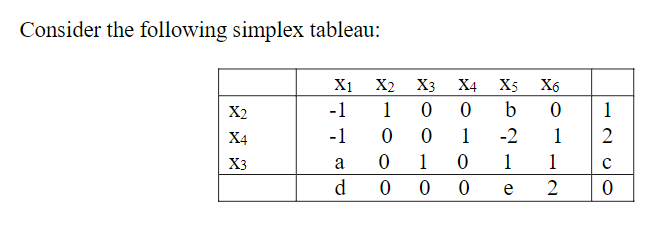
Question: Make Sure to explain why we need these ranges for the situations below: Consider the following simplex tableau: X1 X2 X3 X4 X5 X6 -1
Make Sure to explain why we need these ranges for the situations below:
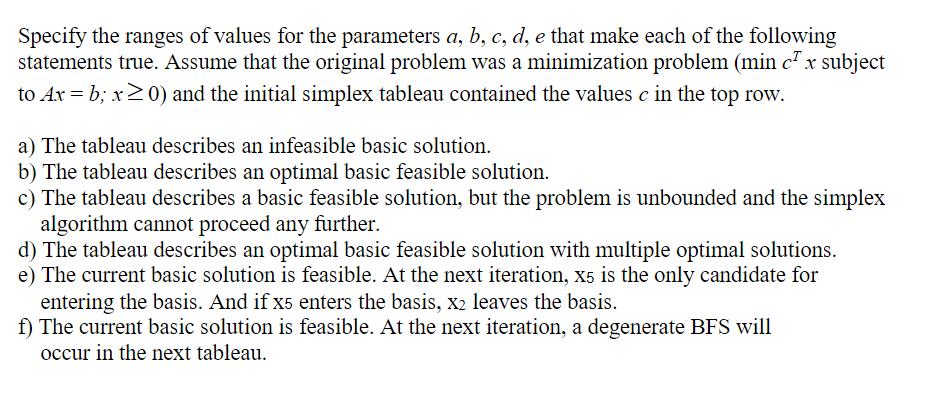
Consider the following simplex tableau: X1 X2 X3 X4 X5 X6 -1 1 0 0 b 0 -1 0 0 1 -2 1 a 0 1 0 1 1 0 0 0 2 1 2 1 Specify the ranges of values for the parameters a, b, c, d, e that make each of the following statements true. Assume that the original problem was a minimization problem (min c x subject to Ar = b; x 20) and the initial simplex tableau contained the values c in the top row. a) The tableau describes an infeasible basic solution. b) The tableau describes an optimal basic feasible solution. c) The tableau describes a basic feasible solution, but the problem is unbounded and the simplex algorithm cannot proceed any further. d) The tableau describes an optimal basic feasible solution with multiple optimal solutions. e) The current basic solution is feasible. At the next iteration, x5 is the only candidate for entering the basis. And if x5 enters the basis, X2 leaves the basis. f) The current basic solution is feasible. At the next iteration, a degenerate BFS will occur in the next tableau. Consider the following simplex tableau: X1 X2 X3 X4 X5 X6 -1 1 0 0 b 0 -1 0 0 1 -2 1 a 0 1 0 1 1 0 0 0 2 1 2 1 Specify the ranges of values for the parameters a, b, c, d, e that make each of the following statements true. Assume that the original problem was a minimization problem (min c x subject to Ar = b; x 20) and the initial simplex tableau contained the values c in the top row. a) The tableau describes an infeasible basic solution. b) The tableau describes an optimal basic feasible solution. c) The tableau describes a basic feasible solution, but the problem is unbounded and the simplex algorithm cannot proceed any further. d) The tableau describes an optimal basic feasible solution with multiple optimal solutions. e) The current basic solution is feasible. At the next iteration, x5 is the only candidate for entering the basis. And if x5 enters the basis, X2 leaves the basis. f) The current basic solution is feasible. At the next iteration, a degenerate BFS will occur in the next tableau
Step by Step Solution
There are 3 Steps involved in it

Get step-by-step solutions from verified subject matter experts
 Study Help