







Question: MAN302 Assessment 3 -Case Study report (Individual) Marks allocation: 10 marks Due date: End week 8 Word count: 1,300 words The 'Never Say Die' Spirit
MAN302 Assessment 3 -Case Study report (Individual)
Marks allocation: 10 marks
Due date: End week 8
Word count: 1,300 words
The 'Never Say Die' Spirit That Sealed This Food Entrepreneur's Success -fiid
Resilience, perseverance and self-belief are the traits that define a true entrepreneur, and Shane Ryan has all these in abundance, which he demonstrated when he overcame two failed attempts to get his vegan food business fiid off the ground.
Third time around the 30-year-old Irishman succeeded, and within a year his business was profitable, listed as a supplier with several major supermarkets, and with annual sales of $0.5 million.
Ryan had started his career in the hospitality industry, and it took him all over the world. By the time he was 23 he had worked in seven different countries, and with one of the world's most luxurious hotel companies. As exciting as it was, he realized that a traditional career in hospitality wasn't conducive to the role he really wanted, that of an entrepreneur, with control of his own time and destiny.
Shane Ryan says that fiid was born out of a personal pain point - his gruelling work schedule in the hotel industry had taught him the importance of good quality food for his physical and mental wellbeing.
fiid was started as there were people just like Ryan who had a need for healthy, delicious food but these people had no time to prepare it.
Ryan had spotted a gap in a market where healthy and plant-based foods were becoming popular but were not available on the supermarket shelves.
Ryan decided to create a range of high-quality, natural plant-based wholefood solutions that were convenient, and represented real value.
His first business attempt (fiid 1.0) failed for a number of reasons, but mainly because it wasn't the right solution for the problem he was trying to solve. Ryan admit that he made an incorrect assumption on how much he could charge for his product "I was just too expensive" he said.
Ryan considered himself to be a good problem solver, so after understanding what caused fiid 1.0 to fail he worked out how to pivot. He formed a partnership with a large food company who could support him. Nine months after closing the kitchen door on fiid 1.0 he launched fiid 2.0 (the second business attempt). Then a few months later disaster struck again, with a second business failure even more heart breaking and frustrating.
"I'd secured three listing with large supermarket chains. This was going to triple the size of the business overnight," says Ryan. "To support this growth, I was moving operations to a larger manufacturer that had also taken a stake in the business, with plans for us to grow it together."
The transition took place over Christmas, but in early January, a lecture before the launch of the major retail listing, the manufacturer announced that it was pulling out of the arrangement," says Ryan. "I scrambled to find another manufacturing partner but couldn't find the right fit and ended up having to pull out from all our retail listings."
Once again Ryan had to dig deep and pick himself up and pivot again. He resolved to create a much stronger business, fiid 3.0, using lessons he had learned along the way.
He says: "The original partnership lacked a contractual agreement. I had been nave in thinking that our gentleman's agreement held any weight and ultimately paid the price of for it. Ryan worked out that he had gone into partnership with a business that was far too big and didn't really care about the business relationship. "I was too small. That's a mistake I'll never make again."
So, Ryan did his homework and found a smaller manufacturer that was a far better fit for the relationship that he has in place today.
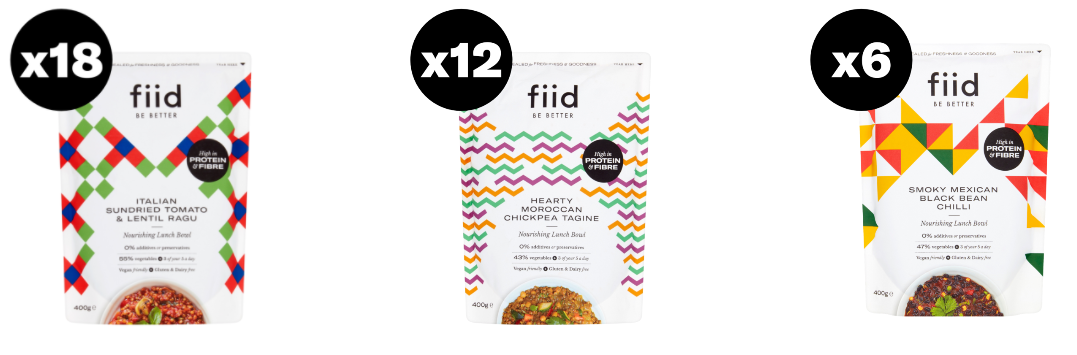
Fiidnow sells a range of its products in major supermarket chains.
Step by Step Solution
There are 3 Steps involved in it

Get step-by-step solutions from verified subject matter experts
 Study Help